KAIST Professor Choi Kyungcheol's Research Team Opens New Chapter in Wearable Device Display Technology
[Asia Economy Reporter Kim Bong-su] Domestic researchers have succeeded for the first time in the world in creating an organic light-emitting diode (OLED) display that emits white light on a thin fiber, pioneering new grounds for the commercialization of wearable devices.
The Korea Advanced Institute of Science and Technology (KAIST) announced on the 20th that Professor Choi Kyung-chul's research team from the Department of Electrical Engineering and Computer Science succeeded in developing fiber OLEDs that emit white light on fibers thinner than human hair.
Electronic fibers, based on the concept of wearable technology, are actively being researched both domestically and internationally as the ultimate form factor of wearable devices. In particular, the field of electronic fiber displays is receiving significant attention for its diverse applications, including functional clothing, fashion, medical, safety, and vehicle design.
The research team developed a foundational deep coating process and has successfully implemented essential display technologies such as fluorescent OLEDs and operable high-efficiency phosphorescent RGB OLEDs in the form of electronic fibers thinner than human hair. However, white OLEDs, which are essential for realizing full-color displays and lighting technologies, faced challenges in development due to their structural complexity and lack of approach. Generally, white OLEDs have a tandem structure with 2 to 3 times the multilayer stacking of single-layer structures of primary color OLEDs. Therefore, considering solvent orthogonality and curvature dependency, it was difficult to implement multilayer structures on fibers. The thin charge generation layer (CGL) in the multilayer structure is vulnerable to the curvature of fibers, making it unsuitable for fiber applications.
To overcome the issues of multilayer structures, the research team focused on designing a deep-coatable white single emission layer suitable for fiber structures. The white single emission layer consists of primary color emitting materials and multiple charge transporters for charge balance, designed through simulation and optimization processes. It was also designed materially to enable the deep coating process. Through this, white OLEDs were implemented on fibers for the first time, demonstrating a luminance level of up to 700 cd/m2 (candela per square meter) suitable for outdoor visibility and high electro-optical performance of about 10 cd/A (candela per ampere). Additionally, the developed white OLED electronic fibers showed stable white emission with reduced color change dependency under operating conditions due to the optimized energy transfer process in their structure.
The research team stated, "We have successfully implemented the essential display technology of white OLEDs, which was previously absent in the fiber display field, on a single fiber thread," and added, "It is expected to be applicable to various fields including high-quality fiber displays, fashion, functional clothing, and vehicle design."
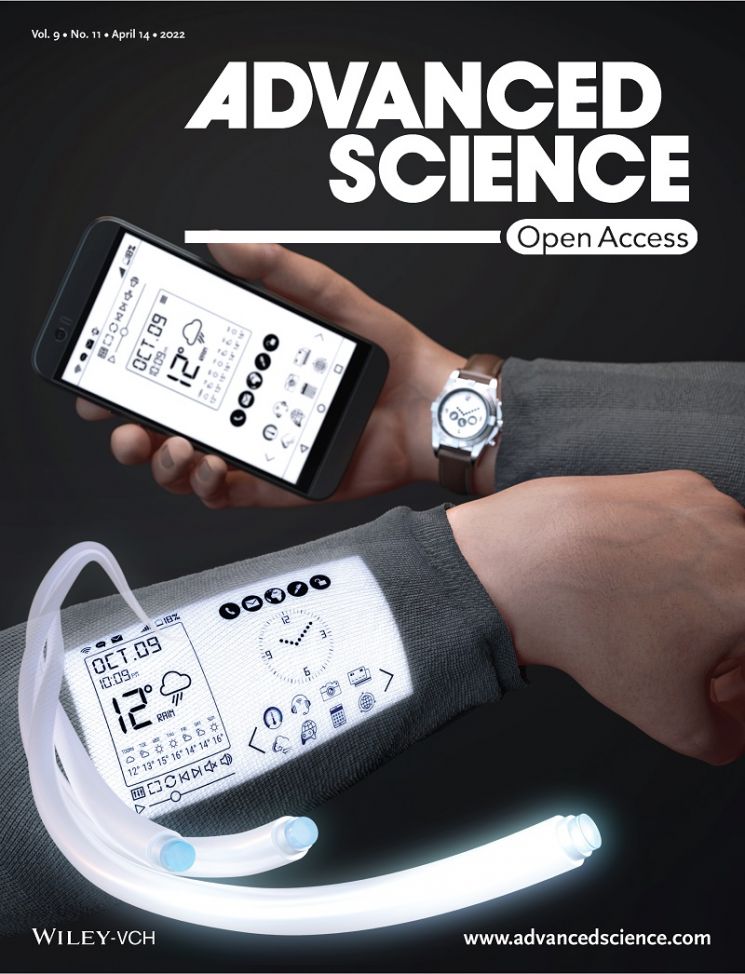
This research was published online on January 24 in the international journal Advanced Science (IF 16.8) and appeared as the full internal cover paper in the printed issue on the 14th.
© The Asia Business Daily(www.asiae.co.kr). All rights reserved.

















