Opening Statement at Confirmation Hearing Emphasizes Interest Rate Signal for Smooth Landing of Household Debt
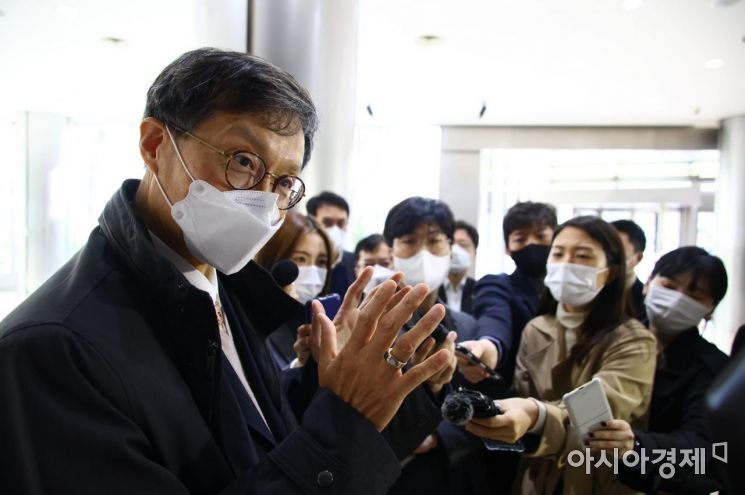
[Asia Economy Reporter Seo So-jeong] "While being careful not to undermine growth momentum, we will adjust the degree of monetary policy easing at an appropriate pace to achieve price stability, and through this, we will promote financial stability such as the soft landing of household debt."
On the 19th, Lee Chang-yong, the nominee for Governor of the Bank of Korea, stated in his opening remarks at the National Assembly's Planning and Finance Committee confirmation hearing that he would promote financial stability through monetary policy considering growth and inflation amid significantly increased external uncertainties.
Lee began by saying, "It is very difficult to gauge how far the repercussions of the prolonged Ukraine crisis will expand," and added, "The U.S. Federal Reserve (Fed) is expected to normalize monetary policy at a rapid pace, and depending on the situation, there may be several big-step interest rate hikes." Regarding China, he explained that concerns about economic slowdown are growing due to the rapid spread of the Omicron variant, which is expanding the upside risks to domestic inflation and downside risks to the economy.
Lee forecasted, "Consumer prices, which rose more than 4% last month, are expected to continue a significant upward trend for some time due to rising prices of raw materials such as crude oil and grains," and added, "The economy will continue its recovery from the COVID-19 crisis, but growth is likely to weaken compared to previous forecasts due to the global economic slowdown."
He mentioned that he would closely monitor inflation and economic risks in future monetary policy operations. He said, "On the 14th, the Monetary Policy Committee raised the base rate from 1.25% to 1.50%, reflecting that the upside risk to inflation is still greater than the downside risk to the economy," and added, "However, going forward, monetary policy operations must carefully observe how inflation and economic risks develop, considering the increased uncertainty."
He emphasized the need for interest rate signals to ensure the soft landing of household debt, which is considered a potential risk to our economy.
He stated, "Although the recent increase in household debt in Korea has somewhat slowed, its level remains high, posing risks not only to financial stability but also to growth," and said, "The upward trend must be continuously eased through interest rate signals and other measures." He also pointed out the need to prepare for the possibility that the impact of rising interest rates could materialize as credit risks, especially among vulnerable groups.
He noted that there are considerable mid- to long-term challenges for the leap forward of our economy after the pandemic. Lee said, "We must implement appropriate exit strategies in preparation for the new normal after post-COVID and redirect resources used to overcome the crisis toward new growth industries," and diagnosed, "Structural issues such as youth unemployment, elderly poverty, income inequality and polarization, and aging have increased concerns that they will undermine growth potential, deepen social conflicts, and lead to long-term secular stagnation."
He emphasized, "We will deliberate with relevant authorities on measures to manage the rapidly increasing government and private sector debt during this process, as well as prepare related countermeasures," and added, "While maintaining a healthy tension with the government, we will comprehensively review economic policies and communicate and coordinate as necessary to achieve consistency."
He also expressed his ambition to strengthen the Bank of Korea's research capabilities. Lee said, "We will respond promptly to emerging issues such as central bank digital currency (CBDC), digitalization of the economy, green finance, and balanced regional development," and added, "We will develop the Bank of Korea not only as the core of monetary and financial policy but also as a distinguished top think tank that understands our economy best."
He continued, "We will ensure that the Bank of Korea's research outcomes contribute to policy formulation by the government and local governments and assist decision-making in the private sector," and added, "We will upgrade the Bank of Korea into an active and future-oriented organization that adapts to changing policy environments, and together with Bank of Korea employees, we will strive to enhance organizational flexibility so that individual competition and cooperation lead to overall capacity strengthening."
© The Asia Business Daily(www.asiae.co.kr). All rights reserved.
![Clutching a Stolen Dior Bag, Saying "I Hate Being Poor but Real"... The Grotesque Con of a "Human Knockoff" [Slate]](https://cwcontent.asiae.co.kr/asiaresize/183/2026021902243444107_1771435474.jpg)
















