Delayed Supply of Necessary Parts
Causing Widespread Disruptions in Finished Product Production
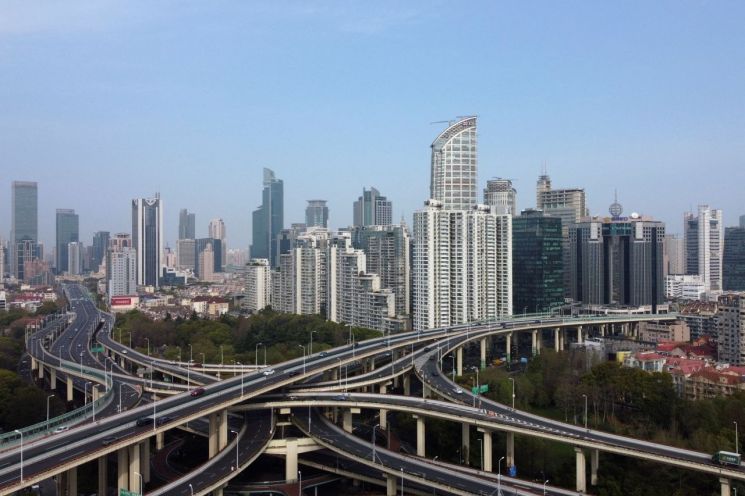
[Asia Economy Reporters Sunmi Park, Hyunseok Yoo, Chaeseok Moon] POSCO, which has a steel product processing center in Kunshan, Jiangsu Province near Shanghai, China, has seen a significant decrease in steel finished product production since the lockdown of the area at the end of March. The situation is similar for most Korean companies located near Shanghai, including Hyundai Steel. A local Korean company official lamented, "There are talks that the Shanghai lockdown may be eased on the 20th, but it is expected to take considerable time before factories resume operations."
As the Shanghai lockdown enters its third week, logistics and supply chain disruptions for Korean companies are intensifying. The ultra-strict lockdown is expanding not only in Shanghai but also to other cities such as Xi'an in Shaanxi Province and Zhengzhou in Henan Province, raising concerns that companies with production and logistics plants locally or those producing and receiving products through cooperation with local companies will suffer greater damage.
According to industry sources on the 18th, Samsung Electronics recently sent official letters to its B2B laptop clients notifying them of possible supply delays. Samsung Electronics operates a home appliance factory in Suzhou, China, and runs a semiconductor production line in Xi'an. LG Electronics, which receives most of its parts from partner companies near the northeastern coastal region where its home appliance factory is located, is also preparing countermeasures amid concerns that the lockdown may be prolonged.
The semiconductor industry in China is being shaken by the Shanghai lockdown. Strengthened quarantine controls have reduced container truck traffic, causing disruptions in both product shipments and semiconductor parts imports. If the lockdown continues for months, production cuts due to shortages of raw materials and parts inventory will be inevitable. According to statistics from the Shanghai Semiconductor Industry Association, last year Shanghai's semiconductor industry sales amounted to 257.89 billion yuan, accounting for 25% of the national total, and the related workforce numbered about 200,000, representing 40% of the national semiconductor industry labor force. Consequently, Korean companies that rely on Chinese supplies will inevitably face a chain reaction of impacts. For example, Apple has experienced supply disruptions in its MacBook laptops due to the suspension of operations at Quanta, its largest OEM factory.
Given the production structure of Korean companies heavily dependent on Chinese raw materials and parts, other industries are also inevitably affected. Korea GM's Bupyeong Plant 1 switched from a two-shift to a one-shift operation this month. This plant produces the Trailblazer, which accounts for 80% of Korea GM's total sales. Korea GM is currently unable to receive timely supplies of brake system parts produced by local Chinese partner companies.
Regarding logistics, Shanghai Port claims to be operating 24-hour emergency services, but actual ship waiting times have become much longer than before. Especially for inland transportation, conditions have become stricter recently, requiring truck drivers entering and exiting Shanghai to have permits, which has worsened logistics difficulties. An industry official said, "The port is operating normally, but truck movements are not smooth. There is also a reluctance in surrounding cities to accept trucks departing from Shanghai, and with nearby factories halting operations, cargo volumes have decreased." He added, "For refrigerated or frozen container boxes, there are separate storage warehouses, but as these are filling up, the situation is becoming burdensome."
There are even voices expressing greater concern about the situation after the lockdown is lifted. If export products manufactured in China flood the market while the port congestion in the United States remains unresolved, the situation could worsen further. Labor negotiations at the U.S. West Coast ports are scheduled for next month, and depending on the outcome, strikes may occur, potentially prolonging the global logistics crisis.
Kim Heeyoung, a research fellow at the Korea International Trade Association, said, "The bigger problem is that lockdown areas within China are expanding and becoming prolonged, increasing the risk of lockdowns in other regions. Inland transportation companies are reluctant to move between regions, so if the lockdown continues long-term, Korean companies highly dependent on cooperation with China will inevitably suffer greater damage."
However, a positive note is that on the 16th, Shanghai announced guidelines for resuming manufacturing production, raising expectations for some relief. A list of 666 companies prioritized for production resumption was released, mainly including large foreign-invested enterprises and state-owned enterprises. The main targets are automobile manufacturers and pharmaceutical and biological companies.
© The Asia Business Daily(www.asiae.co.kr). All rights reserved.