First Domestic Type 4 Hydrogen Tank Production
Only One Worldwide with Toyota
Longer Driving Time and Shorter Charging Time than Electric Vehicles, Advantageous for Commercial Vehicles
World's Best Hydrogen Storage Efficiency in Korea
Active Government Support Needed for Infrastructure Expansion and Related Law Passage
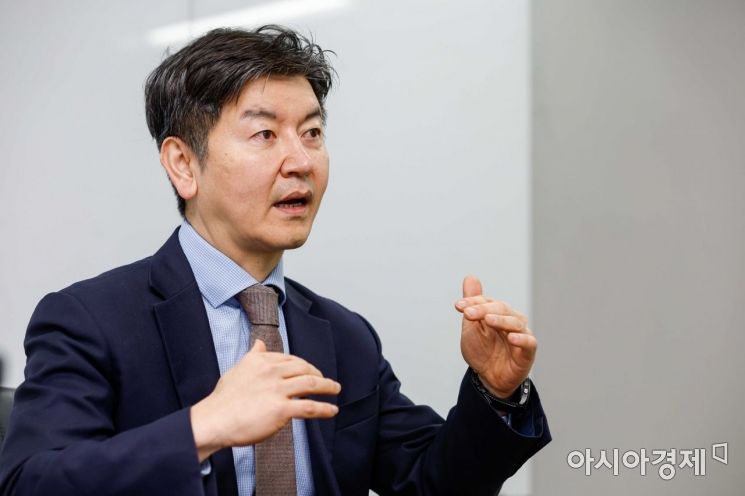 Ahn Hong-sang, CEO of Iljin High Solus, is being interviewed on the 8th at Iljin Building in Mapo-gu, Seoul. Photo by Kang Jin-hyung aymsdream@
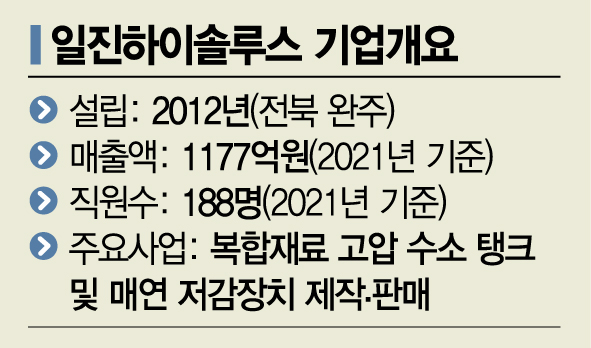
[Asia Economy Reporter Kwak Minjae] Iljin Hysolus is a company that manufactures hydrogen tanks, which serve as the "heart" of hydrogen vehicles. After becoming the world's first to supply hydrogen tanks for Hyundai Motor's hydrogen electric vehicle 'Tucson,' it now supplies all tanks for the 'Nexo.' It was also the first in Korea to produce Type 4 hydrogen tanks. Globally, only Iljin Hysolus and Japan's Toyota have mass production capabilities. This is why it is considered a representative company whose role becomes increasingly important as the hydrogen economy activates. Hong-sang Ahn, CEO of Iljin Hysolus, said, "Electric vehicles appear to be ahead of hydrogen vehicles because they were 10 years earlier," adding, "Once hydrogen vehicles surpass the critical point through policy support, they will grow much more steeply than electric vehicles."
- Last year, global hydrogen vehicle sales accounted for only 0.36% of electric vehicle sales. Does this mean losing leadership in the future eco-friendly vehicle market?
▲ It is true that electric vehicles have a clear advantage in the small and medium-sized passenger car segment. Especially since passenger cars occupy a large share of the automobile market, people are more likely to encounter electric vehicles in daily life. However, hydrogen vehicles have a definite advantage in the commercial vehicle market. They offer longer driving ranges and shorter refueling times compared to electric vehicles. Hydrogen fuel cells have an energy density more than five times higher than batteries. Medium and large commercial vehicles require long operating hours and high output, making hydrogen fuel cells more advantageous than batteries. Commercial vehicles are much more expensive per unit than passenger cars. Therefore, when looking at the overall scale, the two are not really comparable. It is a part that cannot be compared only by market share. It is necessary to consider the value base and look at it comprehensively.
- What about skepticism regarding the hydrogen economy?
▲ Not just because I am part of the hydrogen camp, but objectively, I believe hydrogen will be the ultimate energy source. Unlike electric energy, hydrogen fuel has the advantage of easy storage and transportation. Electricity is stored through energy storage systems (ESS), during which discharge occurs. On the other hand, hydrogen is stored in hydrogen tanks, so energy discharge is almost nonexistent. Also, hydrogen’s volume reduces to 1/800th when in liquid form compared to gas, making transportation highly efficient. Considering the storage and transportation advantages of hydrogen fuel, its energy efficiency is about 15-20% higher than electric energy. In the long term, hydrogen energy imposes less investment burden compared to electric vehicles. Electric vehicle charging stations can be built cheaply within the existing power grid limits, but if electric vehicle adoption continues to increase, the power grid capacity must be upgraded. The additional cost incurred then is greater than the cost of building hydrogen charging stations. This is why the hydrogen economy is bound to be spotlighted in the long run.
- What is Iljin Hysolus’s role and competitiveness in the hydrogen economy?
▲ Globally, only Japan’s Toyota and Iljin Hysolus have mass production lines for hydrogen tanks for hydrogen mobility. Iljin Hysolus is a company capable of producing Type 4 hydrogen tanks, the fourth generation. Since the early 2000s, it has been developing hydrogen tanks and succeeded in mass-producing Type 4 tanks for the first time in the world. Type 4 hydrogen tanks are the most advanced stage among hydrogen fuel tanks and are made of non-metallic materials, unlike Types 1 to 3. Type 4 hydrogen tanks have ten times the strength and only one-third the weight of metal tanks. Non-metallic materials do not react with hydrogen, making them safer than metal materials. Iljin Hysolus has mass-produced over 100,000 hydrogen storage containers so far without significant safety variations. In particular, Type 4 hydrogen tube trailers are expected to contribute to expanding hydrogen infrastructure. Hydrogen tube trailers compress and store hydrogen fuel at production bases and transport and supply it to charging stations. Compared to existing products (Type 1), Type 4 weighs 14 tons less and is 6 meters shorter, allowing easy access to urban areas. The biggest reason hydrogen charging stations cannot be built in city centers is the turning radius and weight of trailers, which this solves. The storage pressure is also increased, reducing the recompression process needed to refuel vehicles at charging stations by half. This process reduction lowers costs. Iljin Hysolus’s Type 4 hydrogen tanks have made nationwide transportation possible and cost-effective, contributing to the expansion of hydrogen infrastructure.
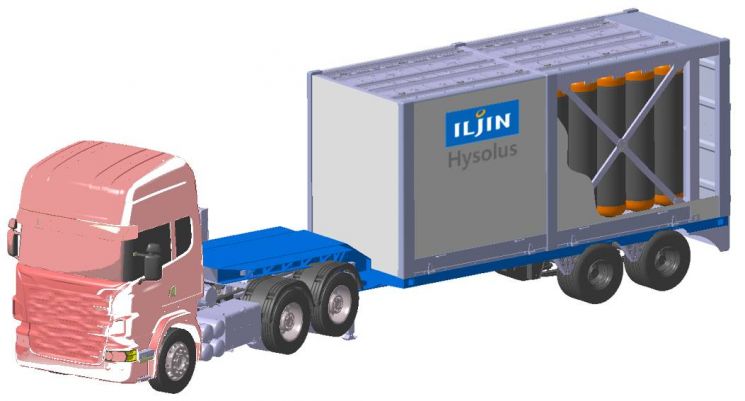 Type 4 tank for hydrogen tube trailers, the first developed domestically by Iljin Hi-Solus.
 [Photo by Iljin Group]
- What do you hope for in the next government’s hydrogen policy?
▲ Recently, China has entered the hydrogen competition. The National Development and Reform Commission, responsible for China’s industrial policy, announced a mid-to-long-term development plan for the hydrogen industry to apply hydrogen to all industrial sectors including transportation and energy storage by 2035. They are increasing hydrogen vehicle charging stations and developing hydrogen mobility such as hydrogen cars, ships, and airplanes. Fortunately, China has not yet acquired Type 4 hydrogen tank technology. Korea is a leading country that relatively quickly secured the hydrogen sector. In particular, Iljin Hysolus’s hydrogen storage technology is confident to be ahead of Toyota’s. Storage efficiency determines the technological level; if Toyota’s storage container holds 100, Iljin Hysolus’s can hold 150. This is why Korea’s hydrogen storage efficiency is world-class. When President-elect Yoon Suk-yeol was a candidate, I met him personally and explained that for Korea to maintain hydrogen leadership, the government needs to actively support more infrastructure deployment, charging station installation, and passing hydrogen law amendments. I believe Korea’s hydrogen industry is moving toward a critical point. If the new government ensures continuity in hydrogen policy, Korea can maintain its technological gap in hydrogen."
- How do you view the prospects of the hydrogen economy? What are Iljin Hysolus’s future plans?
▲ McKinsey classifies the hydrogen industry as a future core industry and forecasts it will grow to $2.5 trillion (about 3,000 trillion KRW) annually by 2050. This market size far exceeds that of information technology (IT) or biotechnology markets. The applications of hydrogen tanks are limitless. Iljin Hysolus plans to target not only commercial vehicles but also drones and eco-friendly ships using hydrogen tanks. Currently, it is negotiating projects with leading European commercial vehicle companies that occupy 80% of the global commercial vehicle market. It supplies hydrogen tanks exclusively to Korea’s largest drone manufacturer. Last year, Iljin Hysolus signed memorandums of understanding (MOUs) with Samsung Heavy Industries and Hyundai Global Service to jointly develop hydrogen electric propulsion ships. Starting next year, the International Maritime Organization (IMO) will enforce regulations on ship carbon emissions, and the eco-friendly hydrogen ship market is expected to steadily grow.
*Profile of CEO Hong-sang Ahn
Major career: Seoul National University, Department of Chemistry; KAIST Master’s; Ph.D. from Northwestern University, USA; Consultant at McKinsey & Company; Partner at Oliver Wyman; Executive Director at Hyundai Mobis
© The Asia Business Daily(www.asiae.co.kr). All rights reserved.



















