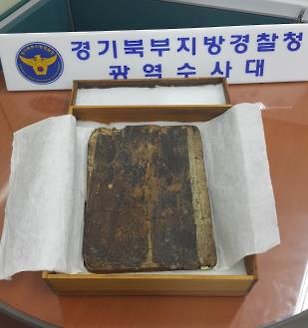
[Asia Economy Reporter Choi Seok-jin, Legal Affairs Specialist] An operator of a private museum and his son, who obtained treasure designation by falsely claiming that items purchased as stolen goods were inherited from their late father, have been sentenced to prison.
The Supreme Court's First Division (Presiding Justice Park Jeong-hwa) announced on the 18th that it upheld the original verdict sentencing Mr. A (73), who was charged with violating the Cultural Heritage Protection Act (inducing false designation, etc.), to three years in prison, and his son Mr. B (50) to two years and six months in prison with a four-year probation.
The court stated, "There is no error in the lower court's judgment that violates the rules of logic and experience, exceeds the limits of free evaluation of evidence, or misinterprets relevant laws."
The father and son, who operate a private museum in Yeongcheon City, Gyeongbuk Province, purchased the Ming Dynasty legal code 'Daemyeongryul (大明律)' from Mr. C, a dealer in stolen goods, for 15 million won in 2012.
Daemyeongryul is a legal code compiled starting in 1367, one year before Zhu Yuanzhang ascended the throne as emperor of the Ming Dynasty, and completed in 1373. Joseon also adopted it as a legal reference.
The Daemyeongryul obtained by Mr. A and his son was a rare edition printed from woodblocks carved in 1389, revised and compiled in the Ming Dynasty. It predates the 1397 promulgated edition still preserved in China.
A few months later, the two went to Yeongcheon City Hall and applied for national cultural heritage designation, claiming it was inherited from their late father. This Daemyeongryul was designated as Treasure No. 1906 in 2016.
The problem was that the Daemyeongryul purchased by Mr. A and others was stolen property taken from Gyeongju in 1998.
When purchasing the Daemyeongryul from Mr. C, the stolen goods dealer, Mr. A and others promised to pay an additional 10 million won if the Daemyeongryul was designated as a treasure or other cultural heritage. However, after the designation, they did not pay the promised additional amount, and Mr. C cooperated with the investigation authorities, revealing their crime.
The prosecution indicted the two on charges of inducing false designation under the Cultural Heritage Protection Act. Article 91 of the Cultural Heritage Protection Act (Crime of Inducing False Designation) stipulates that "anyone who causes a cultural heritage or temporarily designated cultural heritage to be designated by false or other fraudulent means shall be punished by imprisonment for not less than five years."
The first trial sentenced Mr. A to five years in prison and Mr. B to three years, stating, "They made false claims about the acquisition of the Daemyeongryul, the nature of the crime is quite serious, and they deny the crime without showing any remorse."
Mr. C's testimony was critical evidence: "After being released from prison in June 2006, where I served time for mediating stolen goods due to Mr. D from Andong (who died in September 2009), I met Mr. D in September of the same year. During a discussion about past matters, I asked for one of the books he had, which turned out to be the Daemyeongryul. Due to financial difficulties after release, I sold the Daemyeongryul to Mr. A."
Also, the failure to submit the original copy of the cultural heritage sales ledger, which they claimed as evidence that the Daemyeongryul had been passed down in the family for generations, was also evidence of guilt.
The second trial also recognized the guilt of Mr. A and his son.
However, the court reduced their sentences, stating, "The defendants did not fabricate the Daemyeongryul to apply for cultural heritage designation, and the Daemyeongryul is currently entrusted and stored without significant damage." Mr. A was sentenced to three years in prison, and Mr. B to two years and six months with a four-year probation.
In particular, Mr. B's involvement in the crime was considered lighter than Mr. A's, and unlike Mr. A, he had no prior criminal record related to the case.
They appealed, but the Supreme Court found no issues with the second trial's judgment and dismissed their appeal.
© The Asia Business Daily(www.asiae.co.kr). All rights reserved.
![Clutching a Stolen Dior Bag, Saying "I Hate Being Poor but Real"... The Grotesque Con of a "Human Knockoff" [Slate]](https://cwcontent.asiae.co.kr/asiaresize/183/2026021902243444107_1771435474.jpg)
















