35.2 Million Cumulative Medical Visits in 2 Years
Steep Growth Due to Omicron Variant Despite Negative Views from Healthcare Sector
Hospitals and Clinics Join Medical Platforms One After Another
Advantages in Continuous Management of Diseases Like Hypertension, Diabetes, and Infectious Diseases... Institutionalization Under Review
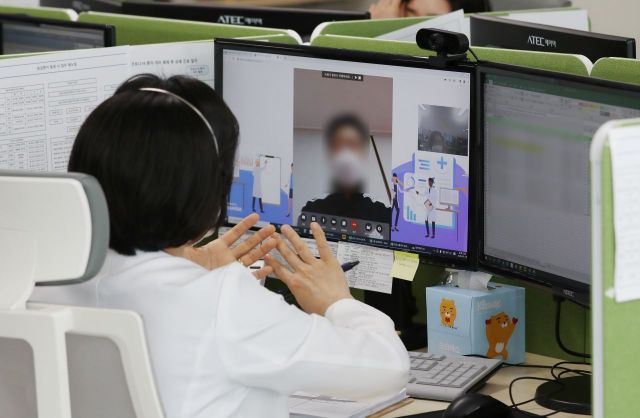
[Asia Economy Reporter Lee Gwan-joo] The 'non-face-to-face medical consultation' that has been piloted since the COVID-19 pandemic is expected to be officially introduced. Although the medical community is fundamentally opposed to the introduction of non-face-to-face consultations, the overall atmosphere is that the formal adoption is certain, given the significantly increased satisfaction among medical consumers due to home treatment for the Omicron variant and the growing number of hospitals and clinics participating in non-face-to-face consultations. The key issue is the 'scope of allowance.' Stakeholders including the government, medical community, and non-face-to-face consultation platform industry need to reach an agreement on how far the level of non-face-to-face medical care will be permitted.
Non-face-to-face consultations "Already the trend"
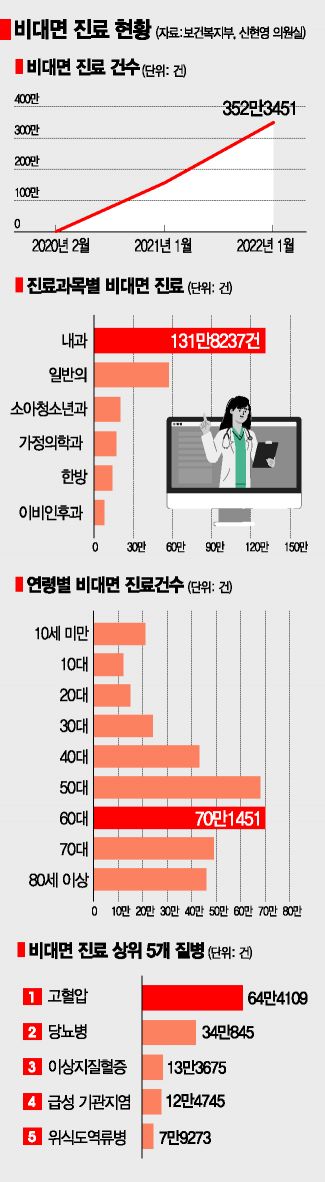
In the domestic medical market, which had been almost barren for non-face-to-face consultations, temporary non-face-to-face consultations were first allowed in February 2020 when COVID-19 began to spread in earnest. It was an unavoidable choice to provide necessary medical services during quarantine situations. Since then, the non-face-to-face consultation market has grown rapidly. The number of non-face-to-face consultations, which was only 24,727 in the first month of introduction, exploded to a cumulative total of 1,592,651 by January last year, and reached 3,523,451 cumulatively by January this year.
Especially after the introduction of a new quarantine system in February this year, which made home treatment the principle due to the Omicron variant pandemic, non-face-to-face consultations increased to an unimaginable extent. For the non-face-to-face consultation platform 'DoctorNow,' the number of users exceeded 900,000 in February alone, and the weekly active users (WAU) surpassed 1 million in March. 'DoctorCall' saw a 293% increase in users from January to March, and 'SolDoc' had a 317% increase in prescriptions during the same period. Notably, 'Namanui Doctor' showed a 700% increase, and 'Ollacare' had over a 2000% increase in user growth.
The healthcare and medical community has consistently maintained a negative stance on the introduction of non-face-to-face consultations. When bills to allow non-face-to-face consultations were repeatedly proposed in the National Assembly, the Korean Medical Association, Korean Dental Association, and Korean Pharmaceutical Association issued a joint statement in October last year, opposing it by saying, "The violation of the principle of patient face-to-face consultation will cause great harm to public health." However, after the Omicron variant outbreak, there is a sense that the expansion of non-face-to-face consultations is an 'irreversible trend.' The fact that more hospitals and clinics are joining non-face-to-face consultation platforms proves this. One platform had about 360 affiliated medical institutions until early this year, but the number increased to about 900 by the end of March. Some tertiary general hospitals have also joined non-face-to-face consultation platforms.
Non-face-to-face consultations likely to be allowed mainly for chronic diseases
As legislation on non-face-to-face consultations approaches, the key issue is how far to allow non-face-to-face consultations. Even within the non-face-to-face consultation platform industry, there is consensus that non-face-to-face consultations are only an auxiliary means. Kim Soo-man, TF team leader of DoctorCall, said, "The essence of non-face-to-face consultation services lies in supplementing the medical gaps of current face-to-face consultations and efficiently utilizing limited resources." There are also opinions that non-face-to-face consultation services can help patients manage their health. Lee Ho-ik, CEO of SolDoc and a former private practitioner, explained, "Non-face-to-face consultations can actually improve treatment effectiveness. Medical consumers have become able to proactively monitor and manage their health, which can improve customer experience and medication management."
In particular, there is high demand for non-face-to-face consultations for chronic diseases such as hypertension and diabetes. Since these diseases require continuous prescription of medication, non-face-to-face consultations can reduce the inconvenience of visiting hospitals every time, and measurements can be supplemented using medical devices. From February 2020 to January this year, the top five diseases for non-face-to-face consultations were chronic diseases requiring long-term management: hypertension (644,109 cases) ranked first, diabetes (340,845 cases) second, and dyslipidemia (133,675 cases) third.
Considering this situation, it is expected that discussions will first focus on allowing non-face-to-face consultations for chronic diseases requiring continuous prescriptions and consultations, or in situations where face-to-face consultations are restricted due to infectious diseases. The Ministry of Health and Welfare stated, "We plan to review institutionalization measures from a health policy perspective through consultations with the medical community and civil society."
© The Asia Business Daily(www.asiae.co.kr). All rights reserved.


















