[Asia Economy Reporter Yoo In-ho] As the South Korea-U.S. joint military exercises approach, the situation on the Korean Peninsula is cooling down, with North Korea engaging in military provocations.
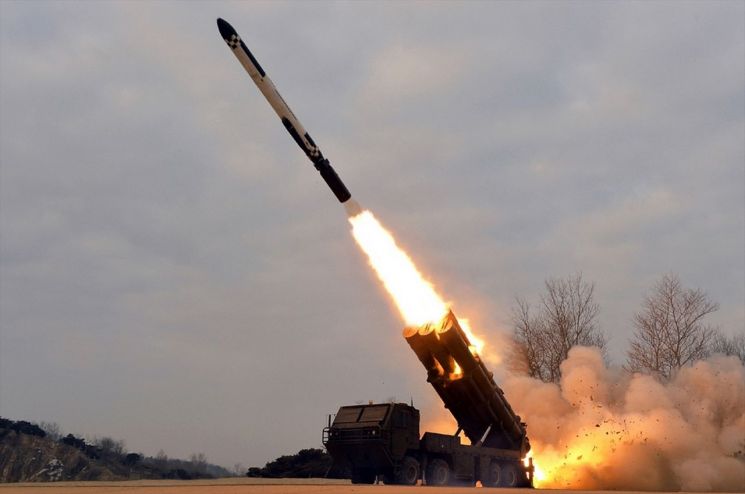
North Korea’s actions align with previous predictions that it would create tension through missile launches and other military demonstrations timed with South Korea’s regime change and the joint exercises with the U.S.
On the 17th, North Korea’s Korean Central News Agency reported that under the observation of Kim Jong-un, General Secretary of the Workers' Party, a new tactical guided weapon was test-fired.
Regarding the test-fired weapon, the report stated, “This new tactical guided weapon system, developed under the special attention of the Party Central Committee, significantly enhances the firepower strike capability of frontline long-range artillery units and holds great significance in strengthening the effectiveness of tactical nuclear operations and diversifying firepower missions of the Democratic People's Republic of Korea.”
The agency also reported on Kim Jong-un, saying, “While revealing the Party Central Committee’s vision for prospective national defense strengthening, he gave a resolute teaching to further reinforce the country’s defense capability and nuclear combat power.”
On the same day, North Korea criticized the South Korean government one day before the start of the main South Korea-U.S. joint military exercises. It blamed the South for escalating tensions on the Korean Peninsula and launched harsh verbal attacks.
The external propaganda outlet Uriminzokkiri mentioned that following the crisis management staff training (CMST), a preparatory exercise held from the 12th to the 15th, the main exercise, the Combined Command Post Training (CCPT), will be conducted from the 18th to the 28th.
It added, “This further intensifies the situation on the Korean Peninsula,” and pointed out, “Moreover, this is a time when reckless remarks and actions by warmongers, including the South Korean Minister of National Defense, are worsening the situation on the Korean Peninsula.” This was a direct reference to Defense Minister Seo Wook’s statement on the 1st about “precision strikes on the origin point in case of missile launch signs.”
The outlet claimed, “The reality clearly proves once again that the warmongers in the South Korean military are the ones driving the situation on the Korean Peninsula toward heightened tension and are the destroyers of peace,” and added, “Those who enjoy fire are bound to perish in it.”
Another external propaganda outlet, Meori, also published an article titled “The Reckless Acts of Warmongers Who Have Lost Reason,” condemning the South Korea-U.S. joint exercises as “a mad act that lights the fuse of a war of aggression against the North in collusion with foreign forces,” and stated, “All the resulting consequences must be fully borne by the South Korean military.”
As inter-Korean relations freeze, attention is focused on the response measures toward North Korea that may be sought between the South Korean and U.S. governments during the visit of U.S. Special Representative for North Korea, Sung Kim.
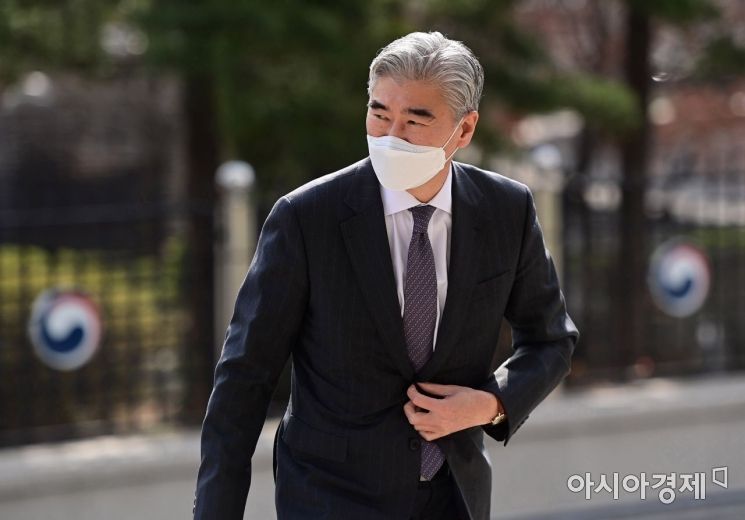 Sung Kim, Acting Assistant Secretary of the U.S. Department of State for East Asian and Pacific Affairs, is moving to attend the 'Korea-U.S. Bilateral Policy Dialogue (BPD)' held at the Ministry of Foreign Affairs in Jongno-gu, Seoul on the 19th. Photo by Jinhyung Kang aymsdream@
Sung Kim, the U.S. chief negotiator for North Korean nuclear talks, is scheduled to visit South Korea from the 18th to the 22nd and meet with Noh Kyu-duk, Director General for Korean Peninsula Peace and Security Affairs at the Ministry of Foreign Affairs, and other senior officials.
Kim plans to discuss the situation on the Korean Peninsula, including the international community’s response to North Korea’s recent intercontinental ballistic missile (ICBM) test launch and the projectile launched on the 16th.
In particular, Kim is expected to meet not only current South Korean government officials but also members of President-elect Yoon Suk-yeol’s transition team to coordinate the direction of North Korea policy with the new administration.
He is anticipated to hold close consultations on North Korea issues with key figures in the new government’s diplomatic, security, and defense sectors, including Foreign Minister nominee Park Jin, Unification Minister nominee Kwon Young-se, and Defense Minister nominee Lee Jong-sup.
Earlier, on the 4th, during a meeting in Washington D.C. with Noh Kyu-duk, who had visited the U.S., Kim mentioned his plan to visit South Korea soon and expressed his anticipation to discuss matters not only with Noh but also with the transition team.
© The Asia Business Daily(www.asiae.co.kr). All rights reserved.
![Clutching a Stolen Dior Bag, Saying "I Hate Being Poor but Real"... The Grotesque Con of a "Human Knockoff" [Slate]](https://cwcontent.asiae.co.kr/asiaresize/183/2026021902243444107_1771435474.jpg)

















