Nasal Spray Treatment in Clinical Trials
Advantages Include Easy Storage, Distribution, and Convenient Use
Expected to Gain More Attention in the Future
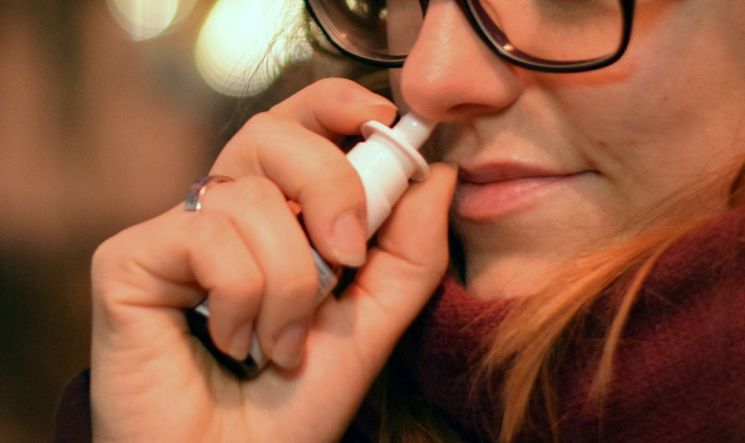
[Asia Economy Intern Reporter Kim Nayeon] A new COVID-19 nasal spray treatment has been confirmed to perform better than the currently used antibody treatments. It showed high therapeutic effects regardless of the variant virus type.
With a Phase 1 clinical trial underway in humans, there is growing interest in whether a new treatment that suppresses the COVID-19 virus simply by spraying it into the nose will emerge.
Researchers from Northwestern University, the University of Washington, and the University of Washington School of Medicine in the United States announced that they have developed a new protein-based antiviral nasal spray treatment and have begun Phase 1 clinical trials in humans.
The research team designed a protein that inhibits the ability of the COVID-19 virus to penetrate human cells using computer modeling, purified it in the laboratory, and made it into a spray form.
In preclinical studies on animals, when compared to antibody treatments currently approved and used by the U.S. Food and Drug Administration (FDA), the virus neutralization ability was found to be similar or greater. In particular, it was effective against all variants, including Delta and Omicron. These research results were published on the 12th (local time) in the international journal Science Translational Medicine.
Previously, the research team used supercomputers to design proteins that can attach to vulnerable sites on the spike protein surface that the COVID-19 virus uses to invade the human body, and published a paper in the international journal Science in 2020.
The antiviral protein maintains binding to the spike protein of the COVID-19 virus while blocking the spike protein’s binding to the ACE2 receptor, which is necessary for human cell invasion. Notably, the minibinder developed by the researchers retained effectiveness against the COVID-19 Omicron variant as well.
The research team stated, "The protein that forms the basis of this newly developed antiviral spray treatment can be mass-produced from microorganisms, making manufacturing cost-effective," adding, "It is stable even in high-temperature environments, which simplifies the manufacturing process and reduces clinical costs." They also expressed hope that "if the clinical trials are successfully completed, it could be conveniently available at pharmacies and may help prevent COVID-19 virus infections."
Meanwhile, interest in nasal spray-type drugs has recently been growing domestically as well.
In particular, Coldmask, a drug that forms a protective barrier inside the nose to block respiratory virus invasion, reportedly saw sales increase by about 1000% in the first quarter of this year compared to the previous quarter.
However, Coldmask was not originally developed for COVID-19 treatment, and the related research has only been proven through in vitro cell experiments, which is a limitation.
SK Bioscience recently also began developing a nasal spray COVID-19 drug in collaboration with the International AIDS Vaccine Initiative (IAVI) and the University of Washington’s Institute for Protein Design (IPD).
© The Asia Business Daily(www.asiae.co.kr). All rights reserved.

















