All Prosecutorial Investigation Functions Removed... Only Corruption Investigation Office and Police Crimes Investigable
Only Police Warrant Application Cases Subject to 'Warrant Request'... No Means to Control Police Investigations
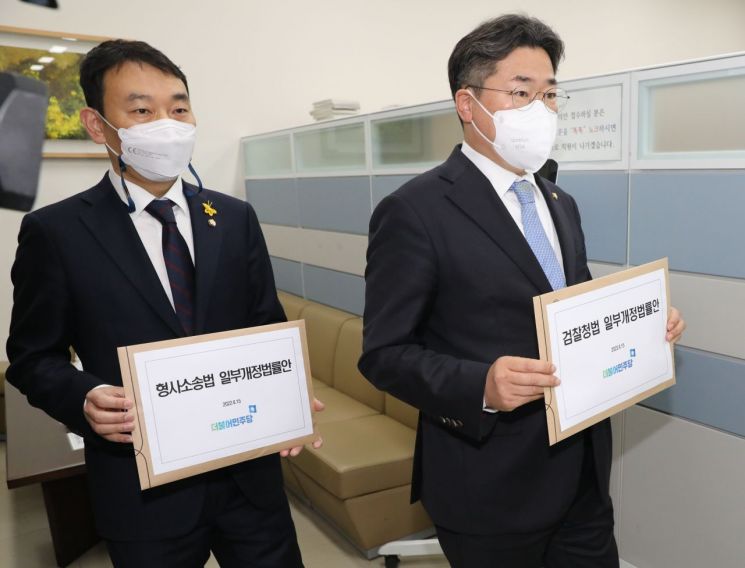 Democratic Party of Korea lawmakers Park Chan-dae and Kim Yong-min submitted amendments to the Prosecutors' Office Act and the Criminal Procedure Act to the National Assembly Secretariat on the morning of the 15th.
 [Image source=Yonhap News]
[Asia Economy Reporter Heo Kyung-jun] If the amendments to the Criminal Procedure Act and the Prosecutors' Office Act proposed by the Democratic Party of Korea are passed, a gigantic "dinosaur police" is expected to emerge. This is because there will be no means to control the police, who have seized not only the authority to initiate investigations but also the authority to conclude them.
The core of the amendments to the Prosecutors' Office Act and the Criminal Procedure Act, proposed by the Democratic Party for the so-called "Geomsu Wanbak" (complete removal of prosecutorial investigation rights), is that when the police investigate and determine there is criminal suspicion, they send the case to the prosecution for trial. Even if the police conclude the case themselves without sending it, and additional criminal facts are confirmed or the complainant or other related parties file objections with the prosecution, the prosecution cannot conduct direct investigations and can only request supplementary investigations from the police.
On the 16th, legal circles inside and outside the industry pointed out that if the amended Geomsu Wanbak bill is passed, the damage will directly affect the public. More than 99% of cases under police investigation are crimes affecting the public, such as livelihood crimes or complaints and accusations, but in reality, there will be no way to object to the investigation results. Even if objections are raised, the structure requires the police to investigate again, making it highly unlikely that the already concluded investigation results will be overturned.
The problem lies in the fact that the public, as consumers of the state's legal services, cannot choose the agency responsible for their investigation. According to the Geomsu Wanbak bill, which all Democratic Party members supported, the investigative role of prosecutors, one of the two pillars of the existing criminal justice system alongside judicial police officers (police), has been entirely removed. Prosecutors are now only allowed to investigate crimes involving the police and the High-ranking Officials' Crime Investigation Agency (Gongsa-cheo). Even if prosecutors recognize additional crimes in cases sent by the police, they must request supplementary investigations from the police. From the public's perspective, the option to receive prosecution investigations during case processing disappears, resulting in a monopolistic police investigation structure.
With the enactment of the bill that completely removes the prosecution's investigative functions, the case processing period is also expected to increase. Prosecutors will only be responsible for forwarding cases to trial and handling the trials, while all investigations must be handled by the police, who are already struggling with manpower shortages, raising concerns about overload. It is reported that there is a serious tendency within the police to avoid investigative departments.
In fact, among the cases for which the prosecution requested supplementary investigations from the police in the first half of last year (40,784 cases), only about half (56.3%) had supplementary investigations completed within three months. Cases taking 3 to 6 months numbered 13,796 (19.1%), and those exceeding six months or not completed reached 17,643 (24.3%). As of now, 3,834 cases for which supplementary investigations were requested in the first quarter of last year remain unfulfilled.
Also, among 6,583 cases for which the prosecution requested reinvestigation from the police during the same period, 50% were reinvestigated within three months, while 27.3% took between three to six months or more than six months. Cases without reinvestigation results to date account for 22.7%.
The opinion that increasing police personnel could shorten case processing times is not considered a solution by legal experts. The significant variance in individual investigative capabilities among police investigators leads to increased objections from related parties and a rise in supplementary and reinvestigation rates, ultimately prolonging case processing periods. Therefore, this cannot be a fundamental countermeasure.
The significant expansion of police authority is also problematic. Under the current Criminal Procedure Act, a "prosecutor" can request an arrest warrant from the court to detain a suspect, and the police can apply to the prosecutor, who then requests the court for an arrest warrant to detain the suspect. However, according to the Geomsu Wanbak bill, only the police can apply to the prosecutor to obtain an arrest warrant from the court. Under the amendment, the prosecution cannot independently request arrest warrants; prosecutors can only request warrants if the police have applied for them.
Ultimately, although the Democratic Party stated that the Geomsu Wanbak bill was proposed to decentralize the bloated powers of the prosecution, those powers have simply been transferred to the police, resulting not in a division but a reorganization of the power structure.
© The Asia Business Daily(www.asiae.co.kr). All rights reserved.

















