Hankyung Research Institute, Report on 'Estimated Appropriate Benchmark Interest Rates in the US and Korea and Implications'
US Benchmark Rate Expected to Rise 2.33% This Year…Korea 2.86%
Household Interest Burden Increases by 40 Trillion Won…3.45 Million Won per Household
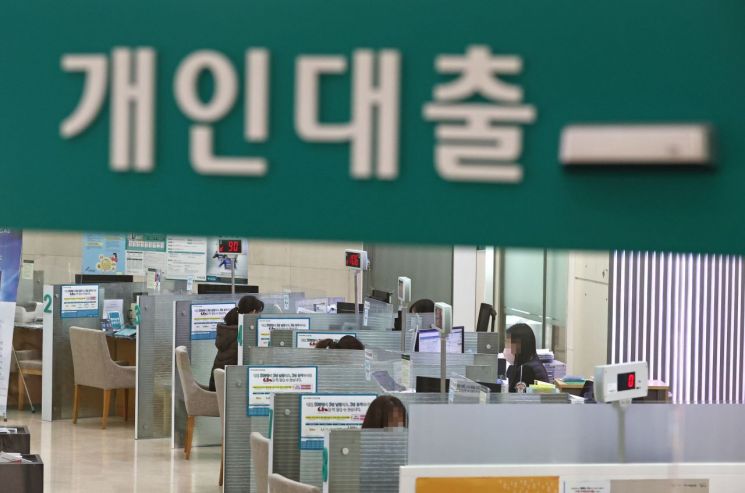
[Asia Economy Reporter Jin-ho Kim] As the U.S. Federal Open Market Committee (FOMC) is expected to implement a so-called 'big step' (raising the benchmark interest rate by 0.5 percentage points at once) next month, an analysis suggests that South Korea's benchmark interest rate will also approach 3% within this year. This marks the complete end of the prolonged low-interest-rate era over the past few years, raising concerns that the interest burden on households, which have relied heavily on 'debt,' will increase significantly.
According to a recent analysis report titled "Estimation of Appropriate Benchmark Interest Rates in the U.S. and South Korea and Its Implications" released by the Korea Economic Research Institute (KERI) under the Federation of Korean Industries, the domestic benchmark interest rate is expected to reach 2.86% this year. This estimate is based on the assumption that the U.S. benchmark interest rate will rise to 2.33%.
KERI stated that despite economic uncertainties such as Russia's invasion of Ukraine, the U.S. is considering a big step of raising the benchmark interest rate by 0.5 percentage points in May following the rate hike in March. This is because inflation is accelerating too rapidly while real economic fundamentals such as employment remain solid.
In fact, the U.S. consumer price inflation rate in March this year was 8.5%, the highest in 41 years since December 1981's 8.9%. Meanwhile, the unemployment rate in March dropped to 3.6%, and the GDP growth rate in the fourth quarter of last year recorded a robust 7.0% increase.
KERI established a model explaining the U.S. benchmark interest rate using economic variables such as the U.S. inflation rate (year-on-year consumer price inflation), unemployment rate, and money supply (M1), and estimated that the appropriate benchmark interest rate for the U.S. this year is 2.33%.
KERI commented, "Since the current U.S. benchmark interest rate as of April is 0.375% (ranging from 0.25% to 0.5%), it means that an increase of 1.95 percentage points is necessary to reach the appropriate benchmark interest rate level. As the U.S. Federal Reserve has already started raising the benchmark interest rate, the upward trend will continue until it reaches at least the appropriate level."
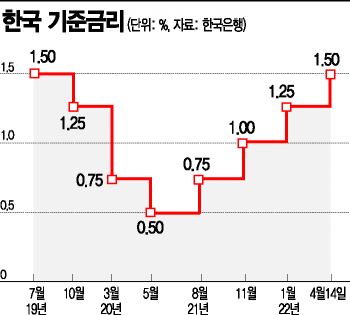
Based on this estimate, KERI calculated the appropriate increase in South Korea's benchmark interest rate if the U.S. Federal Reserve raises its benchmark interest rate to the appropriate level of 2.33%.
Assuming the Korean won exchange rate remains stable (expected exchange rate depreciation of 0%), if the U.S. benchmark interest rate reaches 2.33% and South Korea's benchmark interest rate remains at the current level of 1.25%, the interest rate gap between Korea and the U.S. would widen to 1.08 percentage points, causing an interest rate inversion. To secure the appropriate benchmark interest rate difference of 0.53 percentage points, the Bank of Korea is estimated to raise the rate by 1.61 percentage points.
The problem is that the burden of household debt, the biggest risk factor in the Korean economy, will increase significantly. According to KERI's calculations, if South Korea's benchmark interest rate rises by 1.61 percentage points, the household loan interest rate will increase by 1.90 percentage points. The annual increase in household loan interest burden due to the rate hike is estimated at 40.3 trillion won. On a per household basis, this means an increase in interest burden of 3.45 million won.
Choo Kwang-ho, Director of Economic Policy at KERI, suggested, "As the aggressive interest rate hike announced by the U.S. makes an increase in South Korea's benchmark interest rate inevitable, it is necessary to enhance the financial resilience of vulnerable private sectors such as households by expanding private sector jobs and to minimize the extent of the rate hike."
© The Asia Business Daily(www.asiae.co.kr). All rights reserved.
![Clutching a Stolen Dior Bag, Saying "I Hate Being Poor but Real"... The Grotesque Con of a "Human Knockoff" [Slate]](https://cwcontent.asiae.co.kr/asiaresize/183/2026021902243444107_1771435474.jpg)












