Microcystin Detected in Crops Produced in Nakdonggang Basin
No Domestic Standards for Assessment, Risk of Witch Hunt Feared
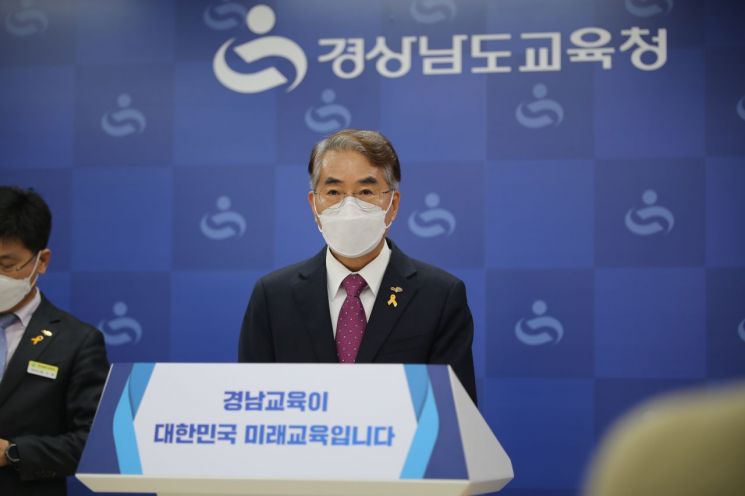 Park Jong-hoon, Superintendent of Education for Gyeongnam Province, is holding a press conference regarding the detection of toxic substances from green algae in food ingredients related to the Nakdong River.
[Asia Economy Yeongnam Reporting Headquarters Reporter Lee Seryeong] Park Jong-hoon, Superintendent of Education of Gyeongnam, has called for the establishment of permissible standards for toxic substances in river algae blooms and for a thorough investigation of the situation.
On the 12th, the School Meal Gyeongnam Solidarity, Gyeongnam Environmental Movement Federation, and Nakdong River Gyeongnam Network reported that microcystin was detected at 3.18 μg per 1 kg of rice grown with Nakdong River water, demanding that the education office make testing for algae bloom toxins in school meal ingredients mandatory.
Microcystin is a representative toxic substance of algae bloom toxins and is known to be about 100 times more poisonous than cyanide.
Assuming an adult weighing 60 kg consumes 300 g of rice per day, it is estimated that 0.945 μg of microcystin is ingested, which is claimed to exceed 15.9 times the reproductive toxicity standard of France.
On the 14th, the Gyeongnam Office of Education held a press conference regarding the detection of algae bloom toxins in the Nakdong River and announced that it would promptly investigate the production status and distribution routes of agricultural products containing toxic substances.
Superintendent Park Jong-hoon said, “The safety of children’s meals cannot be neglected even for a moment,” and “We demand a swift and proactive response at the government level.”
He added, “The results requested by the School Meal Gyeongnam Solidarity and others from a university in Busan followed the standards of France and California, USA,” and “We will propose to the government to quickly establish domestic permissible standards and suggest investigation agencies and methods.”
The Gyeongnam Office of Education plans to send official letters to the Ministry of Environment, Ministry of Agriculture, Food and Rural Affairs, and Ministry of Food and Drug Safety to urge the establishment of permissible standards for toxic substance detection.
They will also demand a thorough investigation and information disclosure regarding the production status and distribution situation of agricultural products containing algae bloom toxins.
If it is difficult or delayed to establish standards at the central government level, the education office plans to conduct its own sample survey in cooperation with related agencies.
Superintendent Park said, “We will identify distribution routes focusing on eco-friendly rice, cabbage, radish, lettuce, and other ingredients produced in the Nakdong River basin, and request cooperation for investigations from the provincial environmental research institute and university laboratories.”
He explained that applying foreign standards in the absence of domestic standards could unintentionally harm farmers producing in the Nakdong River basin, so the investigation will be conducted confidentially.
Considering the relatively severe algae bloom in the middle and lower reaches of the Nakdong River, he also expressed willingness to cooperate with the Busan Office of Education.
“This is probably not just a problem of the Nakdong River,” he said, “We need to look at other main and tributary rivers connected to the Nakdong River to protect the health of farmers in the basin and create a protective shield to ensure the healthiness of children’s food.”
The education office stated that in addition to government proposals, it will strengthen water quality environmental education for the Nakdong River and safely implement river and stream experiential education.
They plan to recommend schools to avoid having children directly enter the water in areas with high algae bloom occurrence.
They will conduct on-site inspections at each school to share problems and prepare countermeasures, and once microcystin permissible standards are established, they will guide each farm and school to comply with the policy.
Superintendent Park clearly expressed his intention to run for the local election, stating, “If I succeed in a third term, I will prioritize proposing this issue to the National Council of Superintendents of Education to resolve it.”
With Park Jong-hoon announcing his candidacy for the Gyeongnam Superintendent of Education election in June, Deputy Superintendent Choi Seong-yu will act as interim superintendent and, together with the Education Welfare Division, will proceed with government proposals and sample surveys by farm.
© The Asia Business Daily(www.asiae.co.kr). All rights reserved.

















