Survey of 304 Manufacturing Companies by Sangui
Three out of Ten Companies "Lose Money the More Products They Sell"
'Cost Reduction' Is Critical... "Government Price Stabilization Support Is Urgently Needed"
"Need to Address Complex Inflation Factors Such as Wages, Interest Rates, and Logistics Costs"
 As the price of lithium, the key raw material for electric vehicle batteries known as "white petroleum," soars to unprecedented heights, concerns are growing over increased production costs for companies and higher sales prices for consumers. The photo shows a lithium mine in Nevada, USA. (Photo by Asia Economy DB)
[Asia Economy Reporter Moon Chaeseok]
#1. Mid-sized construction company A has fallen into a situation of worrying about losses. This is because prices of major construction materials such as rebar and cement, which account for 30% of the total construction cost, have surged by about 20%. Since most of the projects were contracted 2 to 3 years ago, it is difficult to find a sharp countermeasure. With the Bank of Korea raising the base interest rate by 0.25 percentage points to 1.50% on the 14th, news that construction material prices will rise again next month has dampened the company’s mood.
#2. Food company B has frozen product prices for several years but is now facing great difficulty in enduring further. This is due to the ongoing war between Russia and Ukraine, which has caused continuous increases in flour and sugar prices as well as logistics costs. Because other companies have recently raised prices and are receiving harsh criticism from consumers, the company finds itself unable to act either way.
It has been found that companies are struggling to properly reflect the recent sharp rise in raw material prices in their product prices. Many companies are suffering losses the more they sell. As 'complex inflation,' where prices rise across the board, becomes a reality, companies are urging the government to implement comprehensive and innovative measures to reduce cost burdens not only from raw material prices but also wages, interest rates, and logistics.
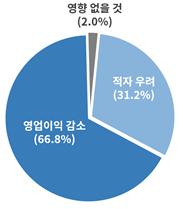 Survey results on the impact of rising raw material prices on companies. (Source: Korea Chamber of Commerce and Industry)
On the 14th, the Korea Chamber of Commerce and Industry (KCCI) announced the results of a 'Survey on the Impact of Recent Raw Material Price Surges on Companies' conducted with 304 manufacturing companies. 75.6% of respondents said that the surge in raw material prices has significantly increased production costs. The dominant opinion was that this phenomenon would negatively affect operating profits. 66.8% of respondents expected operating profits to decline this year if the current situation continues. In particular, 31.2% admitted that selling products would result in losses, making operating deficits inevitable. 98% of surveyed companies expressed concern that rising raw material prices would harm their businesses. A KCCI official stated, "Since the beginning of this year, procurement prices for almost all industrial sectors, including energy such as crude oil, natural gas, and coal, as well as steel, minerals, and grains, have surged," adding, "Recent raw material price increases often exceed what companies can bear, increasing their burdens."
For example, the price of lithium, a key raw material for electric vehicle batteries known as 'white petroleum,' surged about 472% over nine months from June last year to last month. Neon and krypton, essential raw materials for semiconductors, also rose sharply by 260.9% and 105.1%, respectively, compared to the same period last year. The Standard & Poor's (S&P) Goldman Sachs Commodity Index (GSCI), a representative raw material price index, rose 29% in the first quarter, marking the highest quarterly increase in 32 years since 1990.
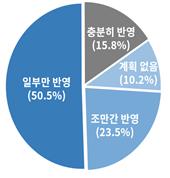 Survey Results on Whether Raw Material Price Increases Are Reflected in Product Prices. (Source: Korea Chamber of Commerce and Industry)
Companies reported that due to consumer backlash, they have been unable to fully reflect raw material price increases in product prices. Only 15.8% of companies said they had 'fully reflected' the burden caused by raw material price hikes in product prices. 74.0% answered that they had 'partially reflected' (50.5%) or 'plan to reflect soon' (23.5%). Meanwhile, 10.2% said they currently have no plans to reflect the increases. The main reason companies partially or did not reflect the surge in raw material prices in product prices was 'concern over sales decline' (42.7%). Other reasons included 'difficulty raising prices immediately due to prior contracts with clients' (32.5%) and 'still holding sufficient raw material inventory secured in advance' (16.5%).
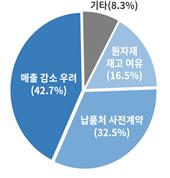 Survey results on reasons for not reflecting in product prices. (Source: Korea Chamber of Commerce and Industry)
The majority of companies responded that if raw material prices continue to rise, they will have no choice but to raise product prices. When asked about countermeasures if raw material prices remain high, 78.9% of companies chose 'product price increase.' This indicates that companies must raise product prices to offset losses caused by raw material price hikes. Additionally, more than half of the surveyed companies (50.3%) said they would also pursue 'overall cost reduction.' Since it is difficult to fully reflect raw material price increases in product prices, tight management seems inevitable. Other responses included 'considering raw material substitution' (23.0%), 'no plans' (4.3%), and 'suspension of sales (deliveries)' (2.6%).
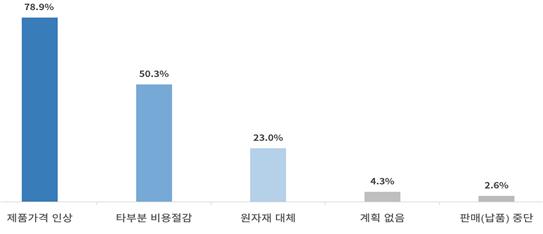 Survey Results on Corporate Responses if Raw Material Prices Remain Unchanged. (Source: Korea Chamber of Commerce and Industry)
Companies viewed 'overall price stabilization' (39.5%) as the most urgent government measure. They explained that burdens on companies are accumulating as prices rise broadly and fluctuate widely, including energy prices and public utility fees, beyond just raw materials. A significant number of companies (36.5%) also demanded 'support for stable raw material procurement.' Other demands included 'support for reasonable adjustment of delivery prices' (9.9%), 'cost burden relief such as tariff reductions' (9.5%), and 'operating fund support' (4.6%).
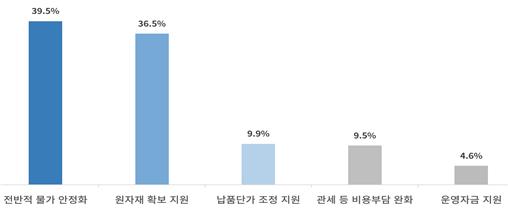 Survey results on measures desired from the government to alleviate corporate burdens. (Source: Korea Chamber of Commerce and Industry)
Jeon Insik, Director of Industrial Policy at KCCI, emphasized, "Companies need to consider not only immediate measures to alleviate the burden of rising raw material prices but also strategies to cope with the gradually materializing complex inflation," adding, "The government should comprehensively review cost burden factors for companies, including wages, interest rates, and logistics costs, as well as raw material prices, and prepare measures at the government level."
© The Asia Business Daily(www.asiae.co.kr). All rights reserved.



















