No.1 Reason for Apartment Non-Occupancy: 'Delay in Selling Existing Homes'
Jusan Research Institute: "High Proportion Due to Transaction Freeze"
Meanwhile, Nationwide Expectation for Housing Market Recovery in April Grows
[Asia Economy Reporter Hwang Seoyul] As the unprecedented transaction freeze continues, many households are unable to move in due to unsold existing homes.
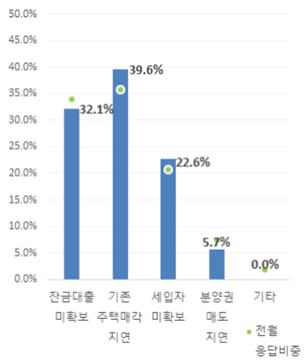
According to the Korea Housing Industry Research Institute (hereafter KHIRI) on the 14th, a survey on the reasons for unsold apartments nationwide last month showed that "delay in selling existing homes (39.6%)" ranked first. This figure has risen for two consecutive months since January (33.3%) and February (35.8%). The survey was conducted among about 500 housing construction companies that are members of the Korea Housing Association and the Korea Housing Builders Association.
Until January, the top reason for unsold homes was "failure to secure balance loans," but the rankings reversed starting last month. The reason "failure to secure balance loans" was highest at 40.7% in December last year but declined for three consecutive months, dropping to 32.1% (2nd place) last month. "Failure to secure tenants (22.6%)" and "delay in selling pre-sale rights (5.7%)" followed.
No Heesoon, a research fellow at KHIRI, said, "Until now, 'difficulty in financing' accounted for the largest part of the reasons for unsold homes, but the ranking changed due to the transaction freeze. It seems that as more sellers wait to get higher prices, sales transactions are not actively taking place."
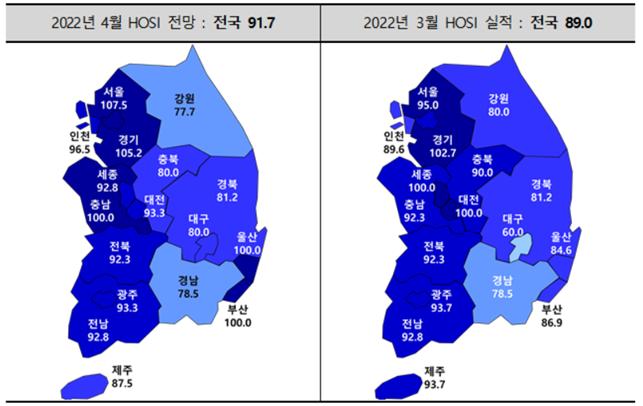
Meanwhile, expectations for the recovery of the nationwide move-in market are growing. The April nationwide Housing Occupancy Sentiment Index (HOSI) forecast announced by KHIRI on the same day recorded 91.7, up 18.9 points from last month. HOSI is an index that comprehensively assesses the move-in conditions of apartment complexes that are about to be occupied or are in the process of occupancy, as judged by housing suppliers. A value above the baseline of 100 indicates favorable move-in conditions, while a value below indicates deterioration.
Expectations for recovery in move-in conditions by region also increased. The metropolitan area HOSI (103.1) rose 29 points compared to last month, the metropolitan cities (93.2) increased by 23.8 points, and the provincial areas (86.2) rose by 11.3 points.
In particular, ▲Seoul (107.5) ▲Gyeonggi (105.2) ▲Busan (100.0) ▲Ulsan (100.0) ▲Chungnam (100.0) showed values exceeding the baseline of 100. Daegu (80.0) re-entered the 80-point range for the first time in seven months since October last year.
However, ▲Gangwon (77.7) ▲Gyeongnam (78.5) recorded values in the 70s, showing lower forecasts compared to other regions.
© The Asia Business Daily(www.asiae.co.kr). All rights reserved.
![Clutching a Stolen Dior Bag, Saying "I Hate Being Poor but Real"... The Grotesque Con of a "Human Knockoff" [Slate]](https://cwcontent.asiae.co.kr/asiaresize/183/2026021902243444107_1771435474.jpg)

















