Six-member Monetary Policy Committee System Amid President's Absence
Emerging as Key Interest Rate Decision Variable
Rising Inflation Fuels Sense of Crisis
Fed's Aggressive Tightening Also a Burden
Possibility of Interest Rate Inversion Between Korea and US
Attention on Additional Rate Hike in May
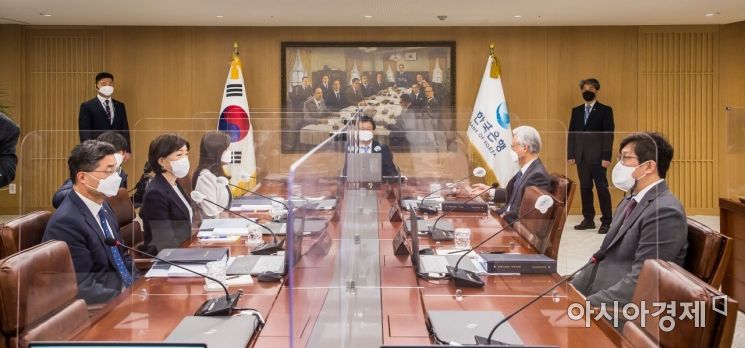 Joo Sang-young, Acting Chairman of the Monetary Policy Committee, is presiding over the Monetary Policy Committee meeting held at the Bank of Korea in Jung-gu, Seoul, on the morning of the 14th. 2022.04.14. Photo by Joint Press Corps
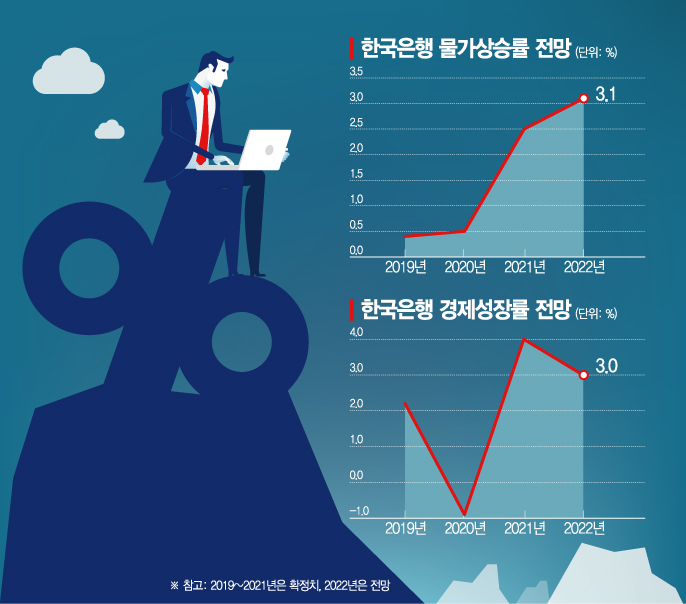
[Asia Economy Reporter Seo So-jung] On the 14th, the Bank of Korea's Monetary Policy Committee raised the benchmark interest rate by 0.25 percentage points despite the vacancy in the governor position, reflecting the urgent priority of price stability. Initially, the absence of a governor was seen as a factor favoring a rate hike in May, but with the recent acceleration of the U.S. Federal Reserve's (Fed) tightening measures and warning signs in economic indicators, concerns grew that a delay could lead to a missed opportunity.
On that day, the Monetary Policy Committee meeting was held with Lee Chang-yong, the nominee for the Bank of Korea governor, yet to assume office, and Monetary Policy Committee member Joo Sang-young acting as chair. Although the unprecedented situation of six committee members deciding the benchmark interest rate without a governor was a variable in the decision, the committee ultimately agreed on a rate hike based on the shared assessment of the serious inflation situation.
The main reason for this decision was soaring inflation. The consumer price index (CPI) in March surged by as much as 4.1%, marking a rise above 4% for the first time in over a decade, triggering a sense of crisis within the committee that the inflation situation could not be ignored. The cumulative consumer price inflation rate up to March this year already stands at 3.8%. At the Bank of Korea’s ‘Price Situation Review Meeting’ on the 5th, it was analyzed that the consumer price inflation rate would remain above 4% for the time being. According to the Bank of Korea’s March Consumer Sentiment Survey, the expected inflation rate reached 2.9%, the highest in 7 years and 11 months. Lee Chang-yong, the governor nominee, also expressed concern, saying, "This year’s consumer price inflation rate seems likely to exceed the Bank of Korea’s forecast (3.1%)."
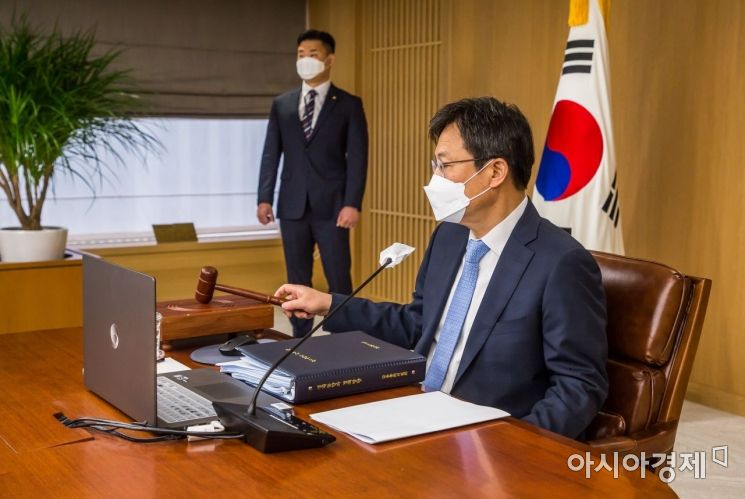 Joo Sang-young, Acting Chairman of the Monetary Policy Committee, is presiding over the Monetary Policy Committee meeting held at the Bank of Korea in Jung-gu, Seoul, on the morning of the 14th. 2022.04.14. Photo by Joint Press Corps
The Fed’s aggressive tightening stance also increased the pressure. According to the U.S. Department of Labor, the U.S. consumer price index (CPI) in March rose 8.5% year-on-year, marking the largest increase since December 1981. With U.S. inflation hitting a 40-year high, Fed officials have repeatedly emphasized the need to quickly raise the benchmark interest rate to a neutral level. Lael Brainard, nominated as Vice Chair of the Fed Board, also reiterated the necessity of tightening, stating, "Inflation levels remain high."
An interest rate inversion between South Korea and the U.S. could become a reality. If the U.S. implements a ‘big step’ of raising the benchmark rate by 0.5 percentage points in May and continues with additional hikes, the inversion could occur within months. This situation raises concerns about capital outflows by foreign investors and a depreciation of the Korean won. Professor Kim Sang-bong of Hansung University’s Department of Economics said, "Considering the domestic inflation situation, it seems there was a judgment to raise interest rates," adding, "The Fed’s tightening stance and the persistence of high domestic inflation were the background for the rate hike decision despite the governor vacancy."
It is also analyzed that the new government’s prioritization of stabilizing people’s livelihoods, including inflation, played a role in the rate hike decision. President-elect Yoon Seok-youl instructed the Presidential Transition Committee on the 6th to "make stabilizing people’s livelihoods, including inflation, the top priority of the new government."
Going forward, market attention will focus on whether the Monetary Policy Committee will implement additional rate hikes at the May meeting. Professor Sung Tae-yoon of Yonsei University’s Department of Economics said, "Initially, the market expected one rate hike between the April and May meetings, but with the Fed’s recent strong indication of a big step, the possibility of an additional hike in May cannot be completely ruled out." Regarding the decision to raise rates amid the governor vacancy, a Bank of Korea official said, "By deciding to raise rates despite the governor vacancy, it demonstrated the independence and stature of the Monetary Policy Committee as a collegial body."
© The Asia Business Daily(www.asiae.co.kr). All rights reserved.



















