Unable to Decide on Virtual Asset Status
Patent Office and Ministry of Science Also Conduct Research Following FSC
[Asia Economy Reporter Cha Min-young] While IT companies such as Naver and Kakao, along with telecom operators, are accelerating their entry into the non-fungible token (NFT) market, government ministries are struggling to keep up with the market without having designated the responsible authorities or established applicable laws. Despite various issues arising, including potential copyright violations, it remains undecided whether NFTs should be classified as ‘virtual assets,’ making it difficult not only to supervise but even to take the first steps toward legal institutionalization.
Ministry of Science and ICT Also Commissioning NFT Research
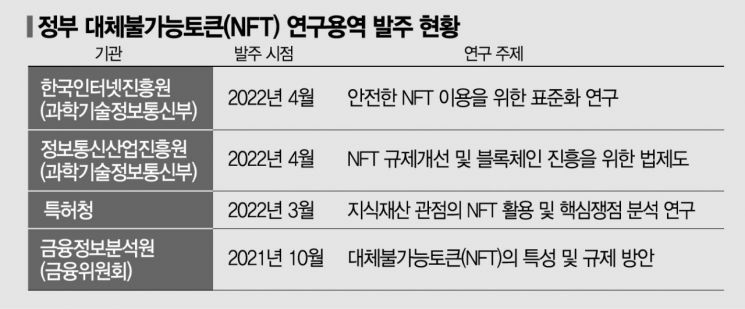
According to the Public Procurement Service’s Nara Marketplace on the 14th, the Ministry of Science and ICT (MSIT) commissioned two NFT-related research projects on the 12th. The contracting agencies are the Korea Internet & Security Agency (KISA) and the National IT Industry Promotion Agency (NIPA), both under MSIT. The topics are ‘Standardization Research for Safe NFT Use’ and ‘2022 Legal System for NFT Regulatory Improvement and Blockchain Promotion,’ respectively. An MSIT official explained, "Due to the complex nature of NFTs, multiple government ministries are involved. We issued research projects in a way that avoids overlap and are proactively preparing in advance."
The most proactive entity in initiating NFT legal institutionalization is the financial authorities. The Financial Services Commission (FSC) plans to include NFTs in the ‘Virtual Asset Business Act’ currently being prepared with the National Assembly. The Financial Intelligence Unit (FIU) under the FSC conducted a ‘Research on NFT Characteristics and Regulatory Measures’ through the Korea Institute of Finance from October to December last year. The Korean Intellectual Property Office (KIPO) also commissioned a research project titled ‘Analysis of NFT Utilization and Key Issues from an Intellectual Property Perspective’ on the 28th of last month. The Ministry of Culture, Sports and Tourism, which oversees copyright law, recently prepared an ‘NFT Transaction Guideline’ as a temporary response to copyright infringement disputes and is in the final stages of revision.
NFTs Changing Identity Depending on the Case
Although ministries are commissioning research and preparing guidelines, there is still a long way to go before legal institutionalization. Issuing a single or a small number of NFTs does not constitute ‘securities (investment)’ but issuing a large number of NFTs falls under securities according to the Capital Markets Act. NFTs can be used as part of blockchain technology for unique proof purposes, such as highly scarce artworks or real estate registration documents, but they can also be used for investment purposes, which poses problems. The FSC FIU research report concluded, "Few other countries have directly designated NFTs as virtual assets, so we need to decide carefully as well."
As the NFT market size rapidly expands, there are calls for ministries to engage in closer discussions for legal institutionalization. Blockchain data platform company Chainalysis stated in its ‘2022 Virtual Asset Outlook’ that the global NFT market in 2021 is estimated to be at least $26.9 billion (approximately 32.0782 trillion KRW).
Reality Ahead of Regulation, Lawsuits Overseas
Naver’s affiliate Line established Line Next, a specialized NFT subsidiary, in Korea and the United States last December. Kakao is also operating the NFT trading platform ‘Klip Drops’ through its subsidiary Ground X. KT has been running an NFT beta service since March. SK Telecom plans to introduce NFTs to its metaverse (extended virtual world) platform ‘ifland.’
Overseas, lawsuits surrounding NFTs are in full swing. French luxury brand ‘Herm?s’ claimed in December last year that the NFT product ‘MetaBirkins,’ which pays homage to the ‘Birkin bag,’ infringed on its property rights. Herm?s stated, "We have neither approved nor consented to the commercialization of the ‘Birkin bag’ in the metaverse or blockchain industry," and pointed out, "MetaBirkins infringed on Herm?s’ intellectual property rights and trademarks."
© The Asia Business Daily(www.asiae.co.kr). All rights reserved.

















