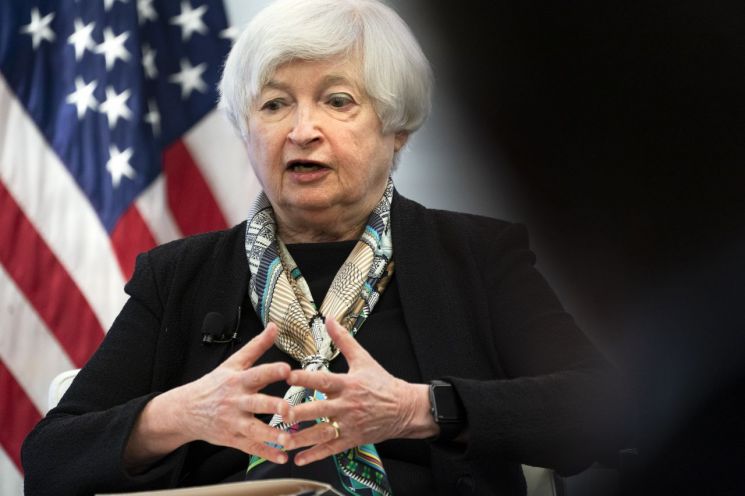
[Asia Economy Reporter Jeong Hyunjin] On the 13th (local time), U.S. Treasury Secretary Janet Yellen presented Friend-shoring as a vision for the new global economic order triggered by Russia's invasion of Ukraine. The core idea is to strengthen economic cooperation, including global supply chains, among countries that share core values and principles. Secretary Yellen also strongly warned China while pressuring countries that undermine the sanctions imposed by the U.S., Europe, and other Western nations against Russia.
According to Bloomberg News and others, Secretary Yellen stated in a speech at the U.S. think tank Atlantic Council that no country should use its market position in critical raw materials, technology, or production as a disruptive force to the economy. Regarding supply chain issues, she expressed support for the Friend-shoring strategy, which relies on allies rather than countries with geopolitical tensions.
Secretary Yellen emphasized, "Friend-shoring means that there is a group of countries that clearly adhere to standards and values about how the global economy operates, and these countries strengthen ties with their partners to ensure the supply of critical materials." She added, "There is a need to modernize the multilateral approach to building trade integration" and "We must build free yet secure trade."
Friend-shoring is a term derived from "Ally-shoring," coined in 2020. As supply chain issues emerged during the COVID-19 pandemic, the idea of reducing dependence on China led to the creation of this term. Bloomberg explained that Bonnie Glick, Deputy Administrator of the U.S. Agency for International Development (USAID), used the term informally, and it was first introduced to the public through others' contributions to Newsweek in 2020, later being adopted by institutions like the Brookings Institution. The Biden administration officially replaced the term Ally-shoring with Friend-shoring in a supply chain-related report in June last year.
The evolution of global trade forms began with "offshoring," where some tasks were sent overseas to countries with lower labor costs, followed by "reshoring (onshoring)," where domestic companies returned home for cost reasons. During the COVID-19 pandemic, supply chain issues led to the emergence of terms like ally-shoring and friend-shoring, which mean resolving supply chain problems through allied countries. These terms reflect the globalization trend that intensified in the 1990s and 2000s, weakened after the global financial crisis, and now highlight the need for economic bloc formation.
Secretary Yellen brought up Friend-shoring at this time largely due to Russia's invasion of Ukraine. She said the West will not stand idly by regarding actions that undermine sanctions and strongly hopes China will create positive outcomes from its special relationship with Russia and help end the war. She warned that if China does not do so, its global standing will be damaged. This statement is interpreted as a caution against China, which has strengthened ties with Russia during this crisis and may not only refuse to join Western sanctions but might even support Russia.
With the U.S. Treasury Secretary, who has led the global trade order, directly mentioning Friend-shoring, it is expected that trade forms with barriers at the economic bloc level will gradually strengthen. The U.S. political media outlet The Hill noted, "The U.S. can use supply chains to achieve new foreign policy goals," citing cooperation between the U.S. and Europe in building semiconductor supply chains as an example. Indeed, U.S. semiconductor company Intel announced it will invest 110 trillion won in Europe over the next decade, including building a semiconductor factory in Germany last month with 23 trillion won investment, supported actively by Europe, aiming to break the Asia-centered semiconductor supply chain.
What is Friend-shoring?
It is a trade strategy where countries that hold market positions in critical elements of supply chains such as raw materials, technology, and production capacity oppose disruptions to the trade order and build supply chains by gathering countries that have established trust and adhere to mutually and multilaterally agreed trade rules.
© The Asia Business Daily(www.asiae.co.kr). All rights reserved.
![Clutching a Stolen Dior Bag, Saying "I Hate Being Poor but Real"... The Grotesque Con of a "Human Knockoff" [Slate]](https://cwcontent.asiae.co.kr/asiaresize/183/2026021902243444107_1771435474.jpg)
















