Institutions and Foreigners Remain Relatively Stable

[Asia Economy Reporter Lee Myunghwan] In the first quarter of this year, only Donghak Ants recorded a negative return in the stock market, experiencing a bitter outcome. Institutional investors and foreign investors recorded relatively stable returns. Since limited information access and short-term trading tendencies of individual investors are cited as causes of losses, defensive investment is advised.
On the 14th, Asia Economy analyzed data from the Korea Exchange and found that the top 10 stocks by net purchase by individuals in the first quarter (January 3 to March 31) recorded an average return of -16.58% as of the 12th. This was the only negative return among market participants. All 10 stocks, including Samsung Electronics (-14.76%), the most net-purchased stock by individuals, suffered losses. Krafton, ranked 9th in net purchases, fell more than 40%, dropping from 460,000 KRW on January 3 to 267,000 KRW on the 12th.
On the other hand, during the same period, the average return of the top 10 stocks by net purchase by institutions was 9.32%, the highest among market participants. Except for LG Energy Solution (-18.61%) and SK Innovation (-19.15%), all other stocks yielded profits. The top 10 stocks by net purchase by foreigners also achieved a respectable average return of 7.29%.
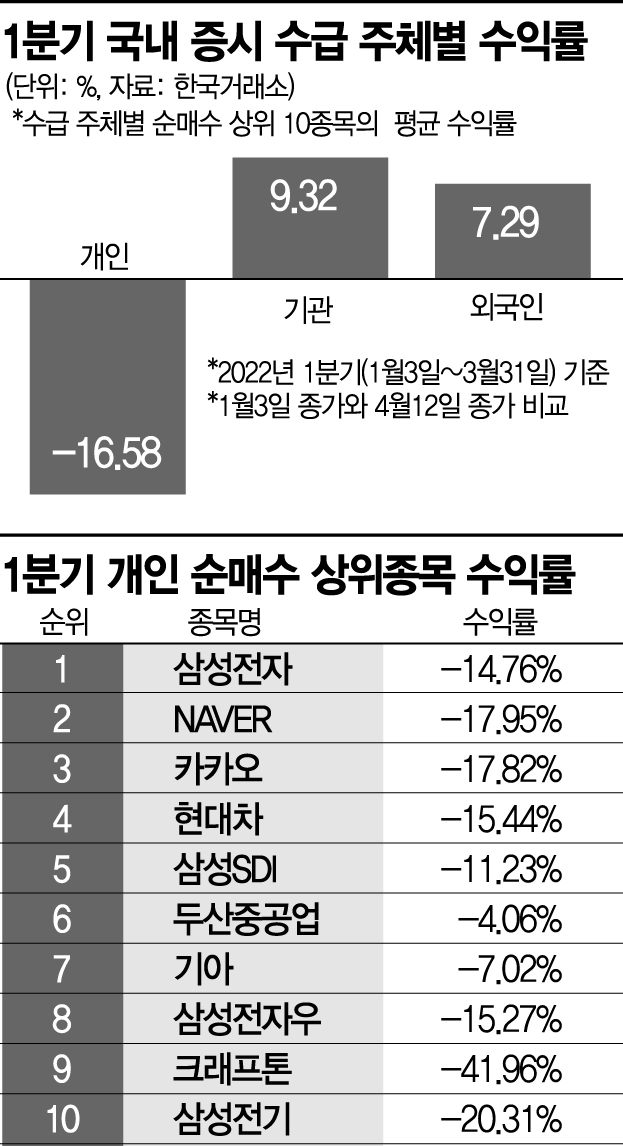
The gap in returns is pointed out to be due to individual investors' lower access to information and analytical capabilities compared to institutions. Hwang Sewoon, Senior Research Fellow at the Korea Capital Market Institute, explained, "It is difficult for individuals to beat institutions and foreigners who make investment decisions systematically based on pre-set criteria," adding, "The domestic stock market shows a pattern where individuals buy stocks sold by institutions and foreigners, and institutions and foreigners buy stocks sold by individuals." In fact, among the top 10 stocks net-sold by institutions in the first quarter, five stocks (Samsung Electronics, Doosan Heavy Industries, Krafton, Kia, Hyundai Motor) were included in the top 10 net-purchased stocks by individuals. The top 10 stocks net-sold by institutions showed an average return of -12.78%.
There is also analysis that the short-term trading tendency of individuals is a cause of low returns. Investing with only immediate profits in mind carries a high risk of losses. Kim Minki, Research Fellow at the Korea Capital Market Institute, stated in a report published in February, "(Individual investors) were more than twice as likely to sell stocks that had risen in price than those that had fallen," and "the disposition effect was confirmed in individual investor transactions." The disposition effect refers to the tendency to quickly realize gains but delay realizing losses. This effect mainly appears in investors with little experience or in stocks that are difficult to value, and investors with a strong disposition effect tend to have poor performance. Research Fellow Hwang advised, "Since the possibility of a price uptrend reversal this year seems low, a long-term approach is necessary."
Meanwhile, in the first quarter, individuals showed the only net buying trend among market participants by purchasing a total of 14.21 trillion KRW worth of stocks across the KOSPI and KOSDAQ markets. In contrast, foreigners and institutions net-sold 7.596 trillion KRW and 6.558 trillion KRW, respectively.
© The Asia Business Daily(www.asiae.co.kr). All rights reserved.
![Clutching a Stolen Dior Bag, Saying "I Hate Being Poor but Real"... The Grotesque Con of a "Human Knockoff" [Slate]](https://cwcontent.asiae.co.kr/asiaresize/183/2026021902243444107_1771435474.jpg)

















