[Seoul District News] Geumcheon-gu Siheung 5-dong Complex Center with 2 Basement to 6 Above-Ground Floors Applies Passive and Active House Methods for Future-Oriented Eco-Friendly Building · Haenggung Village Small Library, Shared Kitchen, and Expanded Resident Shared Spaces ... Nowon-gu Improves Environment Around Seokgye Station ... Songpa-gu Transforms Pungnap Underground Passage into Historical Exhibition Hall by June, Linked with Pungnapdong Fortress and Songpa Dullegil Season 2 ... Dongdaemun-gu Operates Jungnangcheon Park Golf Course with 9 Holes, 3 Bunkers, Shade Tents, and Benches until November.
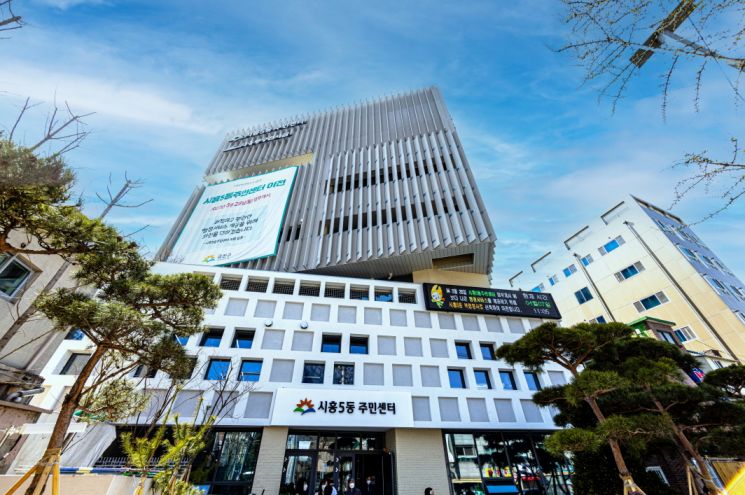
[Asia Economy Reporter Park Jong-il] Geumcheon-gu (Mayor Yoo Seong-hoon) is completing the construction of the long-awaited Siheung 5-dong Complex Office and will hold a completion ceremony at 2 p.m. on the 15th.
The district office building, built in 1988, had old facilities, limited space, and was located on a back road, causing inconvenience to residents.
The newly constructed ‘Siheung 5-dong Complex Office’ is a new-concept complex facility where culture, administration, and welfare services can be enjoyed in one place. Located at 6, Geumha-ro 24-gil, it was built on a site of 763.7㎡ with a total floor area of 3,057.9㎡, spanning two basement floors and six above-ground floors.
The main facilities include ▲basement floors 1-2 parking lot ▲1st floor Haenggung Village Small Library, shared kitchen ▲2nd floor Integrated Civil Service Office ▲3rd floor Fitness Center ▲4th floor Residents’ Autonomy Association Office, Volunteer Camp, Lecture Room ▲5th floor Auditorium and Multipurpose Room ▲6th floor Siheung Haenggung Exhibition Hall.
In particular, the 6th floor Siheung Haenggung Exhibition Hall is designed to promote ‘Siheung Haenggung,’ a historical and cultural resource, as a tourist attraction and to create an educational environment for Geumcheon’s history and culture.
The 1st floor Haenggung Village Small Library operates from 9 a.m. to 6 p.m. on weekdays. The 3rd floor Fitness Center is currently closed to prevent the spread of COVID-19 but may reopen depending on future pandemic conditions. The 6th floor Siheung Haenggung Exhibition Hall is scheduled to open in early July after interior construction is completed.
Additionally, the Siheung 5-dong Complex Office is a future-oriented eco-friendly public building applying the ‘Passive-Active House Construction Method,’ which minimizes energy waste and actively utilizes natural energy. It is expected to receive Passive House and Green Building certifications as well as an energy efficiency rating.
Yoo Seong-hoon, Mayor of Geumcheon-gu, said, “The old and cramped Siheung 5-dong Community Center had many demands from residents for autonomy hall programs and community spaces,” adding, “Going forward, the Siheung 5-dong Complex Office will be a community hub space where village, welfare, and administration harmonize, and it will become a landmark of future-oriented eco-friendly architecture.”
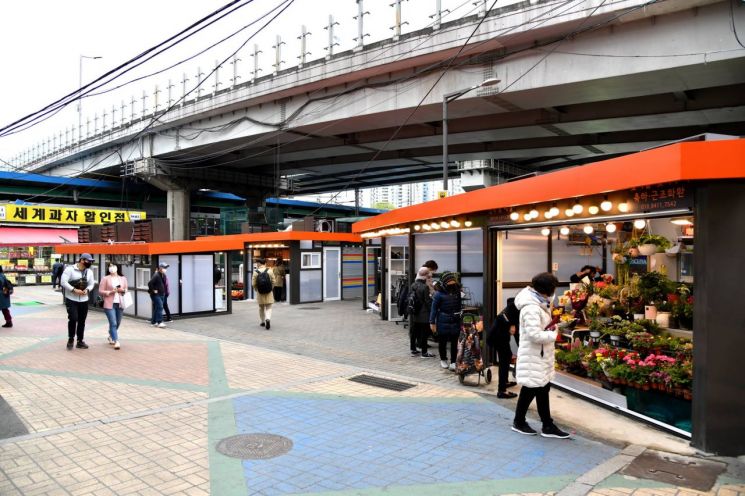
Nowon-gu (Mayor Oh Seung-rok) announced that the Seokgye Station area has been transformed into a safe and pleasant pedestrian-friendly street through an environmental improvement project targeting old street vendors (street stalls).
Seokgye Station is a transfer station where subway lines 1 and 6 intersect and serves as a major stop for city buses, village buses, and intercity buses, acting as a transportation gateway into Seoul from nearby Uijeongbu, Byeollae, and Galmae areas.
Due to the high foot traffic, street vendors were densely located around the station, but aging facilities posed fire risks and caused unpleasant odors and various trash, detracting from the cityscape and prompting continuous complaints for environmental improvements.
Since 2020, the district has established design and basic plans for street vendor improvements around Seokgye Station and conducted several negotiations with street vendor operators to proceed with the improvement project. In December last year, an implementation agreement was signed with the street vendor association to maintain and repair facilities and uphold hygiene and cleanliness, accelerating the project.
First, 19 street vendor locations were divided into three sections for the improvement project. Polluted tents and vinyl coverings, which were the biggest factors harming the urban landscape, were removed and replaced with easy-to-maintain polycarbonate and zinc panel materials. The disorderly shops were unified with a 2.6m height and orange roof exterior, creating a sleek image, and deodorizing devices were installed to reduce odors.
Some exposed water pipes were buried underground, and gas pipes exposed on walkways were connected to a shared LP gas storage box, preventing safety accidents and improving the pedestrian environment.
Old fences around subway exit 1 were replaced, and uneven pavement blocks were leveled to enhance pedestrian safety. To prevent flooding caused by trash such as discarded cigarette butts in rainwater drains, 100 rainwater drains around Seokgye Station were dredged, and anti-adhesion sheets were installed on 12 street lamps and utility poles along the road to prevent illegal advertisements.
The district plans to continuously maintain the environment by assigning manpower such as self-support workers to unauthorized dumping areas around Seokgye Station.
Oh Seung-rok, Mayor of Nowon-gu, said, “The environmental improvement project around Seokgye Station has created a safe walking environment and a pleasant commercial area,” adding, “We will continue to improve street vendors and others under the values of coexistence and mutual growth.”
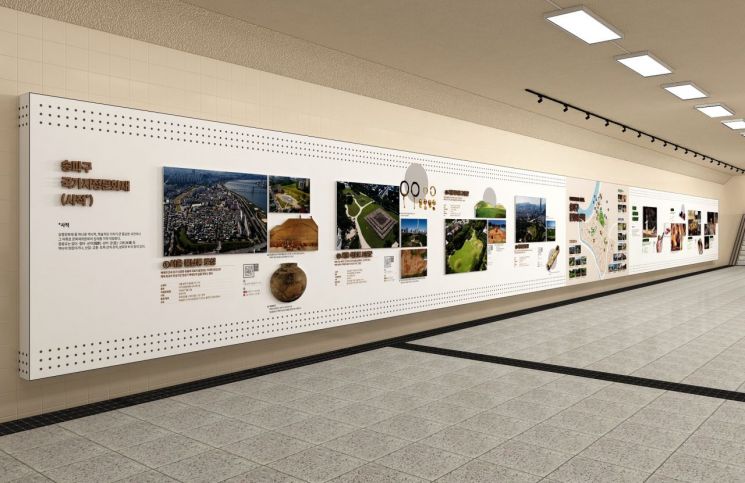
Songpa-gu (Mayor Park Seong-su) is transforming the bleak Pungnap Underpass (346 Pungnap-dong) into a historical and cultural space for residents.
Park Seong-su, Mayor of Songpa-gu, said, “The Pungnap Underpass had become less frequented due to old facilities and a bleak atmosphere, so improvement was urgent,” adding, “Especially considering the recent increase in visitors to Pungnap Fortress due to the creation of the Songpa Dullegil trail and the nearby middle school, the underpass will be decorated as a ‘Historical Exhibition Room Reflecting Songpa Dullegil.’”
Accordingly, the district will transform the Pungnap Underpass into a historical exhibition room by June. This is part of ‘Songpa Dullegil Season 2,’ linking major local attractions such as Pungnap-dong Fortress with the Songpa Dullegil trail.
The district plans to install major tangible and intangible cultural heritage and historical exhibits of Songpa-gu in the Pungnap Underpass to add historical and cultural significance of the Hanseong Baekje period to the Songpa Dullegil trail.
The historical exhibition room will feature a photo zone using a model of Pungnap-dong Fortress and a photo exhibition space for resident submissions. Exhibition panels will introduce four major nationally designated cultural properties (historic sites) in Songpa-gu, including Mongchon Fortress and Bangi-dong Ancient Tombs, as well as major intangible cultural heritage such as Songpa Sandae Nori and Hwahaejang to residents.
Before the full-scale creation, on the 22nd of last month, Mayor Park Seong-su visited the site to check the smooth progress of the project. Nearby residents from Pungnap 1 and 2-dong also participated to share future plans.
Mayor Park Seong-su said, “Once the historical exhibition room is completed, anyone walking the Songpa Dullegil will be able to easily feel the breath of the Baekje Hanseong period,” adding, “We will faithfully carry out the Songpa Dullegil Season 2 project to promote the diverse history, culture, and charm of Songpa-gu.”
As a key project of the 7th local government, Mayor Park opened the previously disconnected 50-year section of Tancheon Stream on July 1 last year, completing four courses totaling 21 km of the Songpa Dullegil trail. Since then, the ‘Songpa Dullegil Season 2’ project has been underway to connect local attractions such as Ogeum Park, Olympic Park, Pungnap Fortress trails, Wirye Human Ring, Namhansanseong, and traditional markets to the trail.
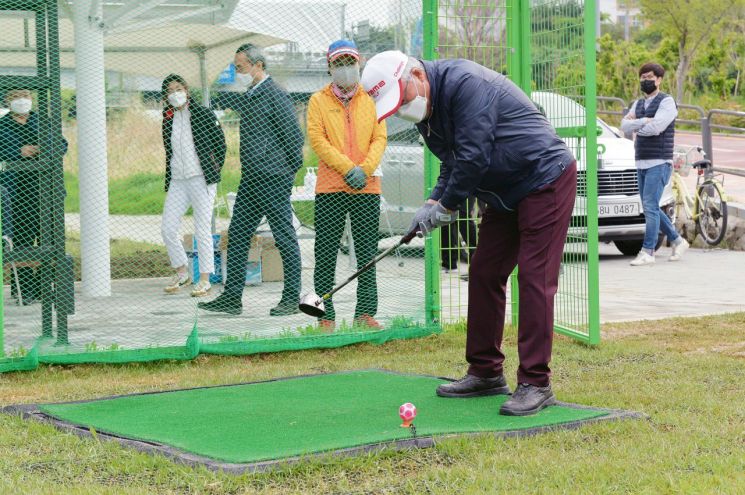
Dongdaemun-gu (Mayor Yoo Deok-yeol) has opened the Jungnangcheon Park Golf Course located at Jungnangcheon 1st Sports Park near Gunja Bridge.
The district conducted a pilot operation in 2021 and began full operation in April this year.
The Jungnangcheon Park Golf Course covers an area of 20m by 250m, featuring 9 holes, 3 bunkers, 1 practice hole, equipment racks for bags, drinking fountains, portable toilets, shade structures, and benches.
To meet residents’ steady interest in park golf, the practice area and rest space were recently expanded.
Additionally, a Park Golf Life Sports Class has been established, inviting professional instructors to provide free basic lessons every Thursday morning. Applications for the Park Golf Life Sports Class can be made on the 10th of each month (Saturdays, Sundays, or the next working day if a holiday) through the Dongdaemun-gu Sports Center on a first-come, first-served basis.
The Jungnangcheon Park Golf Course operates from April to November to protect the grass during winter and can be used by making a reservation in advance through the Dongdaemun-gu integrated reservation site.
Yoo Deok-yeol, Mayor of Dongdaemun-gu, said, “I hope the Jungnangcheon Park Golf Course will contribute to the popularization of park golf and be loved by residents as a space where they can enjoy exercise while feeling nature in the city.”
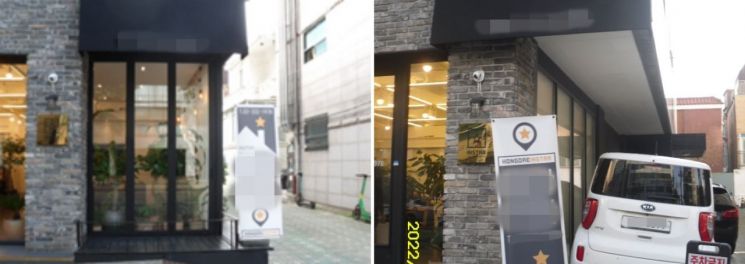
Mapo-gu (Mayor Yoo Dong-gyun) announced that it will conduct a full inspection of building-attached parking lots over four months from April to July to check for violations of related laws.
This year’s regular inspection targets 6,093 buildings and 57,166 parking spaces across nine neighborhoods including Gongdeok-dong, Yonggang-dong, and Sinsu-dong.
The district plans to verify whether building owners are using attached parking lots for purposes other than parking or failing to maintain their original function, aiming to help alleviate alley parking difficulties and prevent safety accidents.
The inspection items include ▲illegal change of use of attached parking lots ▲maintenance of parking lot functions ▲installation and management of CCTV in stacked parking lots with more than 30 spaces ▲compliance with regular inspections of mechanical parking devices.
Depending on the inspection results, minor violations will be corrected on-site, while serious violations such as unauthorized use changes or failure to maintain functions will receive prior notices to restore the parking lots to their original state. After a first correction order and a second correction urging, a third violation will result in prosecution and imposition of enforcement fines, and the building will be managed as an illegal structure.
Even if restoration is made after enforcement fines are imposed, payment is still required, and the obligation to pay enforcement fines is not waived even after criminal prosecution.
A district official said, “We will do our best to ensure that the original parking lot functions are maintained by identifying illegal use changes such as converting parking lots into warehouses or business spaces,” adding, “Since closing entrances or storing items in parking lots directly relates to safety, we ask building owners to check and maintain their parking lots diligently.”
© The Asia Business Daily(www.asiae.co.kr). All rights reserved.
![User Who Sold Erroneously Deposited Bitcoins to Repay Debt and Fund Entertainment... What Did the Supreme Court Decide in 2021? [Legal Issue Check]](https://cwcontent.asiae.co.kr/asiaresize/183/2026020910431234020_1770601391.png)

















