Targeting 48 Countries Including Korea and the United States
[Asia Economy Reporter Kim Jin-ho] Just four days after McDonald's announced the temporary closure of all its stores in Russia to condemn Russia's full-scale invasion of Ukraine, a company filed a trademark application similar to the McDonald's trademark in Russia. Another applicant also filed a trademark application for the McDonald's name written in Cyrillic script, and there was even an attempt to file a trademark under the name McDuck.
As Russia announced it would stop protecting the intellectual property rights of nationals from unfriendly countries in response to Western economic sanctions, 4,800 patents and trademarks held by South Korean nationals are at risk of unauthorized use. In fact, trademark applications similar to those of brands from unfriendly countries continue to be filed, and as the damage to rights holders is becoming a reality, voices are emerging that the government should proactively consider legal and diplomatic responses.
According to the Korea Intellectual Property Research Institute on the 11th, Russia announced the list of foreign countries taking unfriendly measures against the Russian Federation, corporations, and individuals through Federal Government Resolution No. 430-p6 last month. The unfriendly countries include a total of 48 countries, including South Korea, the United States, and Japan.
The gist of the resolution includes special economic sanctions, temporary economic measures, export controls against unfriendly countries, and the use without consent or compensation of inventions, utility models, and industrial designs owned by owners from unfriendly countries.
The Intellectual Property Research Institute pointed out, "The resolution includes adjusting the compulsory license compensation for patent holders to 0%," adding, "This is an issue where immediate infringement of patent holders' property rights can occur."
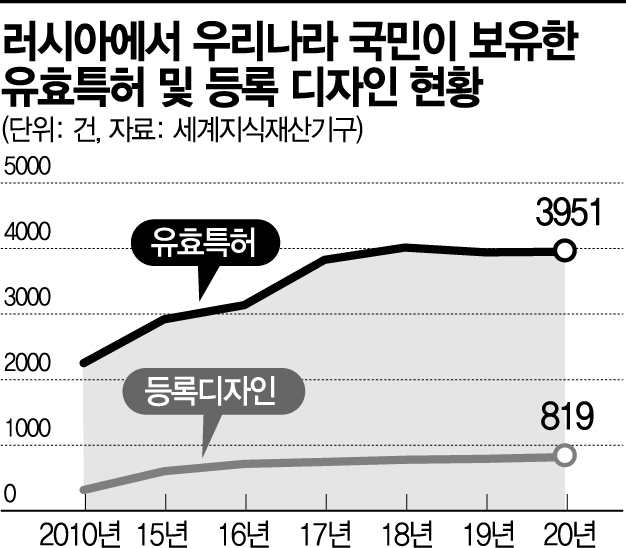
According to the World Intellectual Property Organization (WIPO), as of 2020, there were 3,951 valid patents and 819 registered trademarks held by South Korean nationals in Russia. If Russia's intellectual property sanctions become full-fledged, the intellectual property rights of South Korean nationals are highly likely to be infringed.
The institute predicted that measures to abolish protection such as unauthorized use of intellectual property rights might continue even after the Ukraine crisis. This is because the Russian government is continuing to discuss additional legal measures that weaken foreign intellectual property protection, including the seizure of assets owned by foreign companies leaving Russia.
In fact, lawsuits for damages against those who have unauthorizedly used characters (trademarks) of trademark holders from unfriendly countries in Russia have been dismissed, and applications for trademarks similar to brands from unfriendly countries continue to be filed.
The Intellectual Property Research Institute expressed deep concern especially about the 'zero guarantee of compulsory license' measure for rights holders from unfriendly countries (Resolution No. 299). This measure applies a 0% compensation rate based on the actual profits of the licensee from exercising intellectual property rights for compulsory licenses of patents, utility models, and industrial designs. It can be considered not only a violation of individual property rights but also legally as expropriation of foreign property. It is tantamount to the Russian government effectively 'confiscating' the intellectual property rights of nationals from unfriendly countries.
Jeon Jeong-hwa, Associate Research Fellow at the Global Legal Policy Research Office of the Intellectual Property Research Institute, said, "We need to closely examine the legal issues of the resolution and explore what responses our government can take," and suggested, "It is necessary to focus on whether there is a violation of the 'compulsory license' from the intellectual property law perspective and whether there is a violation of 'international agreements' from the international law perspective."
Furthermore, the institute advised that individuals or companies who have filed or hold intellectual property rights in Russia should devise necessary countermeasures themselves.
First, it was suggested to strengthen portfolios by filing additional intellectual property rights in countries neighboring Russia or important Russian trade partners to prevent infringing products produced in Russia from entering other overseas markets. It also emphasized the need to review the legality and feasibility of paying fees to maintain intellectual property rights within Russia.
For multinational corporations and non-Russian companies, since there is a possibility of illegal reproduction of intellectual property and asset confiscation, it was advised to establish plans to respond or evaluate the legal and economic environment of ongoing businesses.
© The Asia Business Daily(www.asiae.co.kr). All rights reserved.
![Clutching a Stolen Dior Bag, Saying "I Hate Being Poor but Real"... The Grotesque Con of a "Human Knockoff" [Slate]](https://cwcontent.asiae.co.kr/asiaresize/183/2026021902243444107_1771435474.jpg)
















