Baesuyi Jin Jin "Not attached to position, will not avoid responsibility"
Inside Prosecution "Bill to abolish Prosecution Office... Clear intention to block investigation"
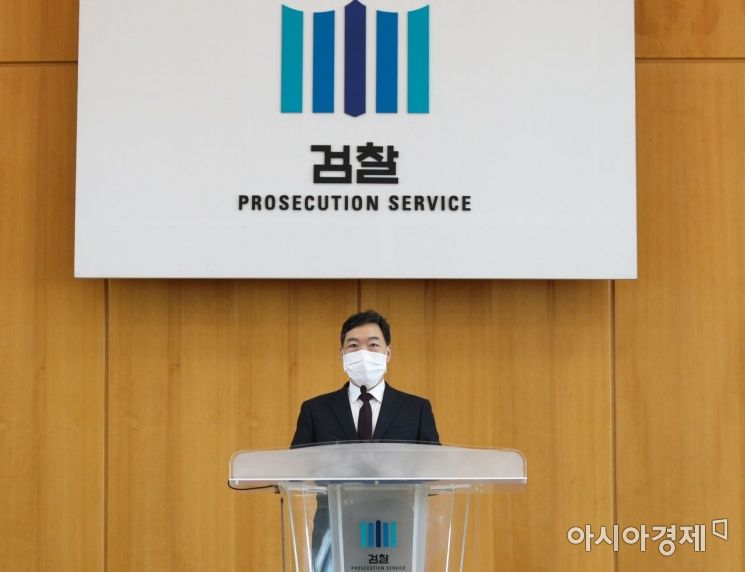 Prosecutor General Kim Oh-soo is delivering a keynote speech at the National Chief Prosecutors' Meeting held at the Supreme Prosecutors' Office in Seocho-gu, Seoul on the 11th. Photo by Kim Hyun-min kimhyun81@
[Asia Economy Reporters Heo Kyung-jun, Kim Dae-hyun] Prosecutor General Kim Oh-soo has taken a last stand, declaring he will resign if the so-called ‘Geomsu Wanbak (Complete Removal of Prosecutorial Investigation Authority)’ bill, promoted by the Democratic Party of Korea, is passed.
On the 11th, at a meeting of 18 district prosecutors’ offices held at the Supreme Prosecutors’ Office, Prosecutor General Kim said, "If the prosecutorial investigation function is abolished, there is no longer any meaning for me as Prosecutor General to perform my duties," adding, "I will not cling to my position and will not hesitate to take any responsibility."
He further emphasized, "If the prosecution is unable to conduct investigations, criminals will not be properly punished and victims’ suffering will increase," and "The response to serious crimes such as corruption, corporate, economic, and election crimes will be paralyzed, case processing will be delayed, and the public will suffer more inconvenience. Ultimately, the prosecutorial system will become hollowed out and can no longer be called the prosecution under our Constitution."
Before attending the meeting, Daejeon District Prosecutor No Jeong-hwan told reporters, "Geomsu Wanbak undermines the spirit and values of the Constitution," explaining, "The Constitution grants prosecutors the core investigative powers such as arrest, detention, and the authority to request search and seizure warrants. This means the Constitution commands that investigative agencies be operated centered on the prosecution across legislative, judicial, and executive branches."
Line prosecutors also held meetings at various district and branch prosecutors’ offices, voicing criticism of the Democratic Party’s Geomsu Wanbak bill. Since the Supreme Prosecutors’ Office officially announced its opposition to the bill on the 8th, posts criticizing the bill abolishing prosecutorial investigative authority have continuously appeared on internal prosecution bulletin boards, with senior and rank-and-file prosecutors from Seoul Central District Prosecutors’ Office, Suwon District Prosecutors’ Office, Daejeon District Prosecutors’ Office, Daegu District Prosecutors’ Office, Gwangju District Prosecutors’ Office, and others holding meetings.
Deputy Chief Prosecutor A said, "It is effectively a bill to abolish the Prosecutors’ Office," and criticized, "According to the Democratic Party’s bill, even investigators can no longer be called investigators. Corruption crimes will run rampant; who exactly benefits from this bill?"
He added, "Isn’t the intention clearly to block investigations? Even during former President Roh Moo-hyun’s time, a special judicial reform committee was formed to discuss this, but changing the judicial system like this is unacceptable," he stressed.
Chief Prosecutor B pointed out, "This is an abuse of political power," and warned, "It is a de facto illegal act, and the entire national system will collapse."
He continued, "Entrusting investigations entirely to the police is practically impossible. The police are already overwhelmed with cases, so their ability to investigate corruption crimes will inevitably decline," raising his voice, "Is it reasonable to create a bill that will cause problems?"
Meanwhile, Justice Minister Park Beom-gye expressed a position effectively supporting the Geomsu Wanbak bill on the same day. While arriving at the Ministry of Justice Gwacheon building, he said, "I think the core issue of Geomsu Wanbak is the fairness of prosecutorial investigations," adding, "Seeing the Prosecutor General and even prosecutors from the Ministry of Justice’s prosecution bureau respond publicly and in unison, I wonder why they do not raise their voices in unison for good and fair investigations."
He also stated, "Fairness is a priority before the system. This is not a matter of discussing fairness as an ‘afterthought’ after actions have been taken," and criticized, "Just as judicial independence exists as a means for judges to conduct good trials, good investigations are essential for prosecutors, and the discussion is about the means to achieve that. The subject and object have been reversed."
© The Asia Business Daily(www.asiae.co.kr). All rights reserved.

















