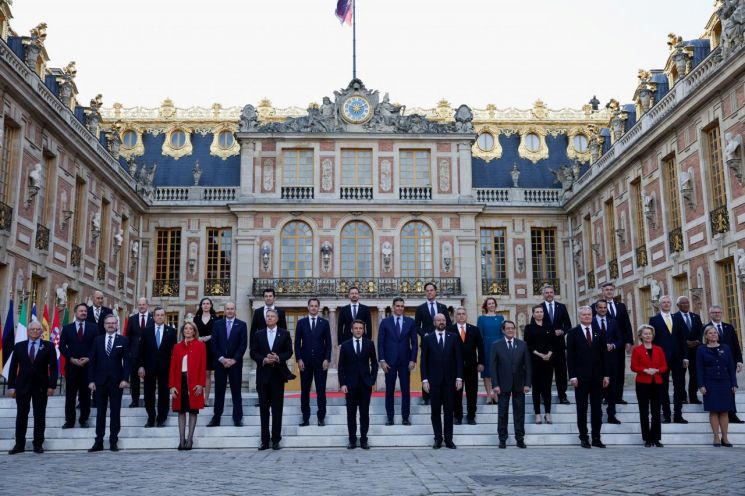
[Asia Economy Reporter Cho Hyun-ui] European Union (EU) member states are set to begin serious discussions on this week's sanctions against Russian crude oil. Following last week's decision to gradually halt purchases of Russian coal, attention is focused on whether dependence on Russian crude oil can also be reduced.
The Wall Street Journal (WSJ) reported on the 10th (local time) that "EU officials are working to focus the next round of economic sanctions against Russia on crude oil." A proposal to ban imports of Russian crude oil is scheduled to be on the agenda at the EU foreign ministers' meeting on the 11th.
The EU is reportedly considering measures such as gradually reducing imports of Russian crude oil, imposing additional tariffs, and depositing crude oil payments into separate accounts instead of paying the Russian government directly.
According to the European think tank Bruegel, as of November last year, EU member states imported Russian energy worth 800 million euros per day (approximately 1.067 trillion KRW). Russian crude oil accounted for one-quarter of the EU's total imports in the first half of last year.
There are still disagreements within the EU regarding sanctions on Russian crude oil. Some member states are reportedly concerned that if a ban on Russian crude oil is implemented, a sharp rise in energy prices could provoke voter anger.
The French presidential election is also cited as a factor hindering progress in discussions on banning Russian crude oil. WSJ analyzed, "Some EU officials are reluctant to rush discussions until the presidential election ends on the 24th due to concerns about its impact on the French election," adding, "It does not appear that discussions will be concluded soon."
Currently, Eastern European countries such as Poland advocate for a ban on Russian crude oil, while Germany, the EU member with the largest economy, opposes such a ban. Viktor Orb?n, the Hungarian Prime Minister who recently secured re-election, also opposes it.
Mustafa Rahman of the think tank Eurasia Group said, "It will be difficult for the EU to reach an easy agreement," but added, "There is a growing atmosphere that the EU must take action against Russian crude oil."
The United States announced on the same day that it would assist Europe's efforts to reduce dependence on Russian crude oil and gas. White House National Security Advisor Jake Sullivan said in a media interview, "Europe is discussing ways to move away from Russian crude oil," adding, "However, it is not reasonable for Europe to immediately stop importing Russian fuel."
© The Asia Business Daily(www.asiae.co.kr). All rights reserved.
![Clutching a Stolen Dior Bag, Saying "I Hate Being Poor but Real"... The Grotesque Con of a "Human Knockoff" [Slate]](https://cwcontent.asiae.co.kr/asiaresize/183/2026021902243444107_1771435474.jpg)
















