Webzen labor-management talks break down, strike declared
Major game companies raise wages by up to 20 million won
Gap with small and medium firms reaches 100 million won
[Asia Economy Reporter Seungjin Lee] As Webzen's labor union has decided to strike demanding a salary increase?the first strike in the gaming industry?small and medium-sized game companies, which have failed to raise salaries again this year following last year, are on high alert.
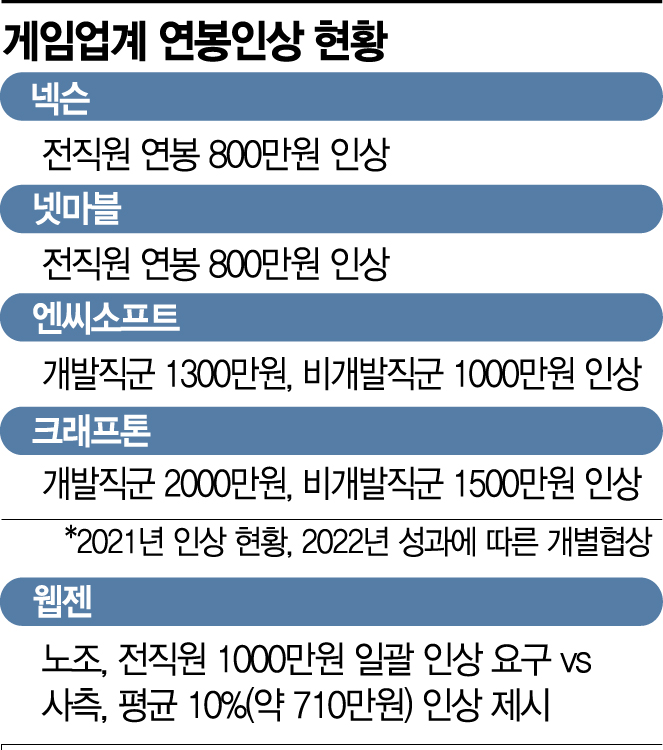
On the 11th, the Webzen branch of the Korean Confederation of Trade Unions (KCTU) Textile and Food Workers' Union held a strike vote with 92.8% of union members participating, and the strike was approved with more than two-thirds in favor. In the wage negotiations held on December 22 last year, the Webzen union demanded a uniform increase of 10 million KRW, but the company proposed an average 10% increase (about 7.1 million KRW) with differential payments based on performance. After a mediation process, the union proposed a compromise of an average 16% increase and a one-time payment of 2 million KRW, but ultimately the parties failed to narrow their differences and declared the breakdown of negotiations in early last month.
Starting with Nexon in 2020, major game companies such as Netmarble, NCSoft, and Krafton have implemented salary increases of up to 20 million KRW per developer. To prevent losing key developers, game companies have engaged in a 'salary increase chicken game,' widening the salary gap with small and medium-sized game companies. According to a recent survey by JobKorea targeting employees working at small and medium game companies, the average salary gap with large game companies reaches up to 100 million KRW.
Small and medium game companies fear that strong wage increase demands will continue as a ripple effect of the Webzen union strike. A representative from a mobile game developer said, "With the ongoing manpower shortage due to a lack of developers, the salary increases by large game companies have further intensified the manpower shortage for small and medium companies," adding, "We do not have the capacity to raise salaries by more than 10 million KRW at once like the large game companies."
Companies that have already concluded salary negotiations are also experiencing heightened tension. This is because a significant salary increase inevitably leads to a decrease in operating profit. The operating profit margins of Netmarble, NCSoft, and Krafton decreased by an average of 9 percentage points from 2020 to 2021. The impact of rising labor costs on operating profits is even greater for small and medium game companies, which find it difficult to release major new games due to increased personnel expenses.
An industry insider said, "Last year, we significantly raised the salaries of all employees and wrapped up this year’s negotiations through individual performance-based discussions, but calls for salary increases continue," adding, "The chicken game will continue."
© The Asia Business Daily(www.asiae.co.kr). All rights reserved.
![Clutching a Stolen Dior Bag, Saying "I Hate Being Poor but Real"... The Grotesque Con of a "Human Knockoff" [Slate]](https://cwcontent.asiae.co.kr/asiaresize/183/2026021902243444107_1771435474.jpg)
















