 The cyber diplomatic mission VANK has launched a global campaign to prevent Japan's historical distortion.
 [Photo by Cyber Diplomatic Mission VANK Official Blog Capture]
[Asia Economy Reporter Hwang Sumi] As Japan's historical distortion worsens, the cyber diplomatic mission VANK has launched a global campaign to stop it.
On the 9th, VANK announced via social networking services (SNS) that the textbooks to be used by Japanese high school students in their second year and above from next year are filled with distorted historical content.
Earlier, Japan's Ministry of Education, Culture, Sports, Science and Technology announced on the 29th of last month at the textbook screening committee meeting that 239 types of textbooks passed the screening. However, according to Yonhap News, some history textbooks deleted or modified expressions such as "forcibly taken" regarding Korean laborers during the Japanese colonial period during the screening process.
Regarding Dokdo, expressions were used claiming it as Japan's inherent territory or that Korea is illegally occupying it. This appears to reflect the Japanese government's unjust claim of sovereignty over Dokdo. Furthermore, the term "military comfort women," which appeared in the Kono Statement where the Japanese government officially acknowledged and apologized for the issue of Japanese military comfort women in 1993, also disappeared.
In this regard, VANK criticized, "Even in textbooks that greatly influence Japanese youths' historical and worldviews, the history of invasion is denied, and lies are taught as facts."
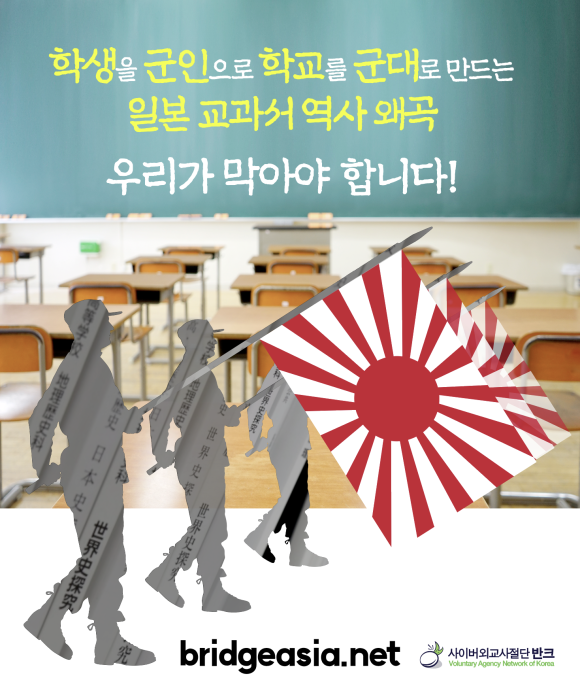
They also produced and released a poster exposing Japan's historical distortion to the international community. The poster titled "Turning students into soldiers, schools into armies: We must stop Japan's textbook historical distortion" features a soldier holding the Rising Sun flag against the backdrop of a high school classroom.
This warns that Japanese youths who see distorted invasion history textbooks in high school classrooms could become soldiers invading neighboring countries.
The poster has been uploaded to overseas photo-sharing sites and can be downloaded and used by anyone. At the bottom of the poster is a global petition address (bridgeasia.net) informing the world that Japan's textbook historical distortion could pose a serious threat to peace in Asia.
VANK emphasized, "The Japanese government is trying to transform schools and youths into armies and soldiers through textbooks to revive imperialist invasion history in the 21st century," and "Japan's historical distortion must be exposed to the international community and stopped at all costs."
Meanwhile, Japan's tendency to distort history seems to be intensifying. Previously, the Japanese government attempted to register Sado Mine, a site of forced mobilization of Koreans during the Japanese colonial period, as a UNESCO World Cultural Heritage site, claiming it has cultural value.
On the 28th of last month, it was belatedly revealed that Japan's Ministry of Foreign Affairs created a video advertising the Rising Sun flag and uploaded it to its official YouTube channel, sparking controversy. The video, released in October last year, described the Rising Sun flag used by Japan during World War II and the Pacific War as 'a part of Japanese culture and a symbol of prosperity and vitality,' 'a traditional culture passed down over hundreds of years.'
© The Asia Business Daily(www.asiae.co.kr). All rights reserved.
![User Who Sold Erroneously Deposited Bitcoins to Repay Debt and Fund Entertainment... What Did the Supreme Court Decide in 2021? [Legal Issue Check]](https://cwcontent.asiae.co.kr/asiaresize/183/2026020910431234020_1770601391.png)