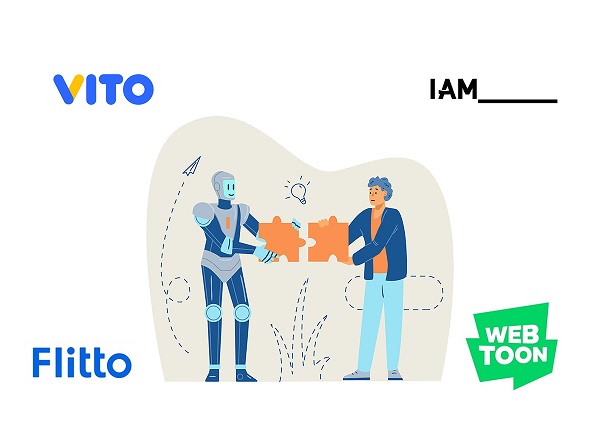
[Asia Economy Reporter Donghyun Choi] Artificial intelligence (AI) technology is drawing attention as it easily solves tasks in our daily lives that are cumbersome and time-consuming.
The call app 'VITO,' operated by AI startup 'ReturnZero,' automatically converts call recordings into text and displays them like a chat for easy at-a-glance review.
VITO provides its service through the 'Somers Engine,' an STT (Speech To Text) technology developed in-house that converts call audio into text, and the 'Moses Engine,' which analyzes the user's voice to separate speakers.
It is popular not only among ordinary people who want to review call contents but also among office workers with many business calls, real estate agents, lawyers, and other professionals for whom verbal contracts, appointments, and contextual records with call counterparts are important.
Users can check the converted chat content anytime within the app and replay only the desired parts of the call. They can save only the necessary audio segments or easily save and store the converted text content.
Additionally, with AI voice recognition technology, VITO supports a 'Call Preview' service that allows users to check previous call contents in text form before answering incoming calls. This feature enables users to quickly review past call history and text conversion records regardless of whether the caller's contact is saved, allowing for more thoughtful and prepared responses.
VITO recently enhanced readability through a service update. The call content text conversion now includes not only Korean characters but also numbers and English letters. Dates, times, addresses frequently appearing during calls, as well as unique unit expressions such as currency, weight, length, phone numbers, and account numbers, can now be clearly expressed using Korean, numbers, and English letters. Furthermore, the chat bubbles have been refined to allow users to intuitively distinguish call content more clearly.
Language data company 'Flitto' has built a large-scale translation database by collecting language data using its own translation platform. Based on this, it developed a machine learning-based AI translation engine.
Flitto launched a crowdsourced translation service in 2012 and has since expanded to professional and AI translation services. It supports translation in as many as 25 languages.
On Flitto's translation platform, users can request translations or participate directly in translations in various formats such as text, voice, image, and video. The AI-powered translation service provides immediate, highly accurate translation results based on abundant language data and allows users to view similar translations done by other translators.
Healthcare startup 'MonoLabs' operates 'I.M,' an AI-based personalized health supplement subscription service. MonoLabs uses AI algorithms to recommend and sell health supplements optimized for each individual and has been selected as a special regulatory exemption business for 'health supplement small-quantity sales.'
The I.M service analyzes an individual's health status to determine which nutrients are needed and recommends appropriate health supplements, eliminating the need for users to search or shop around. Through AI questionnaires on domestic online and offline channels, it analyzes health conditions and lifestyle habits, recommends necessary nutrients, and conveniently packages supplements in single packs for regular delivery.
Since the COVID-19 pandemic, I.M has received great response as a rational and efficient service that helps customers concerned about choosing and taking health supplements to conveniently consume only the necessary nutrients.
Naver Webtoon introduced the 'Webtoon AI Painter' as a beta service last year, which helps naturally color sketches according to context. Creators select colors and touch desired areas, and AI automatically distinguishes the necessary regions and applies color. Unlike the previous manual process, coloring can now be done with just a few touches, which is expected to significantly reduce the effort and time webtoon artists spend on coloring tasks.
The Webtoon AI Painter incorporates technologies developed and researched by Naver Webtoon over three years. Using deep learning, it trained on about 300,000 datasets to learn features of each image area such as faces, bodies, and backgrounds, as well as various coloring styles. Especially, it was developed to specialize in webtoon coloring through webtoon image learning, enabling clear and distinct expression even for unique drawing styles.
Additionally, features such as layer-separated PSD format saving for smooth post-editing by creators and original resolution preservation technology have been applied to enhance service completeness. Naver Webtoon plans to advance and launch services including automatic background generation and automatic character generation, starting with the Webtoon AI Painter.
© The Asia Business Daily(www.asiae.co.kr). All rights reserved.
![Clutching a Stolen Dior Bag, Saying "I Hate Being Poor but Real"... The Grotesque Con of a "Human Knockoff" [Slate]](https://cwcontent.asiae.co.kr/asiaresize/183/2026021902243444107_1771435474.jpg)
















