Greater Weight Fluctuations Increase Cardiovascular Disease and Mortality Risk
Same Trend Observed with Both Weight Gain and Loss
Occurs Across Underweight to Obese Individuals
[Asia Economy Reporter Chunhee Lee] A new perspective has been raised against the existing paradigm that has recommended weight loss for obese diabetic patients. It is argued that not only rapid weight gain but also rapid weight loss can increase the risk of cardiovascular disease.
Professor Hyungkwan Kim's team at Seoul National University Hospital (including fellow researcher Chansoon Park) and Professor Hangyung Do's team at Soongsil University recently published the results of a cohort analysis on the association between weight change and cardiovascular disease in 1,522,241 diabetic patients who underwent two comprehensive health checkups between 2009 and 2012.
Generally, diabetic patients are more prone to cardiovascular diseases such as myocardial infarction and stroke compared to the general population, and their mortality rates due to these conditions have also been higher. If obesity is present in addition, major risk factors for cardiovascular disease such as blood cholesterol levels, blood glucose concentration, and blood pressure can increase. Therefore, in clinical practice, weight loss has generally been recommended for obese diabetic patients. However, there has been no research to prove how much weight loss is appropriate or whether weight loss actually helps prevent cardiovascular disease.
Accordingly, the research team used data from the National Health Insurance Service to measure weight changes in 1,522,241 diabetic patients and categorized them into groups of ▲ weight loss of 10% or more ▲ weight loss of 5-10% ▲ stable weight (less than 5% change) ▲ weight gain of 5-10% ▲ weight gain of 10% or more. They then tracked the occurrence of myocardial infarction, stroke, atrial fibrillation, heart failure, and death over approximately seven years.
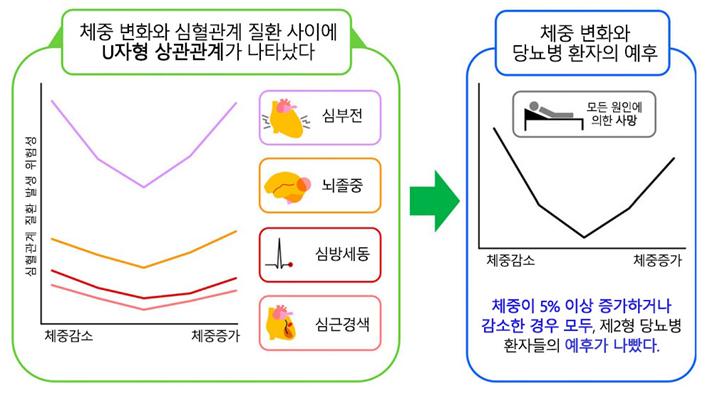
As a result, compared to the stable weight group, all groups with weight changes of 5% or more showed higher annual probabilities of cardiovascular disease occurrence and mortality. In particular, the group with weight changes of 10% or more showed a greater increase in the annual probability of cardiovascular disease occurrence and mortality compared to the 5-10% change group.
In other words, a U-shaped correlation was observed where the greater the degree of weight increase or decrease in patients, the higher the risk of cardiovascular disease and death.
Moreover, this correlation appeared regardless of the obesity level of diabetic patients. This consistent phenomenon was observed in patients ranging from underweight to normal weight, overweight, and obese. In other words, the degree of weight change was found to be more significantly involved in the occurrence of cardiovascular disease in diabetic patients than obesity level.
Professor Hyungkwan Kim stated, “This study is significant in that it revealed that both rapid weight gain and loss in diabetic patients increase the risk of cardiovascular disease, contrary to existing clinical guidelines,” adding, “Weight loss in obese diabetic patients should not be unconditionally viewed positively. When a patient loses weight, it is necessary to comprehensively review how blood glucose levels, dietary habits, and exercise methods are being managed, and whether other diseases have developed.”
This study was published online last month in ‘Diabetes Care (IF 19.112)’, the most authoritative medical journal in the field of endocrinology and metabolism.
© The Asia Business Daily(www.asiae.co.kr). All rights reserved.

















