As of the 8th, cumulative confirmed cases reach 14,983,694... About 3 out of 10 citizens have been confirmed with COVID-19
Government: "Omicron decline trend is becoming clear"
Omicron sub-lineage variants emerging one after another... Following dominant BA.2 variant, XE and XJ variants appear
Reinfection cases surge in the UK as well
Korea's Omicron variant reinfection rate is remarkably low at 0.0002%
Health authorities: "We will re-investigate suspected COVID-19 reinfection cases"
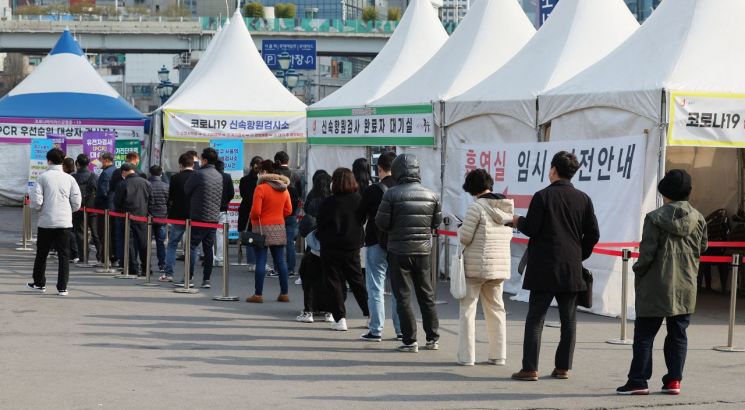 Citizens are waiting to get tested at the temporary COVID-19 screening clinic set up at Seoul Station Plaza.
 [Image source=Yonhap News]
[Asia Economy Reporter Yoon Seul-gi] As the number of COVID-19 confirmed cases has begun to decline gradually, an analysis suggests that about 3 out of 10 citizens have experienced COVID-19 infection, indicating a certain level of herd immunity, which is raising expectations for a return to normal life. However, the pandemic continues indefinitely as COVID-19 variants such as Omicron and Stealth Omicron continue to emerge one after another.
According to the Central Disease Control Headquarters, as of midnight on the 8th, the number of new COVID-19 confirmed cases increased by 205,333, bringing the cumulative total to 14,983,694. This is 19,487 fewer than the previous day (7th) with 224,820 cases, 74,916 fewer than a week ago on the 1st with 280,249 cases, and 134,134 fewer than two weeks ago on the 25th of last month with 339,467 cases.
The government considers the spread of COVID-19 to have entered a declining phase. Prime Minister Kim Boo-kyum stated at the Central Disaster and Safety Countermeasure Headquarters (CDSCH) meeting on the 8th, "The proportion of cases among the high-risk group aged 60 and over continues to rise. Accordingly, more than 1,000 severe cases continue to occur daily, so vigilance must never be relaxed," but also added, "The decline of Omicron is becoming certain."
The cumulative number of COVID-19 confirmed cases accounts for 28% of the total domestic population of 51,628,117, indicating that about 3 out of 10 Korean citizens have been infected with or are currently confirmed with COVID-19. Although there is no absolute standard for herd immunity, it is generally considered that herd immunity is formed when 70% of a group has antibodies.
In Korea, as of the 8th, the vaccination rates are 87.6% for the first dose, 86.7% for the second dose, and 64.0% for the third dose. Due to the rapid increase in confirmed cases caused by Omicron and subsequently Stealth Omicron (BA.2), about 1 in 3 citizens have a history of infection.
As the number of people with antibodies increases, expectations for the end of the pandemic are growing, but the problem lies with COVID-19 variants. The currently dominant strain in Korea is BA.2, a subvariant of the Omicron variant. While symptoms and severity after infection are not significantly different from the Omicron variant, it is characterized by a transmission rate 30% to 50% higher than Omicron. Additionally, the XE variant has appeared in the UK, and the XJ variant in Thailand. Both new variants are hybrid variants combining the Omicron variant and BA.2 variant, but their genetic compositions differ.
With the continuous emergence of COVID-19 variants, cases of reinfection with COVID-19 variants are also increasing overseas. According to the UK daily The Guardian, the UK Health Security Agency (UKHSA) recently reported that 804,463 reinfection cases were confirmed from April 2020 to March 20 of this year.
UKHSA also analyzed that 8,717 people were infected three times, 74 people four times, and there may be more reinfection cases beyond these. In the UK, as of December 2020, the first dose vaccination rate was 78.8%, the second dose 73.8%, and the third dose 58.0%, with a cumulative confirmed case count of 21,578,368 as of the 8th.
The Guardian explained the reasons for reinfection as ▲ emergence of variants ▲ waning immunity over time after infection ▲ relaxed regulations. The media stated, "COVID-19 infection protects against reinfection, but this protection weakens over time," adding, "The Omicron variant known as BA.2 has spread, and the more people infected with COVID-19, the larger the potential group for reinfection. Moreover, relaxed regulations have increased the likelihood of exposure to COVID-19."
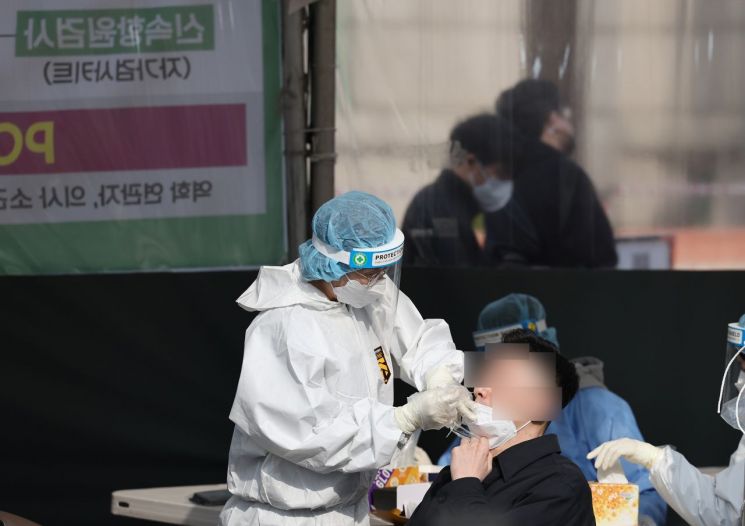 On the morning of the 25th of last month, a citizen visiting the temporary COVID-19 screening clinic at Seoul Station Plaza in Jung-gu, Seoul, is undergoing a rapid antigen test. [Image source=Yonhap News]
As concerns about possible reinfection with COVID-19 spread, the government also announced plans to re-investigate suspected reinfection cases. This is to re-examine whether there are any missed reinfection cases, as the reinfection rate of the Omicron variant in Korea (0.002%) is significantly lower than that of the Delta variant (0.034%).
Earlier, the Korea Disease Control and Prevention Agency (KDCA) stated on the 6th, "We are conducting a reinfection case re-investigation targeting about 9 million people for whom preliminary data preprocessing is possible, and after reviewing preliminary results, we plan to gradually expand the investigation target."
Meanwhile, the KDCA recognizes COVID-19 reinfection in two cases: first, when a PCR (polymerase chain reaction) test is positive 90 days or more after the initial confirmed date; second, when a PCR test is positive 45 to 89 days after the initial confirmed date with symptoms or contact with a confirmed case (or a history of overseas travel).
© The Asia Business Daily(www.asiae.co.kr). All rights reserved.
![User Who Sold Erroneously Deposited Bitcoins to Repay Debt and Fund Entertainment... What Did the Supreme Court Decide in 2021? [Legal Issue Check]](https://cwcontent.asiae.co.kr/asiaresize/183/2026020910431234020_1770601391.png)