Cases of 'Duplicate Responses in Opinion Polls via Call Forwarding' Newly Established in the 2016 Election Law
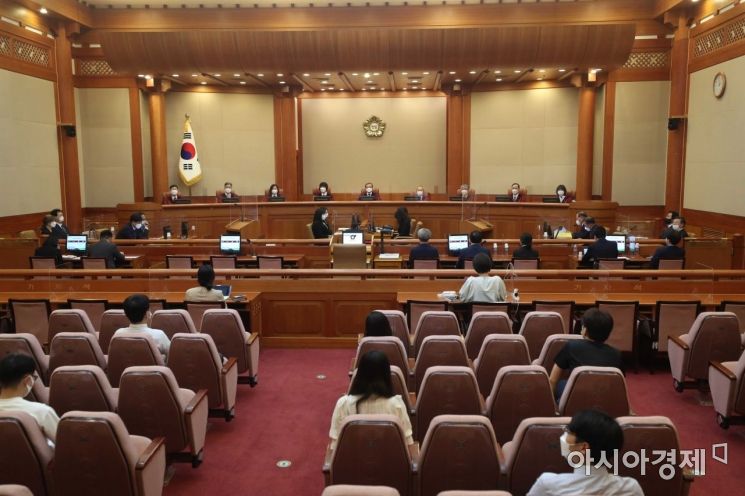
[Asia Economy Reporter Choi Seok-jin, Legal Affairs Specialist] The Constitutional Court has ruled that the provisions of the Public Official Election Act that restrict the voting rights of individuals who have been sentenced to a fine of 1 million won or more for election crimes, and that require individuals sentenced to a fine of 1 million won or more for election crimes to resign from local council positions, do not violate the Constitution.
The Constitutional Court announced on the 8th that in a constitutional complaint case filed by former Daegu Metropolitan City Council members Kim Byung-tae and Seo Ho-young, and Dong-gu district council members A and B of Daegu City, who were sentenced to a fine of 1 million won for violating the Public Official Election Act and whose sentences were finalized by the Supreme Court, claiming that Article 18, Paragraph 1, Subparagraph 3 and Article 266, Paragraph 1 of the Public Official Election Act infringe on their fundamental rights such as voting rights and the right to hold public office, the court dismissed the claim regarding Article 18, Paragraph 1, Subparagraph 3 by an 8 (dismissal) to 1 (acceptance) vote, upholding its constitutionality. Furthermore, the court unanimously upheld the constitutionality of Article 266, Paragraph 1 of the same law.
The petitioners, who were elected as Daegu City council members and Dong-gu district council members in the 7th nationwide simultaneous local elections held on June 13, 2018, were prosecuted and fined 1 million won for installing multiple call forwarding landline phones to assist Lee Jae-man, a former Supreme Council member and a pre-candidate for Daegu mayor from the Liberty Korea Party, and for responding multiple times to opinion polls.
Ultimately forced to resign from their city and district council positions, the petitioners filed a constitutional complaint on September 2, 2019, arguing that the phrase "election offenders" in Article 18, Paragraph 1, Subparagraph 3 of the Election Act?which stipulates that those sentenced to a fine of 1 million won or more for election crimes and whose sentences have not passed five years since finalization have no voting rights?violates their voting rights. They also claimed that the phrase "from Article 256, Paragraphs 1 to 3 of the Election Act" in Article 266, Paragraph 1?which restricts the right to hold public office for five years after a sentence of 1 million won or more is finalized for crimes under Article 256, Paragraph 1?violates their right to hold public office.
Article 256, Paragraph 1, Subparagraph 5 of the Election Act punishes those who respond to opinion polls in violation of Article 108, Paragraph 11, Subparagraph 2. Article 108, Paragraph 11, Subparagraph 2 prohibits "acts of causing the same person to respond two or more times to election-related opinion polls by call forwarding or similar measures involving two or more phone numbers, or instructing, encouraging, or inducing such acts."
The Constitutional Court first limited the scope of the review.
The petitioners argued the unconstitutionality of the entire "election offender" clause in Article 18, Paragraph 1, Subparagraph 3, which restricts voting rights of those sentenced to a fine of 1 million won or more for election crimes and whose sentences have not passed five years, or those sentenced to probation or imprisonment with specific time limits. However, the court limited the scope of review to the petitioners themselves, noting that they were individuals who committed election crimes under Article 256, Paragraph 1, Subparagraph 5 (multiple responses through call forwarding under Article 108, Paragraph 11, Subparagraph 2) and were sentenced to a fine of 1 million won or more with sentences finalized less than five years ago.
The court stated, "The voting restriction provisions are appropriate means to ensure fair elections, impose social sanctions on election offenders, and raise public awareness of election fairness."
It continued, "The election crime under Article 256, Paragraph 1, Subparagraph 5, specifically Article 108, Paragraph 11, Subparagraph 2, criminalizes acts of causing the same person to respond multiple times to election-related opinion polls by call forwarding or similar measures, or instructing, encouraging, or inducing such acts. Such conduct undermines the reflection of voters' true intentions in opinion poll results, threatening election fairness." The court emphasized, "To guarantee election fairness, restricting voting rights of those who commit crimes such as multiple responses through call forwarding is necessary."
Additionally, the court noted, "The voting restriction applies only to those sentenced to a fine of 1 million won or more for crimes such as multiple responses through call forwarding, with sentences finalized less than five years ago, thus limiting the scope and duration." It added, "When a court sentences a defendant to a fine of 1 million won or more, it implies a judgment that the defendant's conduct poses a high risk of undermining election fairness and that the defendant's voting rights should be revoked for a certain period."
In conclusion, the court stated, "The public interest in securing election fairness through voting restrictions outweighs the private interest of individuals deprived of voting rights. Therefore, the voting restriction provisions do not violate voting rights."
However, Justice Lee Sun-ae dissented, stating, "Excessive voting restrictions beyond what is necessary to achieve the purpose infringe not only individual rights but also public interests. Naturally, restricting voting rights by law is not the only method; courts can consider specific circumstances in individual cases to restrict voting rights through judgments. The voting restriction provisions violate the principle of proportionality and infringe the petitioners' voting rights."
Regarding the resignation provision, the court pointed out, "If a local council member is convicted of a crime that undermines election fairness and the judgment is finalized, it is difficult to expect that they will perform local self-government democratically and fairly. Rather, allowing them to retain their position could damage public trust in the entire public office."
It added, "Crimes such as multiple responses through call forwarding directly undermine election fairness. Those criminally punished for such crimes cannot be expected to perform local self-government democratically and fairly."
The court emphasized, "The legislature chose a strong sanction allowing local council members to resign upon being fined 1 million won or more for such crimes, while also allowing courts to consider specific circumstances when deciding on resignation. Mere invalidation of election, return of deposits, or disqualification alone cannot enhance public trust in office to the same extent as the current situation where resignation provisions, invalidation of election, return of deposits, and disqualification are applied simultaneously."
It further stated, "Compared to the infringement of private interests caused by resignation from local council positions, the public interest in preventing unfair influence on election-related opinion poll results, ensuring election fairness, and enhancing public trust in office is more significant. Therefore, the resignation provision does not infringe the petitioners' right to hold public office."
A Constitutional Court official said, "While the court has previously ruled on provisions of the Election Act that restrict voting rights for those sentenced to a fine of 1 million won or more for other election crimes within five years of finalization, this is the first ruling related to the newly established 'multiple response crimes through call forwarding' introduced in the 2016 amendment to the Election Act."
© The Asia Business Daily(www.asiae.co.kr). All rights reserved.
![Clutching a Stolen Dior Bag, Saying "I Hate Being Poor but Real"... The Grotesque Con of a "Human Knockoff" [Slate]](https://cwcontent.asiae.co.kr/asiaresize/183/2026021902243444107_1771435474.jpg)
















