Sales Restrictions and Rising Raw Material Costs
"Alcohol Prices Also Up... Even Delivery Fees Increased"
Panic Buying Amid Concerns Over Price Increases Until Year-End
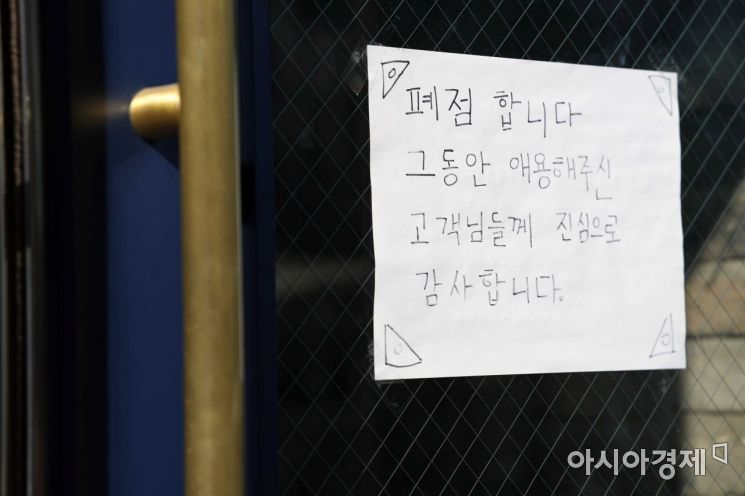 On the weekend of the 20th, a closure notice was posted at a restaurant in Myeongdong, Seoul. Photo by Mun Ho-nam munonam@
[Asia Economy Reporter Song Seung-yoon] "At this rate, it would be better to just close the store." Jin Seung-kwon (35, pseudonym), who runs a chicken restaurant in Gangseo-gu, Seoul, has been sighing more frequently lately. The price of cooking oil has nearly doubled compared to last year, making it impossible to turn a profit. During the height of the COVID-19 pandemic, business restrictions reduced the number of customers, but now that those restrictions are easing, the sharp rise in ingredient costs has become a problem. Jin said, "I already let go of my part-time workers, and even working alone, I barely break even on labor costs," adding, "There is nothing that hasn't gone up, from flour to cooking oil, and I am at a loss about what to do moving forward."
As ingredient prices continue to soar daily, self-employed business owners are facing a double hardship. After enduring business restrictions throughout the COVID-19 period, the rise in ingredient prices this year has pushed them to the brink.
According to the Korea Consumer Agency's Chamgagaek on the 8th, Ottogi soybean oil (900ml) was priced at 3,580 won this month at the lowest price, an 81% increase compared to the same month last year (1,980 won). During the same period, Haepyo cooking oil (900ml) rose from 2,900 won to 3,900 won, a 34% increase. Bulk cooking oil (18ℓ) could be purchased for the low to mid-20,000 won range early last year, but now it has surged to the 50,000 won range. Some wholesalers even say it could exceed 60,000 won within this year.
The price increase was largely due to the surge in raw material costs caused by Russia's invasion of Ukraine, where these materials are primarily produced. The global logistics crisis also had an impact. The sharp rise in cooking oil prices is a particularly severe blow to self-employed business owners.
Especially, places that mainly serve fried dishes, such as chicken restaurants and snack bars, have been hit hard. Since cooking oil is an essential ingredient in most restaurants, many owners say, "The oil prices are so scary that we can't open the store." Flour, which is also essential for fried dishes, has become more than 14% more expensive compared to a year ago.
Businesses dealing with Russian-sourced ingredients are facing similar difficulties for the same reasons. Daegu and myeongran (pollock roe) are seafood products highly dependent on Russia, with 93.6% and 89.2% of their supply coming from Russia, respectively. However, due to Russia's invasion of Ukraine blocking export routes, supplies from other countries such as the United States are replacing these. It is reported that the stockpiles of these items are rapidly decreasing. Following price increases, there are signs of shortages as well.
Lee Sung-won, Secretary General of the Korea Federation of Small and Medium Business Owners and Self-Employed, emphasized, "As the return to normal life after COVID-19 is underway, it will be the next government's role to introduce policies for small business owners at an appropriate time in preparation for the 'post-COVID' era."
© The Asia Business Daily(www.asiae.co.kr). All rights reserved.