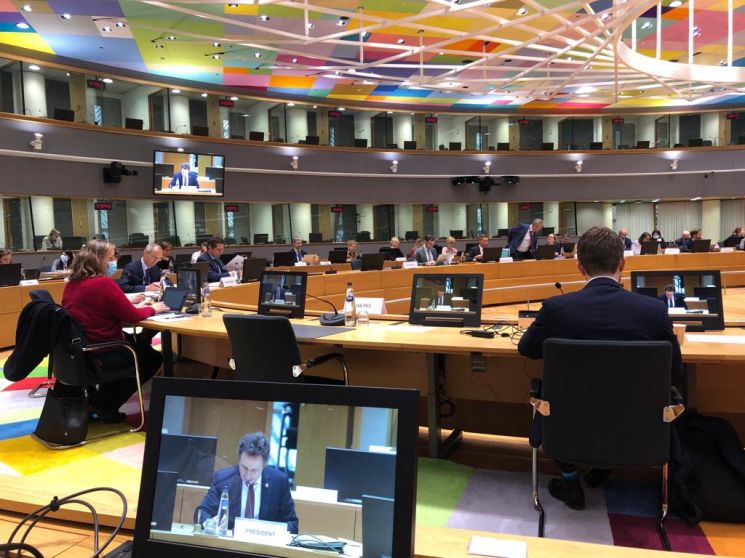
 The European Union (EU) meeting hall in Brussels, Belgium, on the 7th (local time), as released by the French government
[Asia Economy Reporter Jeong Hyunjin] The European Union (EU) has agreed to ban imports of Russian coal as a sanction in response to Russia's invasion of Ukraine. This is the first time Europe has imposed sanctions on Russian energy since the invasion of Ukraine. Discussions are ongoing regarding bans on other energy imports such as oil and natural gas following coal.
According to Bloomberg on the 7th (local time), EU member states discussed the fifth round of sanctions against Russia proposed by the European Commission on the 5th, which includes a ban on Russian coal imports, and agreed to include the coal embargo. After the representatives of EU member states reached an agreement, the United States and the United Kingdom also agreed, and after a period for objections, the final decision is expected on the 8th.
However, this measure will not be implemented immediately but is expected to be enforced starting in August. Since major European countries are highly dependent on Russian energy, immediate enforcement of the embargo is expected to cause significant impact. The European Commission proposed enforcement starting in July, three months later, but due to opposition from Germany, which mainly imports Russian coal, a four-month grace period is expected to be finalized, with enforcement beginning in August.
EU member states are also discussing bans on Russian oil and natural gas imports following coal. However, there are reportedly significant disagreements on this matter. Some EU member states with high dependence on Russian energy, such as Germany, oppose this plan. The Associated Press reported that banning Russian coal imports is considered an easier option for EU member states compared to banning oil and natural gas.
If the EU's coal embargo is finalized, imports of Russian coal worth 4 billion euros (approximately 5.3265 trillion KRW) annually will be banned. The EU imports 40% of its natural gas and 25% of its oil from Russia. In 2020, the value of Russian imports to the EU was 95.3 billion euros, of which 70% was oil and gas.
Ursula von der Leyen, President of the European Commission, told the European Parliament that the newly announced additional sanctions are not the end, saying, "We are looking at oil. We need to look at the income Russia derives from fossil fuels."
© The Asia Business Daily(www.asiae.co.kr). All rights reserved.
![Clutching a Stolen Dior Bag, Saying "I Hate Being Poor but Real"... The Grotesque Con of a "Human Knockoff" [Slate]](https://cwcontent.asiae.co.kr/asiaresize/183/2026021902243444107_1771435474.jpg)











