Additional 60,000-Person Quarantine Facilities Established in Jiangsu and Zhejiang Provinces Following 120,000-Person Capacity Facility
Confident in Defense with Chinese-Style Lockdown as Omicron Severe Case Rate Remains Low
[Asia Economy Beijing=Special Correspondent Jo Young-shin] On April 8, 2020, the Chinese government lifted the lockdown of Wuhan, the capital of Hubei Province. It was 76 days since January 23, 2020. When an unknown cause pneumonia spread in Wuhan, the Chinese government locked down the huge city of Wuhan with a population of 11 million.
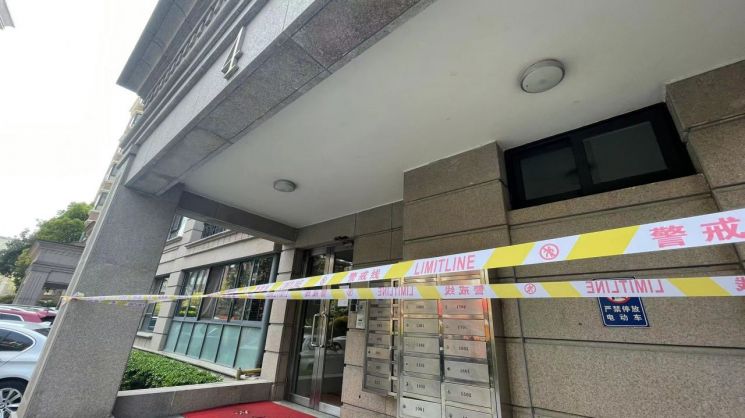
Ahead of the 2nd anniversary of the Wuhan lockdown lift, China is facing the challenge of the spread of COVID-19. This time it is Shanghai, with a population of 25 million.
According to Chinese media including the official Xinhua News Agency on the 7th, on the 11th day of the lockdown, Shanghai City is preparing separate quarantine facilities that can accommodate 60,000 people in Jiangsu Province and Zhejiang Province.
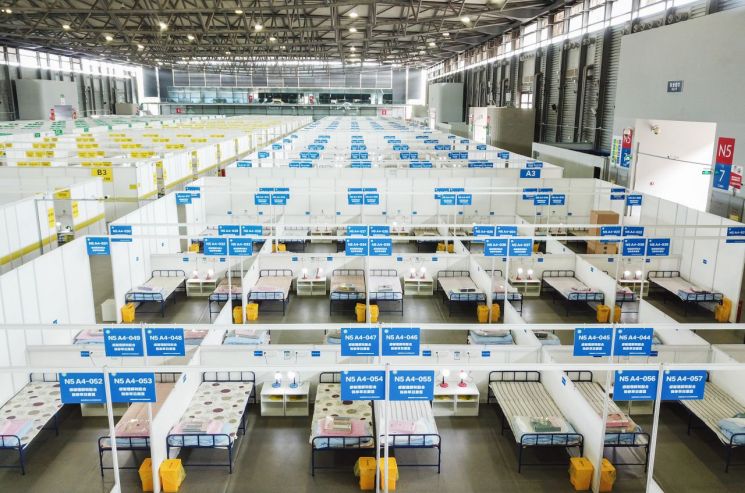
The Shanghai Epidemic Control Center announced that quarantine facilities capable of accommodating 37,000 people have been prepared, and additional space to quarantine 23,000 people is being prepared. Despite having quarantine facilities that can accommodate 120,000 people, it was decided to additionally create separate spaces near Shanghai to quarantine 60,000 people.
Shanghai health authorities are reportedly planning to accommodate simple contacts in Hangzhou, 170 km away from Shanghai, and confirmed cases and close contacts in Yangzhou, 400 km away. It is reported that about 70 people have already been transferred from Shanghai and are quarantined at a quarantine facility (hotel) in Hangzhou.
Huanqiu Shibao reported that 40,000 beds were prepared at the Shanghai International Convention Center, which is 8,500㎡ (2,571 pyeong) in size, and that infected patients have been admitted since the morning of the 6th.
This preparation of quarantine facilities is interpreted as a determination to adhere to the Chinese-style epidemic prevention policy. Among Chinese experts, there were opinions to introduce Western-style methods considering the rapid transmission power and non-lethality characteristics of the Omicron virus, but it seems that the Chinese authorities ultimately chose the existing method of lockdown.
Lei Zhenglong, Deputy Director of the Disease Control and Prevention Bureau of the National Health Commission (NHC), said, "The epidemic prevention and control measures in Guangdong Province, Shandong Province, and Hebei Province are producing results," adding that this means China's zero-COVID epidemic prevention policy is still effective.
The Communist Party organ in Shanghai, Jiefang Daily, also supported this policy of the Chinese authorities by publishing an article stating that COVID-19 prevention must be carried out decisively, swiftly, and strongly.
Lu Hongzhou, director of Shenzhen Third People's Hospital, said, "The outbreak in Shanghai is larger than that in Wuhan, but the severity, such as serious cases, is lower," and argued, "Neighboring provinces and cities of Shanghai should respond quickly for temporary quarantine facilities and hospitals."
Mi Feng, spokesperson for the NHC, said in a statement, "China will adhere to the Chinese-style zero-COVID policy," and "We will strive for testing, quarantine, treatment, and epidemic prevention policies."
Chinese media forecast that the coming week will determine the success of Shanghai's epidemic prevention policy. After completing mass testing of the 25 million population of Shanghai and confirming infection status, and as quarantine of confirmed cases (asymptomatic infected persons) is in full swing, it is expected that the confirmed case trend in Shanghai will be controlled.
© The Asia Business Daily(www.asiae.co.kr). All rights reserved.


















