First Report on Real-Time Broadcast Sales Usage Survey... Food and Household Goods Purchases
15% of Consumers Experienced Damage... Damage Types Include False/Exaggerated Advertising and Defective/Counterfeit Products
[Asia Economy Reporter Lim Cheol-young] The Seoul Metropolitan Government conducted a survey on the usage status of ‘real-time broadcast sales (live commerce),’ which has surged due to the prolonged COVID-19 pandemic and changes in consumer trends such as the normalization of non-face-to-face shopping. The results showed that 6 out of 10 people had experience using live commerce, mainly purchasing daily necessities and clothing/fashion items. However, 15% of consumers with usage experience reported having suffered damages, indicating the need for strengthened preventive measures.
On the 6th, the Seoul Metropolitan Government announced that, given the growing live commerce market and concerns about consumer damages, it conducted an online survey targeting 2,315 consumers aged 20 to 50 who had experience using live commerce, selected from 4,000 respondents, through the Seoul Electronic Commerce Center.
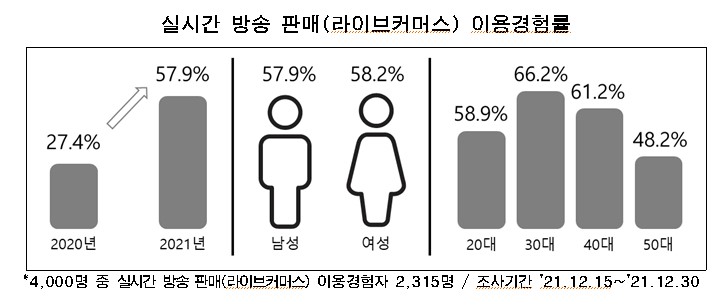
The survey results showed that 57.9% of respondents had used real-time broadcast sales. This figure nearly doubled compared to 27.4% surveyed by the Seoul Electronic Commerce Center in 2020. By gender, males accounted for 57.9% and females 58.2%, showing a similar distribution, and by age group, 20s were 58.9%, 30s 66.2%, 40s 61.2%, and 50s 48.2%, showing a relatively even distribution. This differs from TV home shopping*, which has a similar form to live commerce but shows higher usage rates among specific genders in their 40s and 50s or older.
The most frequently purchased product types through real-time broadcast sales were food at 54.8%, followed by daily necessities at 44%, clothing and fashion items at 39.5%, agricultural and marine products at 23.2%, and cosmetics/perfume at 19.3%. The most used shopping platform was ‘Naver Shopping Live’ at 84.1%, followed by ‘Kakao Shopping Live’ at 54.6%, ‘Coupang Live’ at 47.6%, and ‘Timon TVON’ at 31.7%.
Additionally, users of real-time broadcast sales positively noted that ‘it is beneficial to obtain information about products/services’ at 58.7%, and ‘the host provides sufficient information’ at 49.2%, highlighting the detailed information provided. Furthermore, 53.7% responded that ‘watching live broadcasts makes me want to purchase the actual product/service,’ and 48.8% said ‘there are cases where I suddenly purchase products/services while watching,’ indicating that it can lead to impulse buying.
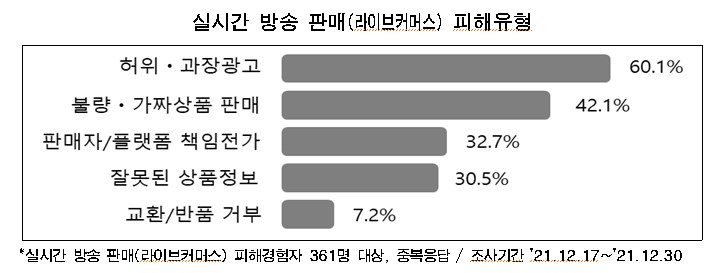
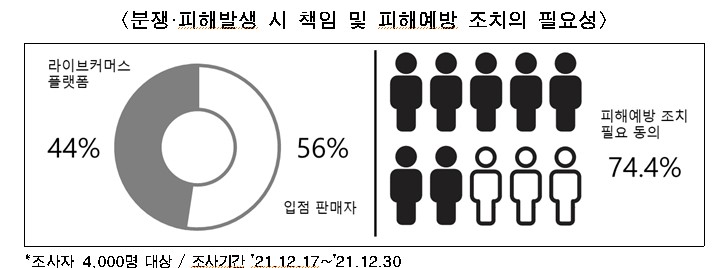
15.6% of respondents reported having experienced damages. Correspondingly, 74.4% expressed the opinion that preventive measures against damages related to real-time broadcast sales are necessary in the future. The main types of damages were false or exaggerated advertising at 60.1%, followed by ▲sale of defective or counterfeit products at 42.1%, ▲shifting responsibility by sellers or platforms at 32.7%, ▲incorrect product information at 30.5%, and ▲refusal of exchange/return at 7.2%.
Regarding responsibility for related disputes and damages, 44.2% answered ‘real-time broadcast sales platform’ and 55.8% ‘seller,’ indicating that sellers are perceived to bear greater responsibility. However, the perception of platform responsibility increased from 42.4% in 2020 to 44.2% last year, showing heightened consumer awareness of platform accountability.
As consumer concerns about real-time broadcast sales are rising, the Seoul Metropolitan Government plans to strengthen consumer damage prevention through continuous monitoring based on these survey results. Additionally, since consumers generally trust the platform’s recognition and brand when making purchases, the government will request that live commerce platforms strengthen self-regulation of sales broadcasts and actively address consumer damages.
Lee Byung-wook, Director of Fair Economy at the Seoul Metropolitan Government, said, “Unlike home shopping, which undergoes strict review and sanctions by the Korea Communications Commission, real-time broadcast sales have room for exaggerated advertising, and consumers are likely to make impulse purchases without properly verifying product information. As the live commerce market grows, it is necessary for live commerce platforms to enhance education and management of sellers.”
© The Asia Business Daily(www.asiae.co.kr). All rights reserved.
![Clutching a Stolen Dior Bag, Saying "I Hate Being Poor but Real"... The Grotesque Con of a "Human Knockoff" [Slate]](https://cwcontent.asiae.co.kr/asiaresize/183/2026021902243444107_1771435474.jpg)


















