[Asia Economy (Suwon) = Reporter Lee Young-gyu] It has been revealed that the concentration of fine dust in Gyeonggi Province has significantly improved after the implementation of the seasonal management system.
Gyeonggi Province announced on the 6th that the seasonal fine dust management system, which has been intensively managed from December to March when fine dust concentration is high through measures such as restricting the operation of old diesel vehicles and cracking down on illegal burning, has been implemented for three years since 2019, and analysis showed that the concentration of ultrafine dust decreased compared to 2018 before the system was implemented.
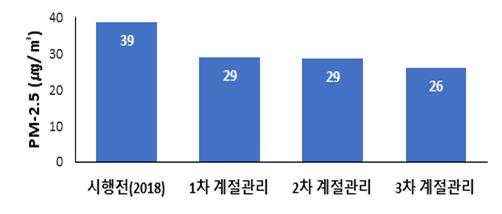
According to the Gyeonggi-do Institute of Health and Environment Research, the average concentration of ultrafine dust (PM-2.5) in the province decreased continuously from 39㎍/㎥ during December 2018 to March 2019 before the seasonal management system was implemented, to 29㎍/㎥ during the first implementation from December 2019 to March 2020, 29㎍/㎥ during the second implementation from December 2020 to March 2021, and 26㎍/㎥ during the third implementation from December 2021 to March 2022.
The number of days classified as "Good" (15㎍/㎥ or less) during the four months of the seasonal management system increased significantly from 11 days before implementation to 31 days during the third implementation. Additionally, the number of "High Concentration" (exceeding 50㎍/㎥) days improved from 22 days before implementation to 7 days during the third implementation.
Park Yong-bae, director of the Gyeonggi-do Institute of Health and Environment Research, stated, "We were able to confirm the policy implementation effect of the fine dust seasonal management system," and emphasized, "Continuous promotion of the seasonal management system is necessary to reduce fine dust."
© The Asia Business Daily(www.asiae.co.kr). All rights reserved.

















