People Power Party 공개 'PPAT' Candidate Qualification Test
Only Talents Passing Basic Qualification Evaluation Eligible for Nomination Review
Expectations to Alleviate Faction Conflicts and Lineup Nomination Controversies
Some Express Concerns It Conflicts with the Principle of Popular Sovereignty
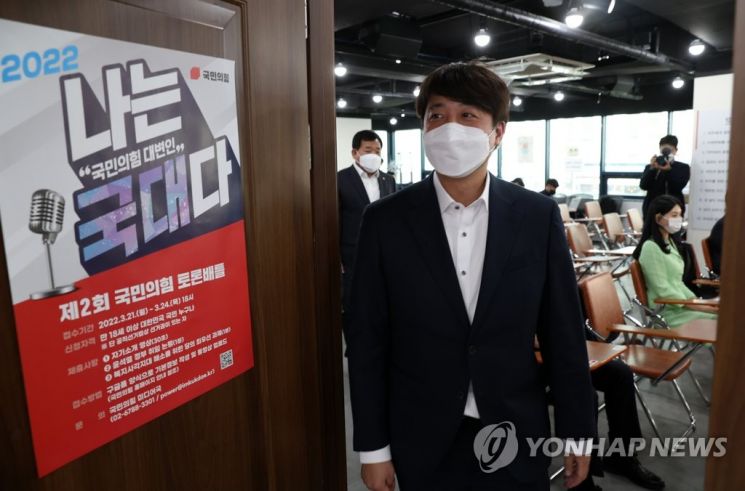 On the 28th of last month, Representative Lee Jun-seok attending the pressuring interview for the selection of the People Power Party spokesperson / Photo by Yonhap News
[Asia Economy Reporter Lim Juhyung] With two months remaining until the June 1 local elections, the People Power Party (PPP) has introduced the country's first basic qualification evaluation exam system for candidates. Accordingly, only candidates who pass the exam will be eligible for nomination consideration, and those with high scores will receive additional points. Attention is focused on whether this exam system can enhance the capabilities of candidates and serve as a foundation for establishing a 'systematized nomination' within the party.
◆PPP: "Must Pass Basic Qualification Evaluation to Be Eligible for Nomination Review"
On the 3rd, Kim Haeng, spokesperson for the PPP Nomination Management Committee (NMC), stated at a National Assembly press briefing, "We have unanimously passed a reform plan to consider only those who pass the basic qualification evaluation as candidates for nomination review," adding, "This is to ensure that PPP public office candidates possess a certain level of competence and qualifications."
The exam, known as the 'People Power Party Aptitude Test' (PPAT), was one of the pledges made by PPP leader Lee Jun-seok during last year's party leadership election. From now on, party-affiliated public office candidates must achieve a certain score on the PPAT to qualify for nomination review.
The first PPAT is scheduled to be held on the 17th, with the test centers to be announced later on the party's website. All applicants for the June 1 local elections must take the exam and pay an application fee of 2.1 million KRW for metropolitan councilors and 1.1 million KRW for basic councilors.
Leader Lee also shared sample questions for the PPAT on his Facebook page on the 1st. The exam broadly tests the abilities required of public officials, including questions on party constitution and regulations, PPP policy content, data interpretation and situational judgment, and current issue analysis.
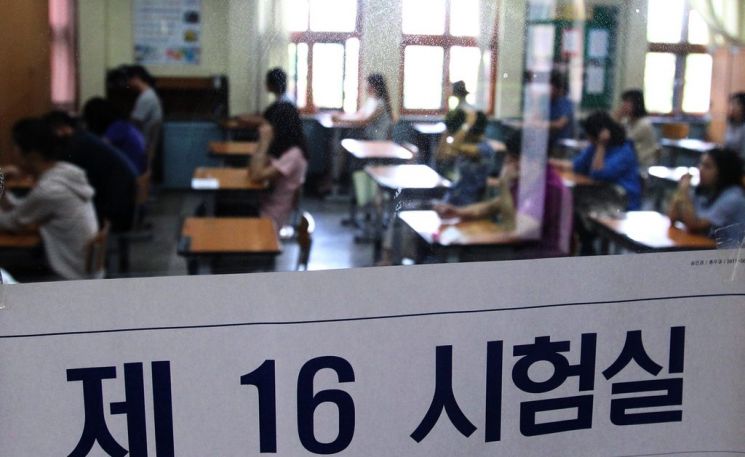 The "People Power Party Eligibility Assessment" (PPAT) was found to include questions similar to those in some domestic national civil service exams. The photo shows a civil service exam room in Seoul last year. This is unrelated to any specific expressions in the article. Photo by Yonhap News.
In particular, the data interpretation and situational judgment examples, which require candidates to read and apply reasoning skills, are similar to the 'PSAT' introduced in the Grade 5 to 7 national civil service exams. Achieving a high score is expected to require considerable study effort.
◆Nation's First 'Written Exam' for Nomination... Can It Resolve Factional Conflicts?
The introduction of a written exam in the nomination process is unprecedented in domestic political history. Previously, during the party leadership election in May last year, Leader Lee claimed at a press conference that a qualification exam could resolve various issues arising in the nomination process.
At that time, he emphasized, "There should be no factional politics based on lining up. The younger generation finds it extremely repulsive. Politicians need to study, and party officials need to study. (Therefore) public office candidates will be required to take a basic qualification exam."
Nomination management for public office candidates is usually handled by the NMC. However, the actual exercise of nomination rights has always been a 'hot potato' within political parties. Factional conflicts influenced by certain politicians have escalated into controversies that divided parties.
In fact, the predecessors of the PPP, the Grand National Party and the Saenuri Party, also suffered from internal factional conflicts in the past. A representative example is the so-called 'Pro-Park nomination massacre' during the 18th general election, following factional conflicts between Lee Myung-bak and Park Geun-hye during the 2007 presidential race, where the pro-Lee faction took power and subsequently excluded many pro-Park lawmakers from nominations.
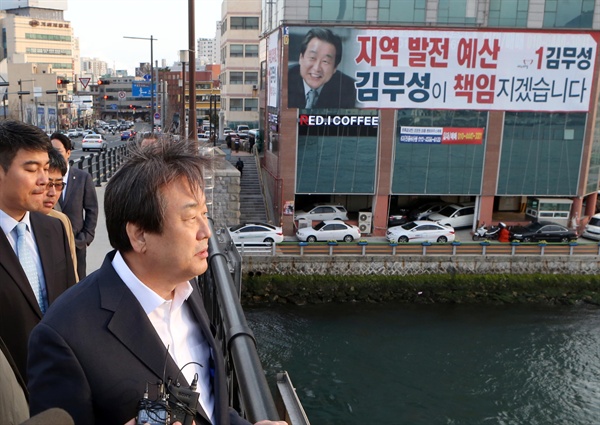 On March 24, 2016, Kim Moo-sung, then leader of the Saenuri Party, is walking across the Busan Yeongdo Bridge, looking out at the sea. / Photo by Yonhap News
After former President Lee Myung-bak, Park Geun-hye took power and, ahead of the 20th general election in March 2016, stated, "I ask that only 'genuine people' be chosen for the people," sparking the 'Jinbak (true pro-Park)' controversy within the Saenuri Party. As conflicts escalated, then Saenuri Party leader Kim Moo-sung launched the 'Oksa Incident' to prevent pro-Jinbak-centered nominations, ultimately leading the Saenuri Party to lose its position as the largest party to the Democratic Party in the general election.
Leader Lee believes that these issues inherent in the Korean party nomination process can be resolved through a qualification exam. The written exam is taken under equal conditions by all candidates, and there is no room for interference by others in the exam results.
◆"Exams Don't Lie" vs. "Are Politicians Civil Servants?" Heated Debate
However, there are also many skeptical views regarding the written exam for election candidates. When Leader Lee first announced the PPAT pledge last year, controversy arose both inside and outside the party.
At that time, Democratic Party lawmaker Ko Min-jung wrote on Facebook, "The ethics of meritocracy drive winners to arrogance and losers to humiliation and anger. Meritocratic arrogance reflects the experience of winners excessively boasting about their success while forgetting the chance and innate luck that supported it," citing Michael Sandel, a Harvard University professor, and his book 'The Tyranny of Merit,' which points out the problems of excessive meritocracy.
There are also criticisms that the qualification exam itself contradicts the spirit of popular voting. PPP lawmaker Kim Jae-won also criticized the nomination qualification exam in a radio interview last July, saying, "It is a serious problem. Personally, I oppose it," and added, "The introduction of the exam system does not align with the fundamental principle of popular sovereignty, even when parties recommend public office candidates."
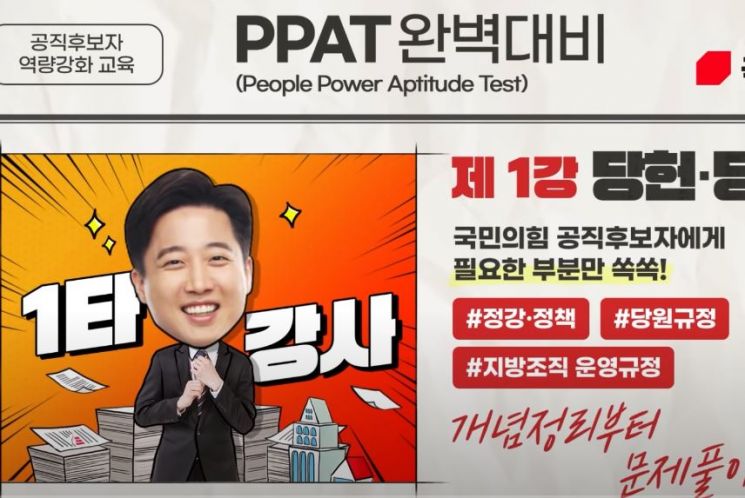 YouTube lecture video produced by the People Power Party for PPAT exam candidates. / Photo by People Power Party YouTube capture
Opinions among voters are divided over the PPAT. A man in his 20s, identified as a PPP party member and office worker, said, "Exam scores don't lie. I think it is much fairer and more transparent than any nomination system so far," adding, "There is criticism that it deepens meritocracy, but shouldn't ability be the top priority when selecting public officials who will govern the country?"
On the other hand, another office worker, B (38), said, "The abilities required of politicians are clearly different from those of civil servants. Especially local councilors are people who listen to and resolve residents' complaints. Is it reasonable to expect busy people who are out in the field to sit at a desk and study?"
Experts say that while the written exam system has clear pros and cons, it is positive in that it can serve as a foundation for 'systematized nomination' within domestic political parties.
Political commentator Lee Jong-hoon said, "(The PPAT) may be controversial because it raises the question, 'Does doing well on an exam mean doing well in politics?'" He added, "There will be a need to readjust the exam subjects and question content in the future to better fit the realities of public office."
He continued, "Nonetheless, it can be a starting point for 'systematized nomination,' which objectively evaluates candidates, rather than the chronic problem of 'closed-door nominations' in domestic party politics," explaining, "Until now, local elections have been shaped by influential members of the National Assembly exercising practical nomination rights, but (the exam system) excludes such patterns."
© The Asia Business Daily(www.asiae.co.kr). All rights reserved.
![Clutching a Stolen Dior Bag, Saying "I Hate Being Poor but Real"... The Grotesque Con of a "Human Knockoff" [Slate]](https://cwcontent.asiae.co.kr/asiaresize/183/2026021902243444107_1771435474.jpg)


















