What to Do About Inflation-Linked Minimum Wage
Business Sector: "Burden on SMEs and Small Business Owners"
Labor Sector: "Must Reflect Price Increases"
Experts: "Decision-Making Structure Needs Revision"
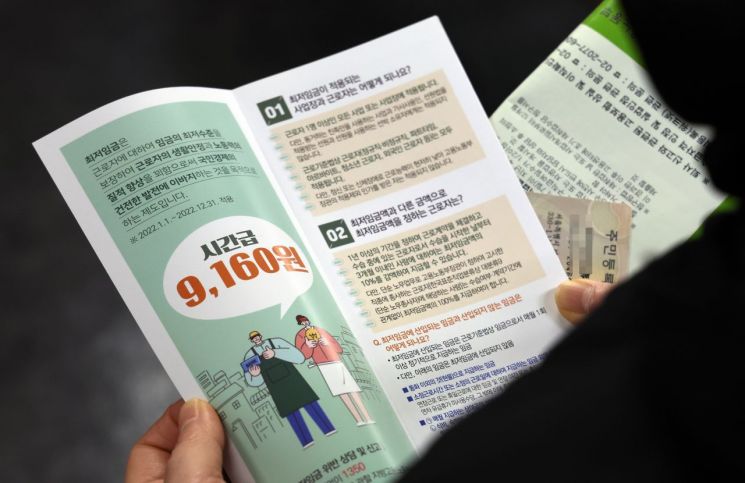
[Asia Economy Reporters Choi Dae-yeol and Yoo Hyun-seok] "With the logistics crisis continuing for over a year and compounded by the Russian invasion, raw material prices have risen by more than 10% since the beginning of the year. However, it is difficult to immediately reflect this in delivery prices. If the minimum wage rises further, the company's situation will deteriorate rapidly." (Representative of mid-sized manufacturing company A)
"The core issue behind the difficulties faced by self-employed individuals is not the minimum wage increase but unfair trade practices, rent and commission fees, and the tyranny and bullying by large corporations. We need to seek solutions to current income inequality and social polarization through raising the minimum wage." (Statement from the Minimum Wage Solidarity on the 4th)
The negotiations for the minimum wage to be applied next year officially kicked off with the first plenary meeting on the 5th. Amid escalating conflicts between labor and management over the minimum wage since the inauguration of the Moon Jae-in administration, this year the ‘sector-specific minimum wage differential application’ proposed by President-elect Yoon Suk-yeol during his candidacy is expected to be a major issue. Han Duck-soo, the nominee for Prime Minister who will lead the next cabinet, clearly stated that steep minimum wage hikes have more drawbacks than benefits and expressed his intention to minimize government intervention, signaling intense confrontations between labor and management.
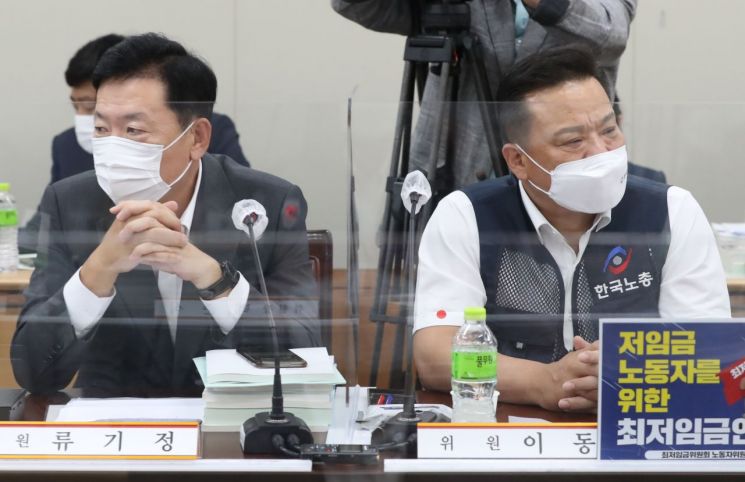 At the 6th plenary meeting of the Minimum Wage Commission held in June last year, Ryu Ki-jung, Executive Director of the Korea Employers Federation, representing the employers (left), and Lee Dong-ho, Secretary General of the Korean Confederation of Trade Unions, representing the workers, are looking in different directions.
 Minimum Wage Deliberations Start
Both Sides Expected to Present Proposals by Mid-May
Prime Minister Nominee: "A Rational Decision Must Be Made"
According to related ministries and industries, the plenary meeting of the Minimum Wage Commission held that day is expected to be the first face-to-face meeting between labor and employer groups this year, focusing more on sharing future schedules rather than presenting concrete proposals from either side. This is part of the procedure following the Ministry of Employment and Labor's request for minimum wage deliberations on April 31, with a deadline set for June 29.
The industry expects it will again be difficult to reach an agreement within the set deadline this year. Prime Minister nominee Han Duck-soo told reporters, "The decision must be made at a reasonable level. If it rises too high in two units, companies may reduce employment, resulting in a lose-lose situation for both labor and management."
The business community argues that the recent sharp rise in the minimum wage has exacerbated difficulties in business operations, especially for small and medium-sized enterprises, small business owners, and the self-employed. The minimum wage has increased by about 42% over five years, from 6,470 won in 2017 to 9,160 won this year, without reflecting the expanded scope of minimum wage inclusion.
The steadily increasing proportion of workers who do not even receive the minimum wage (minimum wage underpayment rate) is also explained by employer groups as a side effect of the steep rise. According to the Korea Employers Federation, the minimum wage underpayment rate was 16.5% in 2019 and 15.6% in 2020, significantly higher than in the early 2000s (4.3% in 2001). This is interpreted as a result of the minimum wage rising to a level that employers find difficult to comply with, reducing market acceptance.
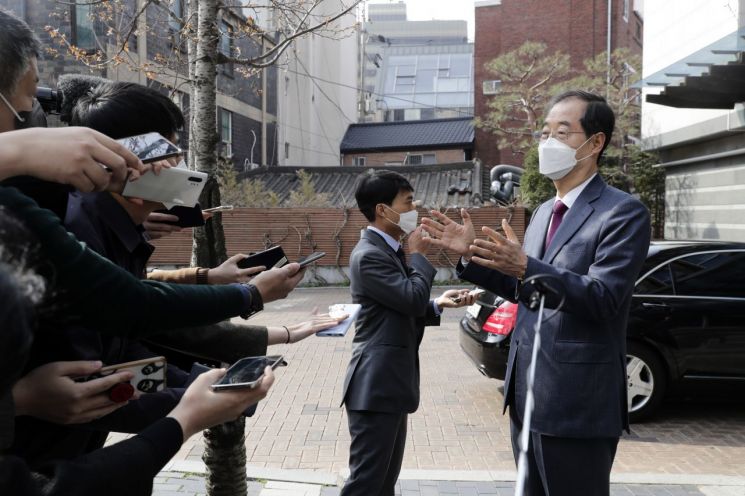 Prime Minister nominee Han Duck-soo is answering reporters' questions as he leaves the 20th Presidential Transition Committee set up at the Financial Supervisory Service Training Institute in Tongui-dong, Jongno-gu, Seoul, on the morning of the 5th.
 Inflation Hits 4% Range for First Time in 10 Years
Labor: "Minimum Wage Should Rise Along with Inflation"
Business: "No Basis for Linking Inflation and Minimum Wage"
The sharp rise in energy prices such as crude oil and gas, which are entirely imported, is also expected to be an important variable in the wage deliberation process. Last month, the consumer price index rose to the 4% range for the first time in 10 years. The prevailing view is that this upward trend will continue within the year.
The labor sector has consistently maintained the position that the minimum wage should be raised in line with inflation, considering the original purpose of the minimum wage. On the other hand, employer groups such as the Korea Employers Federation express a negative stance, arguing there is no basis for linking inflation and the minimum wage, and that minimum wages have been raised regardless of inflation in the past. A representative from the Federation explained, "In 2018 and 2019, when inflation rates were low, the minimum wage was still raised by double digits. The argument that the minimum wage should be raised because inflation has risen can also be used as a counterargument."
This year, the debate over the differential application system mentioned by President-elect Yoon is expected to intensify. The idea is to set different minimum wages depending on industry or region, and sector-specific differential application is already permitted under current law.
Experts point out that the current minimum wage decision structure, which is sharply contested and leaves both sides dissatisfied even after decisions, needs to be revised. Professor Yoon Dong-yeol of Konkuk University said, "Instead of meeting for two or three months a year to decide, the entire decision-making process itself should be changed. Rather than being centered on members lacking expertise as it is now, it should sufficiently reflect industry opinions and incorporate actual economic growth rates and voices from the field."
Visiting Professor Choi Young-gi of Hallym University said, "There have been industries that could not keep up due to excessively high increase rates, but under the current circumstances, it is more appropriate to focus on how to set the increase rate itself rather than on differential application."
© The Asia Business Daily(www.asiae.co.kr). All rights reserved.
![Clutching a Stolen Dior Bag, Saying "I Hate Being Poor but Real"... The Grotesque Con of a "Human Knockoff" [Slate]](https://cwcontent.asiae.co.kr/asiaresize/183/2026021902243444107_1771435474.jpg)


















