Possibility of Honam Prime Minister and Yeongnam Deputy Prime Minister... Choo Kyung-ho Likely to Support 'Strengthening Fiscal Soundness'
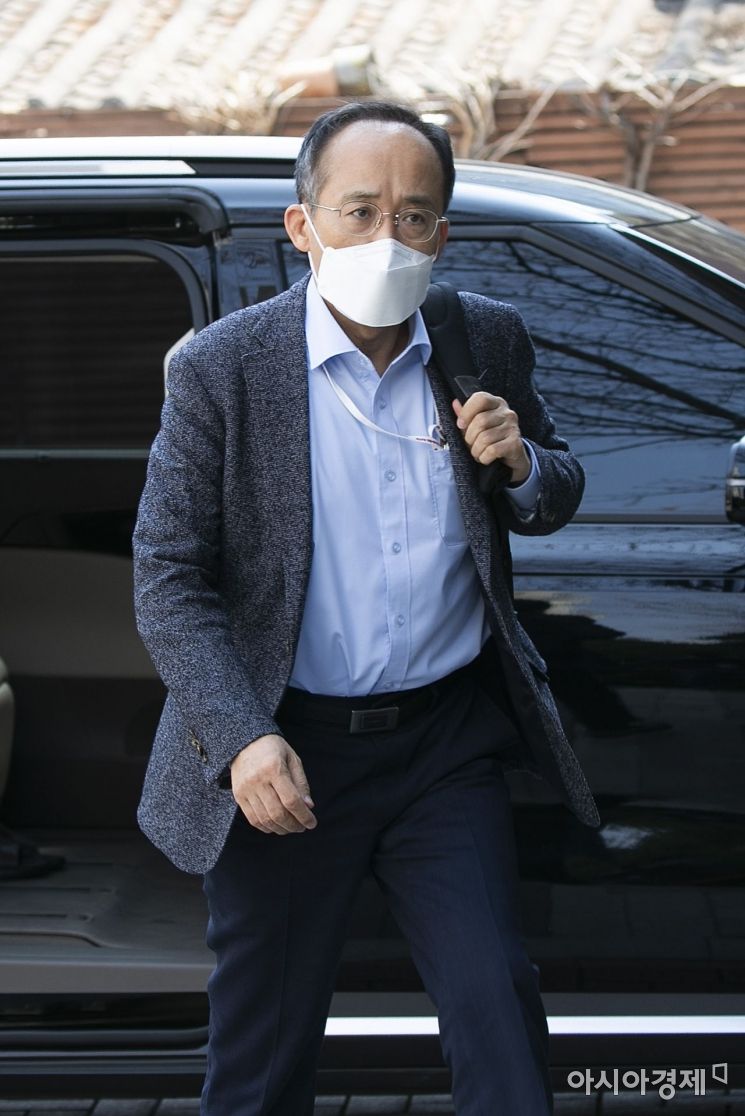
[Asia Economy Reporter Baek Kyunghwan] Chu Kyung-ho, a member of the People Power Party, has been virtually selected as the first Deputy Prime Minister and Minister of Economy and Finance in the Yoon Suk-yeol administration. With this, the outline of the next government’s economic team, including the Prime Minister, Deputy Prime Minister, Financial Services Commission Chairman, and presidential office economic advisors, has become clear. Chu, recognized for his capabilities as a seasoned economic bureaucrat who served as Vice Chairman of the Financial Services Commission under the Lee Myung-bak administration and as First Vice Minister of Economy and Finance under the Park Geun-hye administration, was reportedly chosen considering regional balance with the Prime Minister. President-elect Yoon Suk-yeol plans to sequentially announce cabinet appointments, including the Deputy Prime Minister, from the latter half of this week, taking into account the parliamentary confirmation hearings and the presidential inauguration schedule.
A key official from the Presidential Transition Committee (PTC) said on the 5th, "The appointment of the Deputy Prime Minister must consider both capability and regional balance with the Prime Minister," adding, "Considering that Prime Minister nominee Han Duck-soo is from Honam, Chu, who is from Yeongnam, is regionally appropriate, and we judged that he would pass the personnel screening smoothly."
In political circles, Chu is seen as the best candidate to respond to opposition attacks, having served as a member of the 20th and 21st National Assembly, active in the Planning and Finance Committee and the Special Budget and Accounts Committee, and recently as the floor leader’s senior deputy representative. The opinion that a current lawmaker should take the position to ease the burden of confirmation hearings was also reflected.
If nominee Han and Chu work well together, the future government is expected to strengthen fiscal soundness, including the introduction of fiscal rules. Chu previously proposed strict fiscal rules. He also introduced a bill to amend the National Finance Act to manage the national debt ratio below 45% and the managed fiscal balance deficit ratio below 3%. If these thresholds are exceeded, the structure requires repaying national debt with the world surplus (excess tax revenue plus unspent expenditures). The introduction of fiscal rules is also included in President-elect Yoon’s campaign pledges.
The preliminary plan for the supplementary budget (Chugyeong) that Chu oversees is also expected to take shape. Chu has stated that the PTC will lead the direction, scale, and content of the supplementary budget. Since his presidential campaign, Yoon has advocated as his first pledge to expand compensation and support for small business owners and self-employed individuals, pushing for a second supplementary budget of around 50 trillion won.
Professor Kim So-young of Seoul National University’s Department of Economics, who was part of the economic first division of the transition committee and active during the presidential campaign, is mentioned as a candidate for the presidential office’s chief economic secretary to support nominee Han and Chu. Professor Kang Seok-hoon of Sungshin Women’s University, who served as economic secretary in the Park Geun-hye administration’s Blue House, is also mentioned, as is the possibility of appointing former lawmaker Yoon Hee-sook. Former First Vice Minister of Economy and Finance Choi Sang-mok is more likely to be nominated as Financial Services Commission Chairman rather than Deputy Prime Minister. He is known as a seasoned macroeconomic and financial policy expert, having served as head of the Financial Policy Division at the Financial Services Commission and the Economic Policy Bureau at the Ministry of Economy and Finance. Currently, Choi is working with Chu at the PTC to formulate economic policies.
Professor Lee Chang-yang of KAIST’s Department of Industrial and Systems Engineering, who serves as secretary of the economic second division of the PTC, has been identified as a candidate for Minister of Trade, Industry and Energy. Lee passed the 29th Administrative Examination as the top scorer and served as head of the Industrial Policy Division at the Ministry of Trade, Industry and Energy, accumulating 15 years of public service. Lee Kwan-seop, standing vice chairman of the Korea International Trade Association, is also under consideration. Lee served as Vice Minister of Trade, Industry and Energy during the Park Geun-hye administration and voiced opposition to the nuclear phase-out policy early in the Moon Jae-in administration.
For Minister of Land, Infrastructure and Transport, who must achieve both real estate regulation and housing price stabilization, former First Vice Minister Kim Kyung-hwan and Professor Shim Kyo-eon of Konkuk University, who leads the PTC’s real estate task force, are competing. Kim designed President-elect Yoon’s real estate pledges, and Shim advised on real estate policy at the election campaign headquarters. Both are evaluated as figures who will implement Yoon’s real estate policies in a market-friendly manner.
Appointments in the foreign affairs and security sector are expected to focus on the Korea-US alliance and security posture. Lawmakers Park Jin and Cho Tae-yong are being considered; both were part of the recent Korea-US policy consultation delegation. The PTC is reportedly seeking individuals capable of harmonizing with other ministries to strengthen the increasingly emphasized “economic security.”
Following ministerial appointments, the new government’s organizational restructuring, which had been partially discussed only within the PTC, is also expected to accelerate. If the cabinet outline is completed by mid-month, the organizational restructuring plan is expected to be revealed as early as next week. While there is momentum to abolish the Ministry of Gender Equality and Family and the Ministry of Education, there are internal disagreements about the organization that will inherit related duties, and multiple plans are reportedly being prepared internally. A political figure from the campaign headquarters said, "Since it takes a long time to form a cabinet after organizational restructuring, the order will be to finalize appointments first and then proceed with restructuring," adding, "Consultations will be held with key figures including the Prime Minister nominee."
However, the next government’s organizational restructuring plan is expected to be somewhat delayed. Sensitive issues such as the abolition of the Ministry of Gender Equality and Family remain, and considering the current situation of a ruling party minority in the National Assembly, there is internal support for the opinion that "there is no need to weaken government organizations from the early days of the administration." A political figure from Yoon Suk-yeol’s campaign headquarters said, "Since it takes a long time to form a cabinet after organizational restructuring, the order will be to finalize appointments first and then proceed with restructuring," adding, "Consultations will be held with key figures including the Prime Minister nominee."
© The Asia Business Daily(www.asiae.co.kr). All rights reserved.

















