This Year's Keyword 'Bidojinse'
New Route Development Through Model Change
Financial Structure Improvement Through Performance Enhancement
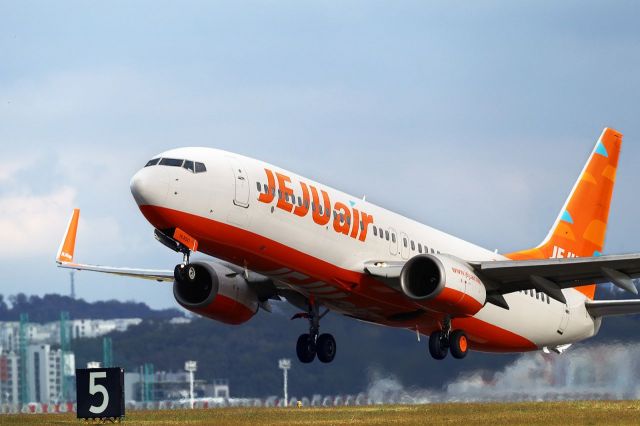
[Asia Economy Reporter Yoo Hyun-seok] Jeju Air is preparing for the post-COVID era by expanding its cargo business alongside the recovery of medium- and short-haul routes. The airline plans to diversify its revenue structure by transitioning its fleet to Boeing's next-generation model, the B737-8, developing new routes, and expanding its cargo business through the introduction of dedicated cargo aircraft.
Jeju Air announced on the 4th that it will focus on the keyword ‘Bidojinse (備跳進世)’ to prepare for the post-COVID era. Bidojinse means ‘Prepare to leap and move forward vigorously into the world.’ It signifies Jeju Air’s aim to establish itself as a leading company in the post-COVID era, based on its resilience in overcoming numerous challenges such as the global financial crisis, the Great East Japan Earthquake, MERS, and SARS.
First, the focus will be on recovering medium- and short-haul routes. By strengthening a low-cost business structure through high efficiency, the airline aims to minimize the costs required for aircraft operations. Through this, Jeju Air plans to capture travel demand after COVID-19 by offering air services at more affordable prices.
Starting next year, the airline will gradually transition its fleet to Boeing’s next-generation model, the B737-8. The introduction of the B737-8 is part of the strategy to upgrade the current fleet. This is to enhance competitiveness in medium- and short-haul routes by focusing on the current business model.
The B737-8 has a flight range over 1,000 km longer than the currently operated B737-800. It can operate flights to Central Asia, Indonesia, and other destinations, creating new opportunities such as developing new routes. Additionally, it can reduce fuel consumption by more than 15% compared to existing aircraft of the same class, and operating costs per seat can be reduced by 12%, which is expected to improve profitability through cost savings.
Jeju Air is also diversifying its revenue structure through the cargo business. In June, it will introduce a dedicated B737 cargo aircraft and officially enter the air cargo transportation business. This introduction of a dedicated cargo aircraft is the first among domestic low-cost carriers (LCCs). The cargo aircraft to be introduced is the B737-800BCF, the same model as the aircraft currently in operation. It is an aircraft converted from a passenger plane to a dedicated cargo plane.
By introducing a cargo aircraft of the same model as its passenger planes, Jeju Air can reduce the costs required for operating cargo flights and improve fleet operation efficiency. Moreover, it will be able to increase cargo transport volume per flight and transport various types and forms of cargo, enabling it to engage in high value-added transportation.
Jeju Air secured financial soundness last year through policy financial support and capital increases. Strengthening sales power on medium- and short-haul routes, expanding overseas markets through new aircraft introduction, and reinforcing the cargo business are expected to further contribute to improving the financial structure through future performance improvements.
A Jeju Air official explained, "At a time when structural reform of Korea’s aviation industry is underway, Jeju Air will analyze the situation with a long-term perspective and prepare flexibly. Through future business strategies, we will be able to solidify our position as a leading airline in the post-COVID era."
© The Asia Business Daily(www.asiae.co.kr). All rights reserved.

















