N-Juan Dollar Exchange Rate Nears 125 Yen; Financial Authorities Expected to Intervene Upon Surpassing
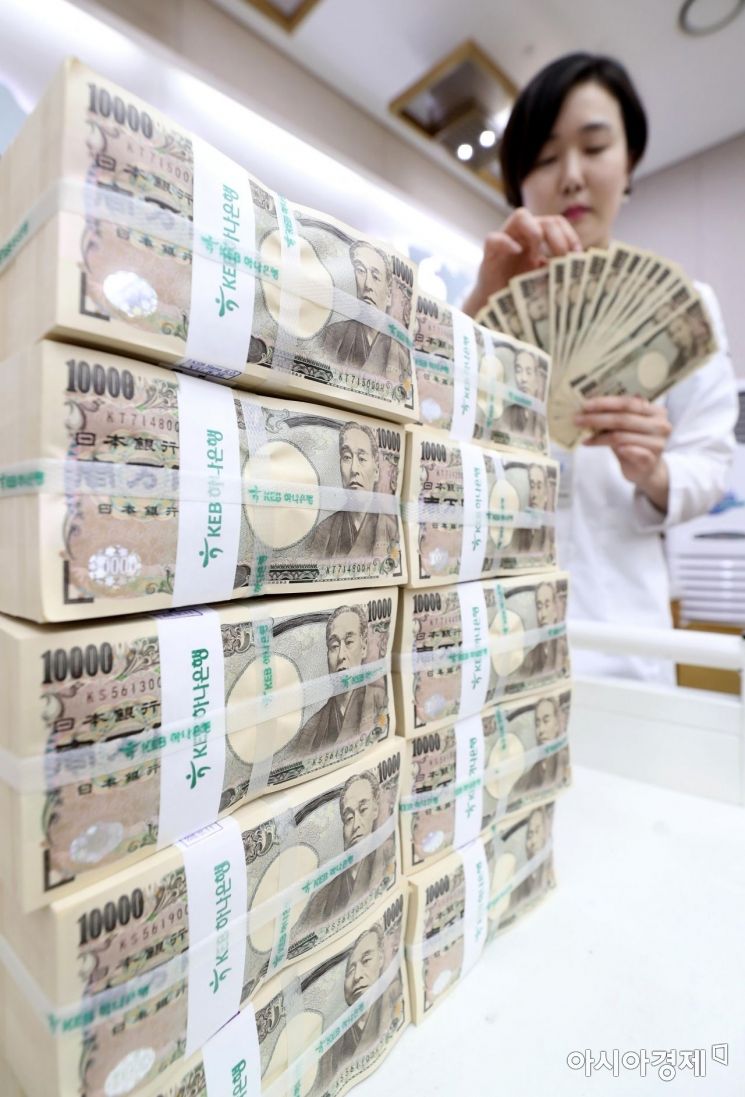
[Asia Economy Reporter Seo So-jeong] Although concerns about the recent yen depreciation have been raised, an analysis shows that the positive effects of a weak yen on the Japanese economy outweigh the negative effects. Furthermore, since factors driving the yen depreciation?such as the Bank of Japan’s continued accommodative monetary policy and persistent current account deficits?remain strongly in place, the weak yen trend is expected to continue for the time being.
On the 3rd, the Bank of Korea’s Tokyo office estimated the impact of yen depreciation on gross domestic product (GDP) from 2000 to 2019 and from 2010 to 2019, concluding that overall, the positive effects on the Japanese economy remain greater.
A Bank of Korea official explained, "However, regarding the effects by pathway, since overseas production by companies has increased, after 2010, the positive aspect shifted from increased goods exports to an improved income balance effect. On the negative side, the rise in import penetration rates of products such as home appliances has led to increased import costs, which in turn has raised consumer prices."
Haruhiko Kuroda, Governor of the Bank of Japan, has also maintained the position that the yen depreciation generally acts as a positive factor for the Japanese economy. While the impact of exchange rates varies depending on economic and trade structures, the fundamental framework that yen depreciation overall contributes positively to economic recovery and price increases in Japan remains unchanged.
However, he acknowledged that the impact of yen depreciation is not uniform across industries, company sizes, and economic agents. Yen depreciation can lead to higher import prices, resulting in decreased real household income and deteriorated corporate profits, which could exert downward pressure on the economy. Nonetheless, recent import price increases are overwhelmingly driven by rising raw material prices rather than yen depreciation.
The Bank of Korea stated, "Opinions on the impact of the recent yen depreciation on the Japanese economy vary depending on which transmission channels are emphasized. While some argue that the effect of yen depreciation on worsening trade terms is limited, others emphasize negative effects such as entrenched trade deficits and weakened consumer sentiment due to rising import prices."
Toshihiro Nagahama, Chief Economist at Dai-ichi Life Research Institute, analyzed that since Abenomics in 2013, the benefits of yen depreciation lie more in increased corporate capital investment than in export expansion. He noted that if corporate earnings improve through yen depreciation via consolidated overseas assets, positive effects such as stock price rises, increased capital investment, and employment growth occur.
However, Daisuke Karakama, Chief Economist at Mizuho Bank, viewed that the increase in overseas production by Japanese companies has significantly reduced the export expansion effect, making the positive impact minimal. Many also hold the view that structural changes in the Japanese economy over a long period have diminished the positive effects through export transmission channels compared to the past. There are opinions that external factors such as global supply chain constraints and rising raw material prices have caused import prices to surge, leading to reduced consumer purchasing power and a greater negative impact on private consumption.
On the other hand, there is a growing opinion that the recent rise in import prices is more due to the increase in crude oil prices than yen depreciation, and that fiscal policies such as tax cuts and subsidies, rather than monetary policy, are more appropriate responses.
The Bank of Korea said, "There are predictions that financial authorities might intervene if the yen-dollar exchange rate approaches or exceeds 125 yen. Given that factors driving yen depreciation?such as the Bank of Japan’s accommodative monetary policy and persistent current account deficits?remain strongly in effect, many expect the weak yen phenomenon to continue for the time being."
© The Asia Business Daily(www.asiae.co.kr). All rights reserved.
![Clutching a Stolen Dior Bag, Saying "I Hate Being Poor but Real"... The Grotesque Con of a "Human Knockoff" [Slate]](https://cwcontent.asiae.co.kr/asiaresize/183/2026021902243444107_1771435474.jpg)
















