Putin's Approval Rating Stays in the 80% Range Despite Economic Hardship
Due to Rally Effect and Russian Government Information Control
Experts Say "War as a Distraction Has Limits"
"Kremlin Popularity Will Eventually Decline"
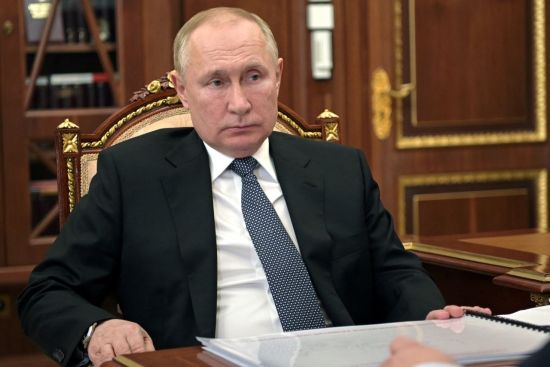
[Asia Economy Reporter Lim Juhyung] Despite harsh economic sanctions from the West and repeated setbacks for the Russian military, public support for President Vladimir Putin remains steadfast in Russia. In fact, as the war approaches nearly a month in duration, his approval rating is soaring above 80%, drawing attention to the reasons behind this trend.
Russia's polling agency 'Levada' announced on the 30th of last month (local time) that President Putin's approval rating stands at 83%. This marks a significant increase of 12 percentage points from the previous month (71%), with Putin's approval rating sharply rising since November last year when it was in the 60% range.
Since the Russian military invaded Ukraine on the 24th of last month, Western countries have imposed severe economic sanctions, placing Russia in a comprehensive crisis across economic, social, and diplomatic fronts.
The United States, United Kingdom, and Europe have reduced imports of Russia's major exports such as crude oil and gas, and frozen or seized offshore assets, causing substantial damage to the Russian economy. The stock market was temporarily closed for about a month from February to March 24, and the value of the ruble became unstable. Since the start of the war, some Russian citizens have held anti-war protests in the capital, Moscow, and other cities.
However, as the war continues beyond a month, the majority of public sentiment appears to be increasingly rallying behind President Putin.
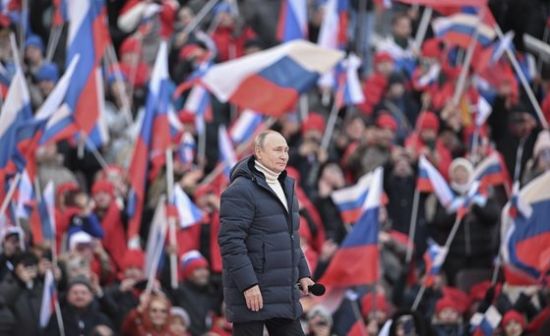 On the 18th of last month (local time), President Putin gave a speech in Moscow, the capital of Russia / Photo by Yonhap News
With the everyday lives of ordinary people becoming more difficult and Russia diplomatically isolated, why do Russians still trust President Putin?
Arik Burakovsky, Deputy Director of the Russia Program at the Fletcher School of Law and Diplomacy at Tufts University, recently cited two main reasons in an article published in the academic media outlet 'The Conversation.'
◆'Rally Round the Flag Effect' Occurs During National Hardship
The first reason is the rally round the flag effect. This phenomenon refers to citizens supporting their leader during national adversity or hardship. Burakovsky explained, "When an international crisis occurs, the rally round the flag effect can strengthen political leadership."
In fact, this is not the first time the rally round the flag effect has been observed with President Putin. According to past approval rating data from Levada, Putin's approval rating also surged significantly when Russian forces invaded the Crimean Peninsula in 2014.
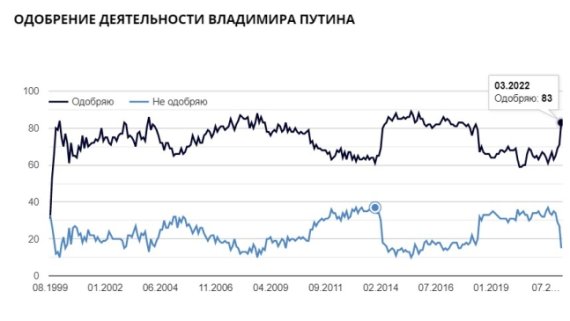 Approval rating trend of President Putin surveyed by Russian polling agency 'Levada' / Photo by Internet homepage capture
However, Burakovsky points out that the rally round the flag effect is only short-term. He stated, "Historically, diversionary wars?conflicts initiated abroad to divert attention from domestic issues?have rarely worked effectively. Overseas wars that involve enormous costs ultimately reduce the Kremlin's popularity. Time will tell."
◆Strong Government Information Control... Citizens' Eyes and Ears Are Covered
The second factor is information control. According to Burakovsky, the Russian government is currently implementing strong information control policies targeting state-run media within the country. A representative method is the prohibition of using the term 'war' when describing the Russia-Ukraine conflict.
Burakovsky explained, "Since February 21, Russian news shows have been spreading lies about Ukraine's security situation," adding, "An anchor on the state broadcaster 'Channel 1' even reported that the Ukrainian government was expelling citizens from the Donbas region." This means the government is disseminating false information to citizens to hide unfavorable facts and justify the war.
However, Burakovsky predicts that President Putin's approval rating will soon begin to plummet.
He noted, "During the Crimean invasion, Putin's approval rating soared to 89%. However, during other Russian military actions such as the Georgia invasion (2008) and interference in the Syrian civil war (2015), approval ratings declined. Once Russian soldiers sent to Ukraine return as corpses, the political cost Putin will have to pay domestically will be very high," he forecasted.
© The Asia Business Daily(www.asiae.co.kr). All rights reserved.



















