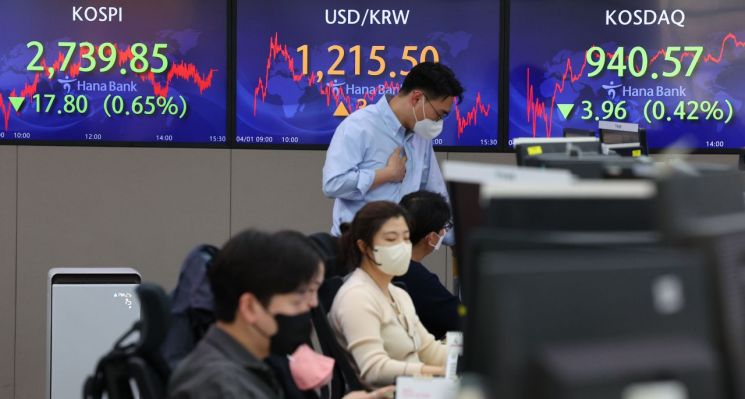
[Asia Economy Reporter Lee Jung-yoon] In the first quarter of this year, both the domestic stock and bond markets showed weakness, resulting in negative returns for related funds.
According to financial information provider FnGuide on the 3rd, as of the 1st of this month, the average year-to-date return of domestic equity funds with assets under management of 1 billion KRW or more was -7.89%. Domestic index equity funds, which aim to achieve returns similar to or matching the index, recorded an average return of -8.59%.
Active equity funds, which seek excess returns over the index through active management, also posted an average return of -6.29% this year, remaining in the loss territory. However, their decline was less severe than that of index funds.
By product, the leveraged exchange-traded fund (ETF) 'TIGER KRX BBIG K-New Deal Leverage,' which tracks the 'KRX BBIG K-New Deal Index' at twice the rate, recorded the lowest return among domestic equity funds this year at -35.00%.
The ETF 'KODEX Game Industry,' which posted high returns last year due to metaverse and NFT (non-fungible tokens), followed with a significant drop of -28.14%. On the other hand, ETFs such as 'KODEX Insurance' (15.93%), 'KODEX Steel' (10.10%), and 'TIGER Bank' (8.68%) recorded the highest returns among domestic funds.
Among funds excluding ETFs, active funds like 'Truston Fair and Square Performance Fee Securities Investment Trust [Equity-Derivative Type] I Class' (3.55%) and 'Korea Investment Small Cap Value Securities Investment Trust (Equity) (A1)' (3.53%) showed favorable returns.
Domestic bond funds (with assets under management of 1 billion KRW or more) recorded an average year-to-date return of -1.05%. Government bond funds (-2.45%), corporate bond funds (-0.58%), and general bond funds (-1.34%) are experiencing losses. However, ultra-short-term bond funds posted a positive return of 0.24% this year.
By product, ETFs mainly investing in long-term government bonds, such as 'KBSTAR KIS Treasury Bond 30-Year Enhanced' (-12.89%) and 'KOSEF 10-Year Treasury Bond Leverage' (-10.58%), ranked among the lowest in returns.
The domestic stock market showed weakness from the beginning of the year due to the Federal Reserve's (Fed) tightening issues, Russia's invasion of Ukraine, and economic instability caused by a sharp rise in commodity prices.
Furthermore, as the market reflects the Fed's accelerated tightening, concerns about economic instability have arisen recently due to the inversion of short- and long-term interest rates. At the end of last month, the yields on the 5-year and 30-year U.S. Treasury bonds inverted, followed by an inversion between the 2-year and 10-year U.S. Treasury bonds. Typically, long-term bond yields are higher than short-term yields. Long-term yields reflect economic outlooks, and when short-term yields invert past long-term yields, it is considered a signal of an economic recession.
Lee Eun-taek, a researcher at KB Securities, explained, "There is some distortion in interest rates, but since the inversion has not been deep or prolonged enough to cause concern, I do not think the probability of a 'recession' has absolutely increased. Generally, recessions appear 17 to 21 months after the yield curve inversion, so there is still time to observe the situation."
The domestic bond market also showed a sharp rise in interest rates this year, reflecting the Fed's tightening. Rising interest rates mean falling bond prices. The yield on the 3-year government bond has risen 98.6 basis points (1 bp = 0.01 percentage points) this year, surpassing last year's increase of 82.2 basis points. The 10-year yield also rose 75.7 basis points, exceeding last year's increase of 53.7 basis points.
© The Asia Business Daily(www.asiae.co.kr). All rights reserved.

















