Survey Results of 380 Members from the Korea Chamber of Commerce and Industry
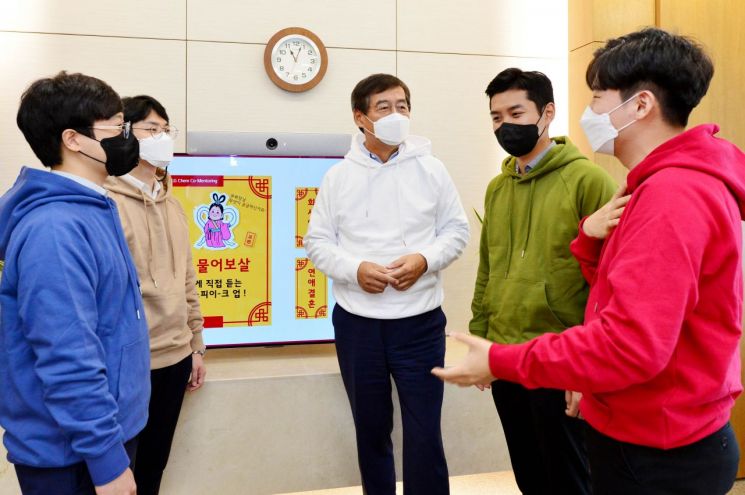 Shin Hak-cheol, Vice Chairman of LG Chem (center), receives communication tips from MZ generation mentors at his office in the LG Twin Towers, Yeouido, Yeongdeungpo-gu, Seoul. (Photo by LG Chem)
[Asia Economy Reporter Moon Chaeseok] A survey has revealed that the MZ generation (born between the 1980s and 2000s), known for being sensitive to companies’ ESG (Environmental, Social, and Governance) management, considers the 'level of ESG' an important criterion when purchasing products. The MZ generation identified Samsung, SK, LG, and Hyundai Motor as outstanding ESG companies.
The Korea Chamber of Commerce and Industry (KCCI) surveyed 380 members of the MZ generation and announced on the 3rd the results of the survey titled "ESG Management and the Role of Companies as Seen by the MZ Generation." About six out of ten respondents said they are willing to purchase products from companies practicing ESG even if the products are more expensive. When asked how much more they would be willing to pay for products from excellent ESG companies compared to similar products from competitors, 70% answered they would pay an additional 2.5% to 7.5%. The domestic companies considered best at responding to ESG management were Samsung, SK, LG, Ottogi, Yuhan-Kimberly, Pulmuone, and Hyundai Motor. Woo Tae-hee, Executive Vice Chairman of KCCI, stated, "As ESG spreads throughout society recently, public awareness of the role of companies is changing, and interest in social contribution and transparent, ethical management is increasing. Since the MZ generation, which leads public opinion and consumption, prefers to purchase products from good companies even if they are more expensive, our companies should actively engage in ESG management."
First, a tendency to seek psychological satisfaction over price was prominent. When asked which concept among newly coined terms reflecting value consumption they considered most important, the MZ generation most frequently chose 'Gasim-bi' (46.6%). This indicates that psychological satisfaction is valued more than performance when purchasing products. Other terms followed: 'Meaning Out' (28.7%), 'Donzzul' (10.3%), and 'Flex' (7.9%). 'Meaning Out' refers to a consumption style expressing one’s beliefs beyond price and quality. 'Donzzul' means a purchasing movement that punishes companies causing social controversies through boycotts, and 'Flex' refers to boastful or ostentatious consumption.
Regarding eco-friendly products corresponding to the 'E' in ESG, 'label-free PET bottles' (41.1%) were the top choice. This was followed by 'electric/hydrogen vehicles' (36.3%), 'recycled plastic clothing' (13.7%), and 'eco-friendly detergents' (7.9%). Lee Jae-hyuk, Director of the ESG Research Center at Korea University, said, "As the MZ generation, which prioritizes Gashim-bi (psychological satisfaction over price-performance), emerges as the main consumer group, the tendency to consume according to beliefs, such as using ESG practices as a purchasing criterion when quality is similar, is spreading. Since ESG issues can be easily shared with the public through SNS and online platforms, companies need to pay more attention to ESG management."
They placed great importance on how well companies uphold transparent management ethics. When asked about the desirable role of companies, the MZ generation’s highest response was 'practicing transparent ethical management' (51.3%). This was 22.4 percentage points higher than 'job creation' (28.9%), which is considered an important social contribution by companies. Other responses included 'environmental protection' (13.2%), 'faithful national tax payment' (2.1%), and 'volunteer activities' (3.4%). Regarding why they care if a company practices ESG management when considering employment, the answers were 'aligns with current environmental and social issues' (50.3%), 'high potential for future growth and development' (29.5%), and 'judged to have good corporate culture and work environment' (18.7%). Yoon Cheol-min, Director of ESG Management at KCCI, explained, "This reflects the MZ generation’s era and social values emphasizing fairness and justice, as well as their experience with employment difficulties due to COVID-19, projected onto the roles they expect from companies."
There was also a tendency to regard ESG management not just as an improvement in management philosophy but as a key factor determining corporate competitiveness. When asked about their top priority if they became CEOs, 82.1% chose 'enhancing corporate competitiveness.' This was followed by 'improving corporate culture and employee welfare' (61.1%) and 'practicing ESG management' (60.3%). Responses for 'producing affordable, high-quality products and services' (36.8%) and 'protecting shareholder rights' (23.4%) were relatively lower.
For the spread of ESG management, respondents said government tax support and other measures are necessary. When asked what is expected to play the most important role in the continuous expansion of ESG management, answers included 'overall improvement of public awareness' (38.4%), 'government legal and institutional support' (27.9%), and 'leading by example from large corporations' (27.6%). This indicates that ESG is not just a corporate issue but requires consensus-building among the public, government, and companies on the importance of ESG. Regarding urgent policies to support ESG management in small and medium-sized enterprises, 'providing tax and interest benefits' (36.6%) and 'building government-level ESG management solutions and portal infrastructure' (36.3%) received high responses. Other selected measures included 'financial support for voluntary ESG management' (14.5%) and 'providing specialized ESG consulting and customized education' (11.6%).
To spread so-called 'pro-business' sentiment, the most urgent tasks for companies and government were improving 'corporate governance and management transparency' (36.6%) and 'contributing to economic growth through job creation and investment expansion' (36.6%).
© The Asia Business Daily(www.asiae.co.kr). All rights reserved.

















