Lee: "We Have Been Fighting an Underdogma Frame War"
Criticizes Targeting the Weak and Entrenched Political Grammar
"It Is Only One Axis of Conflict, Hatred, and Factional Politics"
 Lee Jun-seok, leader of the People Power Party, is attending the discussion forum on "Introduction Plans and Challenges of the Personal Budget System for Persons with Disabilities" held at the National Assembly Members' Office Building on the 1st, delivering a congratulatory speech. Photo by Yoon Dong-joo doso7@
[Asia Economy Reporter Lee Hyun-joo] Lee Jun-seok, leader of the People Power Party, announced that he will hold a debate with the National Solidarity for the Elimination of Disability Discrimination (Jeonjangyeon). It is welcome that the leader of a political party will hold a debate with a civic group representing the disabled on disability policies, but whether it will be a productive policy discussion remains uncertain.
Leader Lee criticized Jeonjangyeon, which staged protests during subway commutes, saying they must "abandon the stubbornness that they can make unreasonable demands by holding Seoul citizens hostage (Facebook, March 27)" and that they "continue illegal protests with an uncivilized perspective that their claims are realized only by causing the greatest unhappiness and inconvenience to the majority (People Power Party Supreme Council meeting remarks, March 28)." He claimed that those engaged in minority politics have waged a frame war with an "underdogma" discourse ("the weak are good and the strong are evil") rather than discussing minority issues (Facebook, March 26).
However, it is Leader Lee who better utilizes the frame war. When disabled people protest inside the subway, someone inevitably experiences inconvenience. Lee cleverly exploits this point, creating a conflict between disabled and non-disabled citizens. By pinpointing everyday inconveniences so precisely, he gives the impression that he is "speaking the truth." His position as the party leader, elected with the support of the majority, adds legitimacy. Meanwhile, the values that disability organizations have advocated for decades, including mobility rights, are all muted. Ultimately, the debate is distorted into a fight between the minority and the majority, ensuring Lee’s chances of winning. Professor Hong Sung-soo of Sookmyung Women’s University Law Department pointed out, "Usually, there are relatively few cases of overt hatred toward disabled people. However, just because overt hatred is absent does not mean there is respect as fellow citizens. It is closer to a so-called 'paternalistic gaze.' The shift from a paternalistic perspective to discrimination happens in an instant (Facebook, March 29)."
Leader Lee’s strategy of attacking the weak is the very language of entrenched political power. In the 21st presidential election, the People Power Party judged that political cohesion among women in their 20s was relatively weak compared to men in their 20s, and adopted a "divide and conquer" strategy symbolized by the "abolition of the Ministry of Gender Equality and Family." Although this was somewhat weakened by a narrow victory margin of 0.73%, conservative vested interests have continuously sought vulnerable groups to attack to consolidate their support base. Political commentator Park Sang-byeong criticized, "This kind of politics is neither future-oriented nor legitimate, and it does not help national unity at all. It only continuously reproduces conflict, division, hatred, and factional politics." Park added, "It is a method of maintaining vested interests by gaining the support of the absolute majority. In the past, similar politics thrived in the U.S. by attacking Black people, Asians, or Latin Americans. Korean politics seems to be heading in that direction as well, which is regrettable."
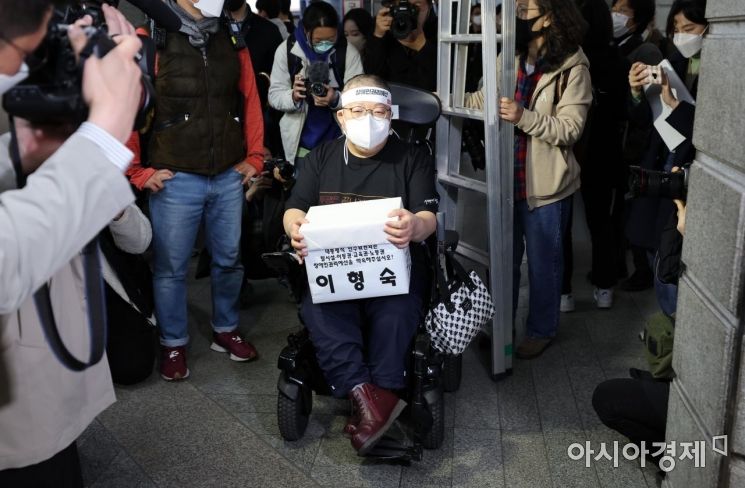 On the 30th of last month, at the subway platform of Gyeongbokgung Station on Seoul Subway Line 3 in Jongno-gu, Seoul, Lee Hyung-sook, Chairperson of the Seoul Disabled Independent Living Center Council, is boarding the subway after shaving her head during the head-shaving protest resolution ceremony held by the National Solidarity for the Elimination of Discrimination against Persons with Disabilities, urging the transition team to respond to demands for the disability rights budget and related law amendments. Photo by Kim Hyun-min kimhyun81@
Leader Lee confidently claims that he has not engaged in disability hatred. The National Human Rights Commission defined hate speech in its "Survey on Hate Speech and Regulatory Measures (2017)" as "expressions that discriminate against or incite discriminatory violence against individuals or groups because they possess attributes as social minorities." Of course, Leader Lee has not explicitly uttered direct hate speech against disabled people. However, he pursues a strategy of frame wars that achieves political effects while minimizing his own responsibility.
One of the political ideologies (platform) pursued by the People Power Party is "We strive for national unity beyond conflict and division and do not reject the past based on factional logic." "Walking with the vulnerable" is also included in the top ten promises. On the 1st, Leader Lee listened to opinions at a meeting with the "National Parents’ Association of Users of Residential Facilities for the Disabled," which opposes deinstitutionalization of disabled people, and attended a debate on "Introduction and Challenges of the Personal Budget System for the Disabled" hosted by People Power Party lawmaker Lee Jong-seong. Although somewhat sudden, since Leader Lee himself vowed that the People Power Party would present related policies before the launch of the Yoon Suk-yeol administration without merely giving lip service to disability groups, attention is focused on whether disability policies, which have always been deprioritized during budget deliberations, will gain momentum this time.
© The Asia Business Daily(www.asiae.co.kr). All rights reserved.


















