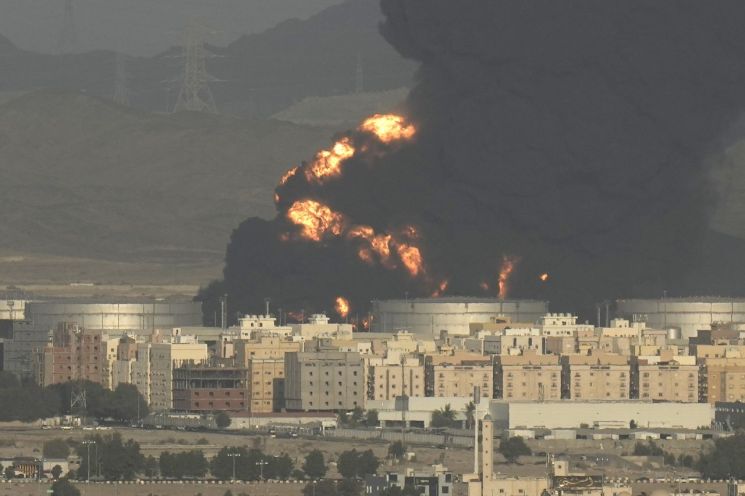
 On March 25 last year (local time), flames and black smoke rose from an oil storage facility in Jeddah, a southern city of Saudi Arabia, after being attacked by Yemeni rebels.
 [Image source=AP Yonhap News]
[Asia Economy Reporter Kim Daehyun] The Iran-backed Houthi rebels and the Saudi Arabia-led Arab coalition in the Yemen civil war have agreed to a two-month ceasefire.
According to foreign media including the AP on the 1st (local time), Hans Grundberg, the UN special envoy to Yemen, announced that a two-month ceasefire agreement has been reached and that the ceasefire could be extended thereafter.
The ceasefire will take effect at 7 p.m. on the 2nd, the first day of Ramadan, the Islamic fasting month, and fuel imports through Hodeidah, Yemen's major port city, and passenger flights at Sana'a airport will also resume.
This agreement came after the Saudi-led coalition supporting the Yemeni government forces unilaterally announced a ceasefire on the 30th of last month. Initially, the Houthi rebels said, "There is nothing new in Saudi Arabia's proposal," and "We expected Saudi Arabia to first lift the blockade on the port and airport," indicating rejection, but ultimately the agreement was successful.
UN Secretary-General Antonio Guterres evaluated, "This agreement should be the first step to ending Yemen's devastating war." U.S. President Joe Biden welcomed it as "a reprieve for the people of Yemen," while also stating, "It is a very important step forward but still not enough," and "The war must be ended."
The Yemen civil war, ongoing for six years since 2015, has been prolonged due to the standoff between the Saudi-led Arab coalition, which has blockaded Yemen's airports and ports, and the Houthi rebels who have gained control of most of the territory through local battles within Yemen.
As the Arab coalition blockaded the Hodeidah port, through which over 70% of Yemen's essential goods enter, millions of Yemenis have suffered shortages of food and medicine, drawing criticism from the international community for inhumane blockade measures.
© The Asia Business Daily(www.asiae.co.kr). All rights reserved.

















