Synthetic ETFs are TRS Contracts... Products Guaranteeing Underlying Index Returns
Physical ETFs Include Real Assets Like Stocks and Bonds
Physical ETFs Can Sell Assets to Return Money to Investors
Synthetic ETFs Mostly Hedge with Futures... Liquidated if Index Hits '0'
Only Physical Hedge Asset Remaining is 'iShares MSCI Russia ETF'
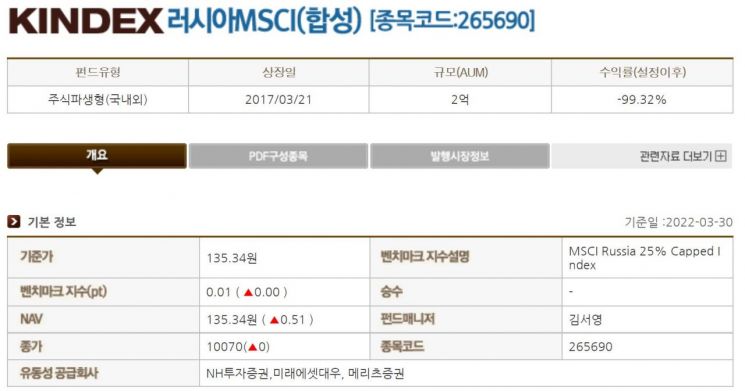
[Asia Economy Reporter Hwang Yoon-joo] The 'KINDEX Russia MSCI (Synthetic) ETF' has almost no chance of preserving the principal even if it avoids delisting.
According to Korea Investment Trust Management on the 3rd, all futures among the hedge assets of the 'KINDEX Russia MSCI (Synthetic) ETF' have been liquidated, and discussions are underway with authorities to resume trading only in the physical assets.
The 'KINDEX Russia MSCI (Synthetic) ETF' is a synthetic product, so it is impossible to recover the principal over time.
ETFs are broadly classified into physical and synthetic types. Physical ETFs operate by incorporating physical assets such as stocks and bonds. Therefore, even if a physical ETF is delisted or encounters problems, it can sell the physical assets it holds and distribute the proceeds to investors.
On the other hand, synthetic ETFs enter into swap contracts with securities firms to guarantee the returns of the underlying index (underlying assets). Investors (asset managers) do not directly acquire physical assets (stocks, bonds, etc.) but pay fees, while the securities firms purchase the physical assets on their behalf. However, the investors (asset managers) bear the gains and losses according to the returns.
Synthetic ETFs were first introduced domestically by Korea Investment Trust Management in 2013. After entering into total return swap (TRS) contracts with securities firms, they incorporate these into ETFs to receive performance. They have the advantage of allowing indirect investment in regions or products that are difficult to access directly, such as emerging markets. Also, when investing in the U.S., where dividend income tax is high, there is a tax-saving effect since it is not a direct investment.

The problem is that the 'KINDEX Russia MSCI (Synthetic) ETF' included both futures and some physical assets as hedge assets. Physical assets such as stocks and bonds can resume trading even if their value declines, and if demand surges, their value can rise again. However, futures are different. If there is a loss at maturity, collateral assets are disposed of to cover it.
When the Russia-Ukraine war began, the ruble's value plummeted, and the Russian stock market was closed, causing extreme volatility. MSCI applied a value of '0.00001' to all Russian stocks in its indices. As the Russian futures prices converged to '0', all were liquidated.
Among the hedge assets of the 'KINDEX Russia MSCI (Synthetic) ETF', the futures cannot be revived, leaving only physical assets such as the 'iShares MSCI Russia ETF'.
An asset management company official said, "Since most of the hedge assets of the KINDEX Russia MSCI (Synthetic) ETF are futures, even if trading resumes, only a portion of the investment can be recovered."
© The Asia Business Daily(www.asiae.co.kr). All rights reserved.