County, Solid Fuel Launch Vehicle Test Success
Ministry of Science and ICT Developing Liquid Engine
Concerns Over Low-Cost, High-Efficiency Next-Generation Launch Vehicle Project Amid Self-Reliance Challenges
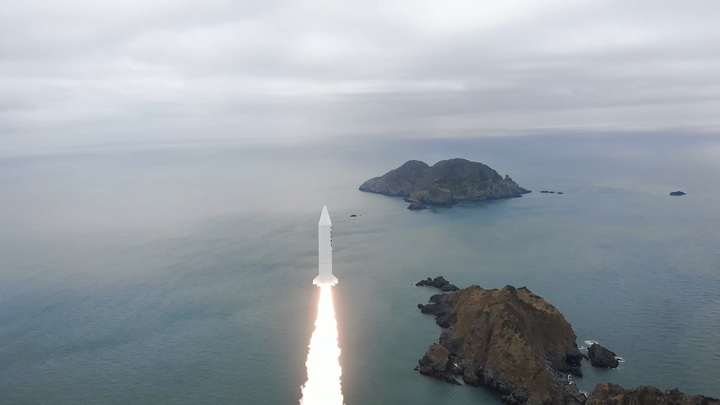 Solid-propellant space launch vehicle test-fired by the Agency for Defense Development on the 30th. Photo by Ministry of National Defense
[Asia Economy Reporter Kim Bong-su] The Agency for Defense Development (ADD) announced the success of the first test launch to verify the performance of a solid-propellant space launch vehicle developed purely with domestic technology, but the Ministry of Science and ICT is not optimistic. This is because the military is developing solid engines while the government is developing liquid engines, causing confusion in the development of Korea's space launch vehicle.
◇ Controversy over Inter-Ministerial Self-Interest
According to the space industry on the 31st, as the era of full-fledged private space development, led by SpaceX and others, has opened, Korea also faces an essential need to develop inexpensive and stable independent space launch vehicles for satellite launches and lunar and Mars exploration. However, with the civilian, government, and military sectors working separately, concerns are rising over high costs, inefficiency, and schedule delays in next-generation launch vehicle development.
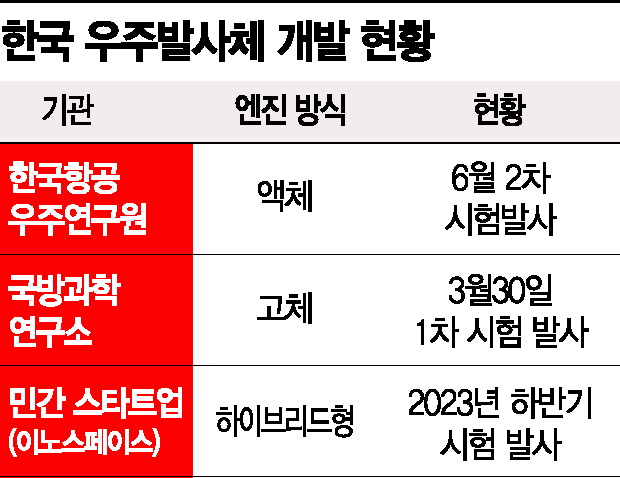
The military is independently pushing forward with solid-fuel rockets and satellite launches. The Agency for Defense Development (ADD) conducted a performance verification test of a space launch vehicle equipped with a solid-propellant engine at the ADD comprehensive test site yesterday. The military plans to use propulsion systems based on solid fuel for space launch vehicles capable of placing small satellites or multiple microsatellites into low Earth orbit. The development is scheduled to be completed by 2024, after which it will be deployed for launching small and clustered microsatellites. In this regard, the military expressed its intention to proceed with the space launch vehicle development plan at the Defense Science and Technology Committee held for the first time at the end of last year. Meanwhile, the Ministry of Science and ICT, the existing responsible ministry, has engaged in consultations, but an invisible power struggle over leadership of the entire space development project appears to be unfolding between ministries.
◇ Developed Nuriho Independently for 13 Years
The Ministry of Science and ICT is currently continuing the existing liquid engine Nuriho project centered on the Korea Aerospace Research Institute (KARI). After the second test launch scheduled for June 15, four additional units will be produced by 2026 to improve reliability, a plan that has been finalized. Nuriho is the largest space development project in history, with a total investment of about 1.975 trillion won. After more than 13 years of numerous trials, errors, and failures, independent development was successful. However, if it is not upgraded quickly, it will lack market competitiveness. The option of adding a solid-fuel booster has been discussed, but it requires redesigning from the ground up. Although KARI is developing core technology for the next-generation engine to succeed the 75-ton liquid engine of Nuriho, no concrete policy or vision has been established. Private companies are also working independently. The private startup Innospace plans to develop and test launch a 15-ton liquid-solid hybrid rocket by the second half of next year.
◇ Criticism of "Lack of Principles"
As the civilian, government, and military sectors each push forward with different types of space launch vehicle development, experts are voicing the need to quickly establish guiding principles and a vision for next-generation Korean launch vehicles to improve efficiency. One expert said, "There are voices questioning how many space launch vehicles Korea really needs," adding, "To utilize KARI's liquid engine technology and ADD's solid engine technology, inter-ministerial consultations must be promptly initiated." Shin Myung-ho, chairman of the KARI labor union, also criticized, "With the abolition of the Korea-US missile guidelines last year, regulations have been lifted, so the research field's voice is that low-cost, high-performance launch vehicles using solid engines and liquid methane should be developed to reduce costs and enhance competitiveness," adding, "Inter-ministerial self-interest is delaying decision-making in the development of Korean launch vehicles."
Meanwhile, the Ministry of Science and ICT responded, "We are continuously cooperating with the Ministry of National Defense regarding space launch vehicle development, and we frequently share development status, so there is no confusion between ministries," adding, "We are aware of the Ministry of National Defense's solid launch vehicle development status, and information about this flight test was shared with the Ministry of Science and ICT in advance by the Ministry of National Defense." The Ministry of Science and ICT further stated, "The next-generation launch vehicle currently under preliminary feasibility study application is being developed by the Ministry of Science and ICT using liquid propulsion, and the extended version to improve performance will be equipped with a solid booster," adding, "This matter has already been mutually shared between the two ministries."
© The Asia Business Daily(www.asiae.co.kr). All rights reserved.
![Clutching a Stolen Dior Bag, Saying "I Hate Being Poor but Real"... The Grotesque Con of a "Human Knockoff" [Slate]](https://cwcontent.asiae.co.kr/asiaresize/183/2026021902243444107_1771435474.jpg)

















