[Seoul District News] Mapo-gu Plants 2,874 Trees Over 1,600㎡ with Residents on 30th and 31st as Part of 5 Million Tree Project... Dongjak-gu Creates Roadside Green Belts and Neighborhood Flower Streets... Gangseo-gu Distributes Eco-Friendly Box Gardens... Eunpyeong-gu Offers Attractions with Bulgwangcheon Cherry Blossom Media Facade and LED Lighting, Opens Bulgwangcheon Media Center... Ryoo Kyung-gi, Jungnang-gu Mayor, Leads Traditional Market Spring Cleaning
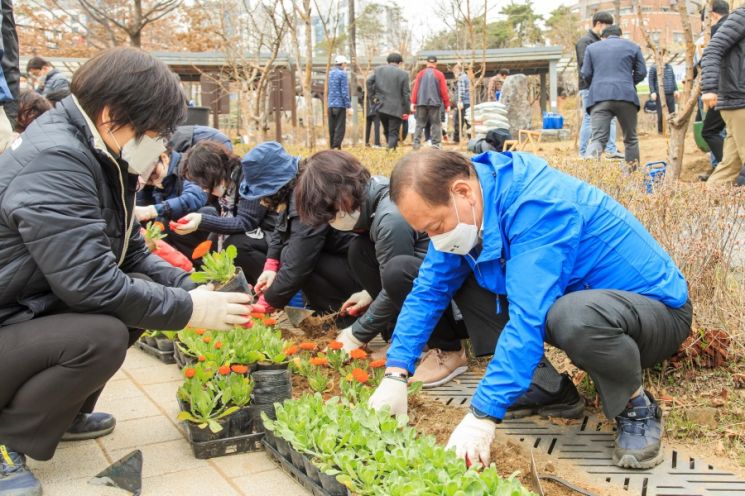
[Asia Economy Reporter Park Jong-il] Mapo-gu (Mayor Yoo Dong-gyun) held a tree planting event over two days on the 30th and 31st in celebration of the 77th Arbor Day.
This year's tree planting event was not limited to a single location; residents from 16 neighborhoods in Mapo-gu participated in a relay-style planting across eight sites, sharing the joy of welcoming spring together.
The event complied with COVID-19 social distancing guidelines, with each venue accepting up to 100 pre-registered participants.
Starting at 9 a.m. on the 30th with planting at the green space on Sinchon-ro, the relay continued hourly at ▲Ssangryongsan Neighborhood Park ▲Dokmakso Park ▲Tojeong Children's Park.
On the 31st, planting took place sequentially at ▲Yanghwajin Historical Park ▲Witjandari Children's Park ▲Mapo-gu Sports Center ▲Gyeongui Line Linear Forest, resulting in a total of 2,874 trees planted over 1,600㎡ during the two days.
This brings the 'Planting 5 Million Trees Project' one step closer to completion. The district aims to plant 5 million trees by 2027, having planted 2.28 million so far, and is accelerating efforts to plant 310,000 trees in 2022.
In March this year, through the 'Living Proximity Greening Project' jointly organized by the Korea Forest Service and Seoul City, 486 trees of 74 species were planted, transforming the Mapo-gu Office building into an indoor garden.
Starting in May, the district will actively promote the 'Gyeongui Line Linear Forest Phase 3 Development Project' utilizing the Gyeongui Line railway site (former Seongsan Driving School site). Private companies, civic groups, and local residents will participate in various planting events to convert the disconnected railway site into a park.
The district is also promoting the 'One Household One Tree Care' project, allowing individuals or families to plant commemorative trees on special occasions such as births, school admissions, weddings, or promotions. Applications can be made through the Mapo-gu website under 'Introduction to Mapo-gu ? Mapo News ? Notices ? 5 Million Trees Planting Commemorative Tree Planting.'
Yoo Dong-gyun, Mayor of Mapo-gu, who attended the relay planting event, said, "Planting trees is a fundamental and basic measure against worsening fine dust and abnormal climate," adding, "Thanks to the voluntary participation of residents like in this planting event, Mapo-gu is successfully creating a clean air city to pass on to future generations."
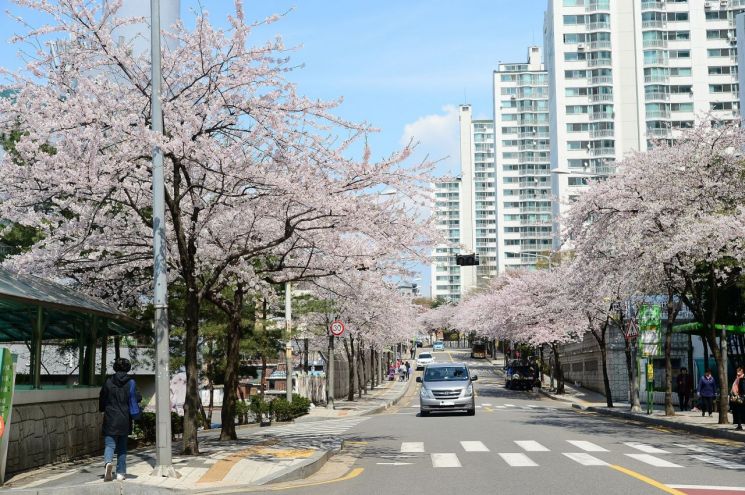
Dongjak-gu (Mayor Lee Chang-woo) is launching 'strip greening' along roadsides and 'Our Neighborhood Flower Road Creation' projects throughout the village to provide residents with a pleasant environment in spring.
Since last month, the district has installed hanging flower pots and street flower pots along four routes including Noryangjin-ro, two traffic islands (in front of Sangdo Station and Chung-Ang University Hospital), and around subway stations, planning to create themed flower beds planted with seasonal flowers, starting spring beautification.
Next, the district will renovate 175 meters of damaged strip green spaces along Nambu Sunhwan-ro and Dongjak-daero and create green spaces by planting diverse seasonal trees along 170 meters in front of Exit 9 of Dongjak Station.
The strip greening project involves planting trees and herbaceous plants in the spaces between street trees on sidewalks to increase green areas, which is expected to help absorb fine dust, promote healthy rainwater circulation through permeable layers, and prevent jaywalking by visually separating pedestrian and vehicle paths.
Additionally, the 'Our Neighborhood Flower Road Creation' project encourages local residents to cultivate green spaces together in alleys throughout the village.
With voluntary participation from resident autonomy committees, neighborhood leaders' associations, Saemaul Women's Associations, and other civic groups, distinctive flower roads suited to each neighborhood's season and location are being created, beautifying main and secondary roads and vacant lots to make the streets vibrant.
Kim Won-sik, Director of the Parks and Greenery Division, said, "I hope the scent of flowers in the city brings smiles to residents," and added, "We will do our best to create lively landscapes wherever residents visit in Dongjak-gu."
Every year from late March to early April, Dongjak-gu is home to famous spots where cherry blossoms cover entire streets. The most representative locations include the National Cemetery, the road from Noryangjin-dong to Sangdo-dong, and Manyang-ro.
At the National Cemetery, visitors can feel the solemnity of those who dedicated themselves to the country, and when weeping cherry blossoms, magnolias, and azaleas bloom, they can fully enjoy the spring atmosphere. Around the Noryangjin exam village, Manyang-ro is lined with cherry blossoms forming a tunnel. While Korea has many cherry blossom spots, this year a casual spring outing strolling through Dongjak-gu's streets would be delightful.
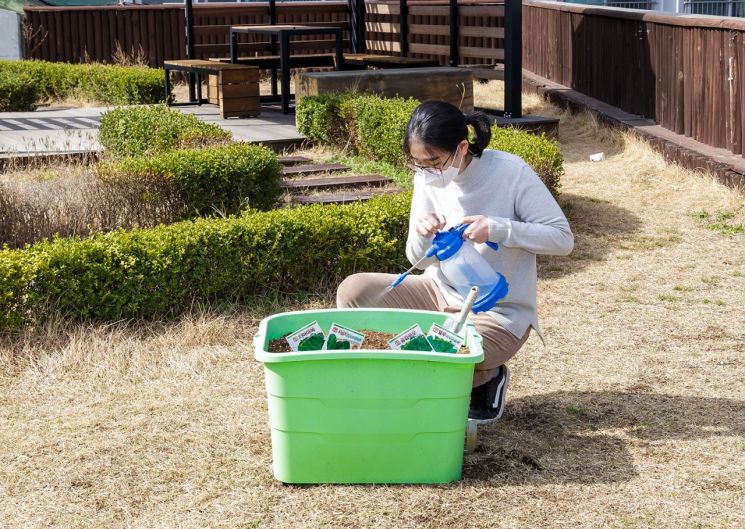
Grow eco-friendly vegetables and greens at home with your family.
Gangseo-gu, Seoul (Mayor Roh Hyun-song) announced it will distribute 'Eco-friendly Box Gardens' that allow residents to experience urban agriculture within their living spaces.
This initiative aims to help residents, who have difficulty going outside due to COVID-19, easily experience agriculture and enjoy healthy leisure activities. Last month, 1,507 households applied for 480 plots of the O-gok Garden Farm urban agriculture experience, showing growing interest among residents.
Accordingly, the district will distribute box gardens that enable cultivation of eco-friendly vegetables in living spaces such as balconies and rooftops. The box gardens consist of general box gardens (570 sets) including a box, 50 liters of soil, seedlings, and a cultivation manual, and smart box gardens (30 sets) that grow plants without soil using LED lights and automatic watering systems.
General box gardens will be distributed at one set per individual for 450 sets, with 50 sets reserved for seniors aged 65 and over. Additionally, up to five sets will be distributed to daycare centers, public institutions, and educational organizations, totaling 120 sets.
Smart box gardens will be distributed to educational organizations such as kindergartens, elementary, middle, and high schools, and public institutions, with up to three sets per applicant for 30 sets total.
Participants pay 20% of the cost: 8,500 KRW per set for individuals, and up to 42,500 KRW for institutions and groups for five sets. For smart box gardens, up to three sets cost 120,000 KRW.
Distribution starts on March 31 at 10 a.m. on a first-come, first-served basis, with winners announced on April 5. After paying the participant's share to the designated account, the box gardens will be delivered to individual addresses.
Residents or groups wishing to apply can visit the Gangseo-gu website and apply via 'Integrated Reservation - Online Application.' Seniors aged 65 and over can also apply in person at the Gangseo-gu Regional Economy Division.
An official said, "We hope the box gardens provide an opportunity to produce fresh food at home without going far and to learn by observing plant growth," adding, "We hope many people participate and enjoy the joy of harvest together."
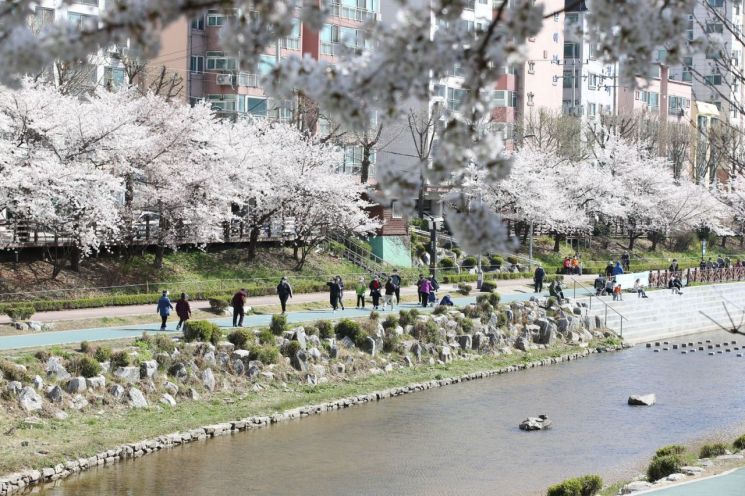
Eunpyeong-gu (Mayor Kim Mi-kyung) announced it will hold the 'Spring of Eunpyeong' event along the Bulgwangcheon Cherry Blossom Path from the 2nd to the 9th.
In line with the phased return to normal life, events featuring media facades and LED landscape lighting along the Bulgwangcheon cherry blossom path will be held to enjoy the beautiful blossoms.
Due to COVID-19 over the past two years, events like the Bulgwangcheon Cherry Blossom Festival were largely canceled, but this year, with gradual recovery, diverse events to enjoy the beautiful cherry blossoms have been prepared.
Under the theme of 'Spring,' media facades, LED landscape lighting enhancing the beauty of Bulgwangcheon cherry blossoms, and COVID-19 prevention and information booths will be operated to allow people of all ages to safely and enjoyably experience the cherry blossom path.
At 6 p.m. on the 2nd, the 'Bulgwangcheon Media Center' opening ceremony will be held. The center, newly established as part of the 'Bulgwangcheon Broadcasting Culture Street' project, will serve as a media culture hub for local residents.
It will offer various media-related programs needed in the digital age, including resident media education, filming, video production and editing, and broadcasting. Facilities include a video editing room for media production and practice, a one-person studio for personal broadcasting, and networking spaces, providing an accessible and beneficial space for residents interested in media to experience and share information.
On the same day, the '2nd Eunpyeong Cultural Tourism Platform Photo Contest' will also be held. Participants can enter by following the Eunpyeong Cultural Tourism (@eptour1) account and uploading photos of the beautiful Bulgwangcheon cherry blossoms with the hashtag #EunpyeongCulturalTourismPhotoContest.
Due to COVID-19 concerns, there will be no separate opening ceremony for the 'Spring of Eunpyeong' event. For more information, visit the Eunpyeong-gu website (ep.go.kr) or contact the Culture and Tourism Division at 02-351-6517.
An official said, "We hope the beautiful cherry blossoms of Bulgwangcheon and various attractions provide comfort to residents tired from COVID-19 and bring vitality to the community," adding, "We look forward to many residents participating in the 'Spring of Eunpyeong' event."
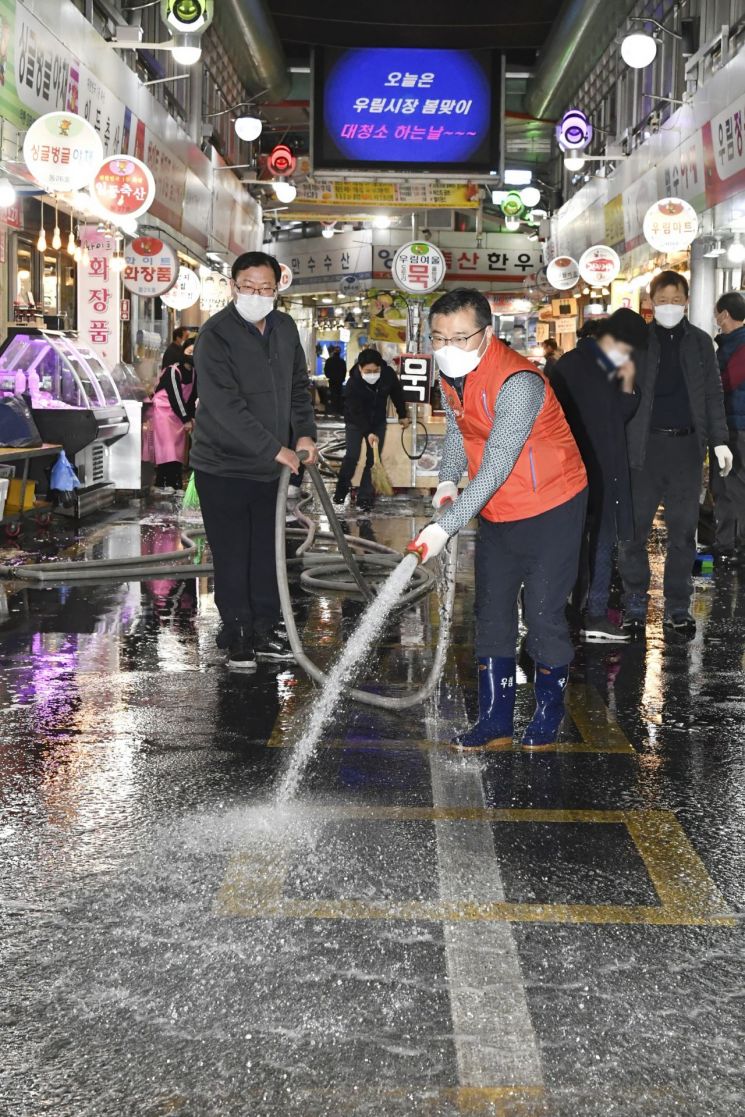 Ryu Kyung-gi, Mayor of Jungnang-gu, is cleaning the market with water to welcome spring together with merchants of Urim Golmok Market at 8 p.m. on the 28th.
Ryu Kyung-gi, Mayor of Jungnang-gu, participated in a spring cleaning event with merchants at Woorim Alley Market in Mangwoo-bon-dong, Jungnang-gu, at 8 p.m. on the 28th.
This cleaning event was organized to support traditional markets and small business owners struggling due to the prolonged COVID-19 pandemic and to ensure residents shopping at the market can do so in a clean and pleasant environment.
Mayor Ryu Kyung-gi swept and washed the market for about an hour alongside merchants at Woorim Alley Market.
Mayor Ryu said, "I joined the cleaning to wash away the dust accumulated over winter and welcome spring with a fresh mindset," adding, "I hope residents visit the now cleaner traditional market often."
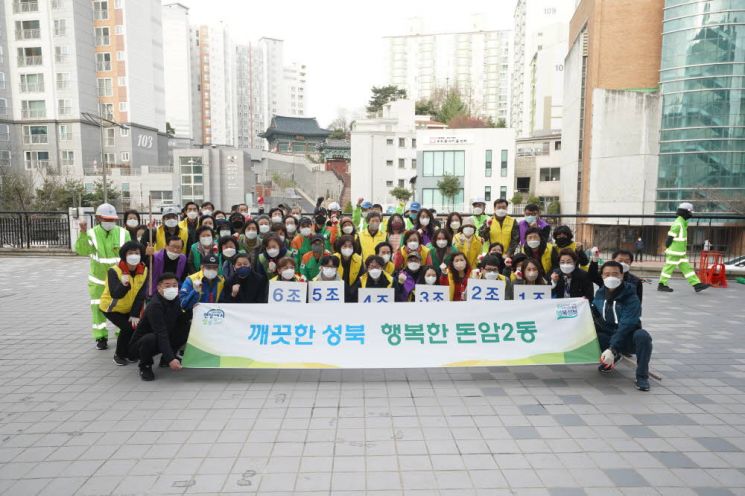 On the 20th, residents of Donam 2-dong and Lee Seung-ro, Mayor of Seongbuk-gu (front row, far right), took a commemorative photo before cleaning.
Seongbuk-gu (Mayor Lee Seung-ro) concluded its spring neighborhood voluntary cleaning campaign across all 20 neighborhoods on April 1. Residents, many suffering from COVID-19 blues, participated in large numbers, expressing that the campaign swept away their gloom and received great acclaim.
During the cleaning period, about 100 residents per neighborhood, including Mayor Lee Seung-ro, focused on cleaning vulnerable areas such as multi-use facilities and alleys. Cleaning vehicles were deployed on side streets to sweep away dust accumulated over winter.
On March 24 in Seokgwan-dong, Mayor Lee Seung-ro, residents, and district officials swept the streets to welcome spring. Seongbuk-gu's voluntary cleaning campaign has served as more than just 'sweeping in front of one's home or store' but as an administrative cleaning effort.
Since 2018, over 500 voluntary cleaning activities have been conducted with participation from 25,000 residents. Before COVID-19, monthly neighborhood cleaning days were held, gathering local residents, the mayor, and district executives to maintain the environment, fostering resident interest and participation.
The cleaning sites where residents gathered were sometimes called 'small-scale mayor's offices.' On mornings when the district's flagship 'On-site Mayor's Office' was held, cleaning with residents was always conducted, allowing the mayor to closely inspect small alleys and listen to opinions from the field.
Mayor Lee Seung-ro said, "Through voluntary cleaning, Seongbuk-gu has created a pleasant living environment and laid the foundation for people-centered field administration," adding, "Seongbuk-gu's resident cleaning is more than environmental maintenance; it is a communication platform where policies are formed."
© The Asia Business Daily(www.asiae.co.kr). All rights reserved.
![Clutching a Stolen Dior Bag, Saying "I Hate Being Poor but Real"... The Grotesque Con of a "Human Knockoff" [Slate]](https://cwcontent.asiae.co.kr/asiaresize/183/2026021902243444107_1771435474.jpg)


















