Emergency Measures under the Child Abuse Punishment Act Also Increased by 46.8%
[Asia Economy Reporter Jo In-kyung] Since the implementation of the 'Immediate Separation System,' which mandates the separation of abused children from their abusers as soon as child abuse is detected, a total of 1,043 'immediate separation' measures were taken last year alone.
The Ministry of Health and Welfare announced these results on the 29th as a mid-term review of the system's implementation status, one year after its introduction.
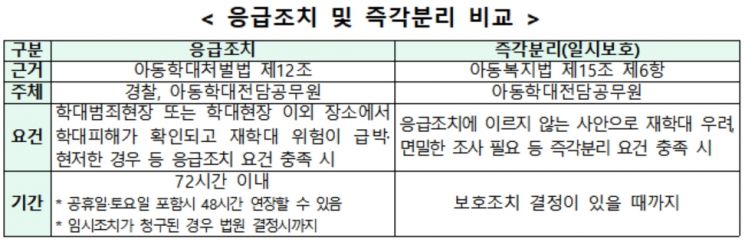
The Immediate Separation System allows local governments to place abused children in temporary care facilities, shelters for abused children, or suitable foster homes until a protective measure decision is made. Through 'immediate separation,' children are protected when detailed investigations and protective actions by local governments are necessary. This system was established to address the limitations of the existing emergency protective measures under Article 12 of the Child Abuse Punishment Act, which only allowed a 72-hour protection period and made separation difficult if abuse was not confirmed, enabling rapid and proactive protection of children in the field.
According to the Ministry of Health and Welfare, from the system's implementation on March 30 last year until December 31, approximately nine months, a total of 2,831 separation measures were taken. Among these, 1,043 were immediate separations, and 1,788 were emergency measures. Emergency measures increased by 46.8% compared to the same period the previous year, and the total on-site separation measures combining emergency and immediate separations increased by 132.4%.
The Ministry explained that the introduction of the Immediate Separation System enabled child abuse response officials (child protection agencies) and police to actively and promptly protect abused children in the field.
Additionally, among cases subjected to immediate separation, 982 cases (94.2%) were determined to be actual child abuse after further investigation, while 61 cases (5.8%) were general cases not involving abuse. Over the past five years, 70-80% of suspected child abuse reports were ultimately confirmed as child abuse, so this rate significantly exceeds that level.
Among the cases confirmed as child abuse, currently 732 cases (74.5%) involve children living with relatives, in foster care, or in shelters for abused children. The remaining 241 cases (24.5%) returned to their original families after case management for parents and family reunification programs. The Ministry plans to support children in returning home through family reunification programs when protection in the original family is possible.
Yang Seong-il, First Vice Minister of Health and Welfare, stated, "Thanks to the active efforts on the ground, we have proactively secured the safety of children at high risk of abuse through immediate separation," adding, "We will continue to gather field opinions and continuously improve the child abuse response system we have built to ensure it functions well in practice."
© The Asia Business Daily(www.asiae.co.kr). All rights reserved.
![Clutching a Stolen Dior Bag, Saying "I Hate Being Poor but Real"... The Grotesque Con of a "Human Knockoff" [Slate]](https://cwcontent.asiae.co.kr/asiaresize/183/2026021902243444107_1771435474.jpg)

















