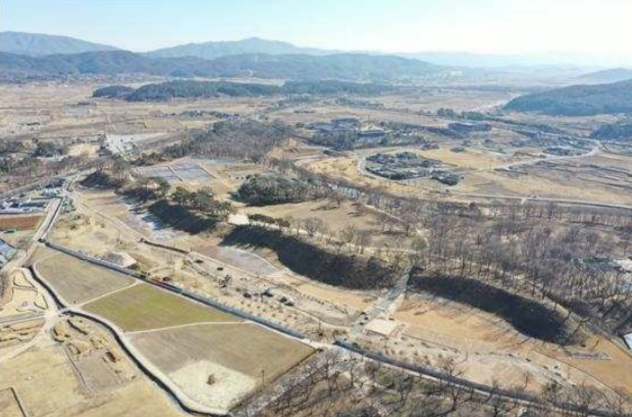
[Asia Economy Reporter Seomideum] The Cultural Heritage Administration will open the Gyeongju Wolseong Moat to the public starting from the 31st. This follows over 30 years of excavation investigations that began in 1984 and more than three years of restoration work that started at the end of 2018.
The Gyeongju Wolseong Moat was first identified during a trial excavation in 1984. Several excavation investigations were conducted until 2021. As a result, it was revealed that before the unification of the Three Kingdoms by Silla, the Wolseong Moat was a pit moat (suhyeolhaeja, 4th?7th century) filled with water by digging into the ground. After unification, a stone-walled moat (seokchukhaeja, post-8th century) was constructed by building stone walls above the pit moat to retain water. This stone-walled moat method is considered to have added a landscaping significance to the original defensive function of the pit moat.
The moat, which has been restored and is now open to the public, preserves the original underground pit moat and stone-walled moat while reconstructing the structure and form of the Unified Silla stone-walled moat on the upper layers as faithfully as possible, enabling the moat’s original function of water retention.
As part of the restoration and maintenance project of the core relics of the Silla royal capital, a total of 10.1 billion KRW (including local government funds) has been invested since 2018 in the Wolseong Moat restoration and maintenance project, which spans a total length of 550 meters (maximum width 40 meters). In addition to the moat restoration, the project includes visitor pathways, landscape lighting, and a circulating water supply system. To the south, the Namcheon River serves as a natural moat, and to the north, an artificial moat surrounds Wolseong, recreating the original function and appearance of the Wolseong Moat, which holds significant meaning.
The Cultural Heritage Administration stated, “We will continue to make multifaceted efforts to ensure that the restoration and maintenance project of the core relics of the Silla royal capital proceeds systematically and actively with public support, and that it leads to effective utilization.”
© The Asia Business Daily(www.asiae.co.kr). All rights reserved.
![Clutching a Stolen Dior Bag, Saying "I Hate Being Poor but Real"... The Grotesque Con of a "Human Knockoff" [Slate]](https://cwcontent.asiae.co.kr/asiaresize/183/2026021902243444107_1771435474.jpg)
















