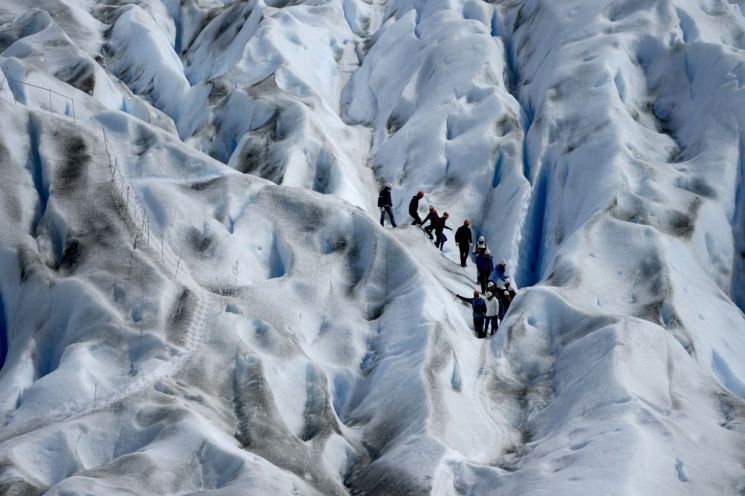
 Tourists are trekking in the Perito Moreno Glacier area of the national park near El Calafate, Argentina.
 [Image source=Yonhap News]
[Asia Economy Reporter Hwang Sumi] A warning has been issued that the tropical glacier on Puncak Jaya, the highest peak in Indonesia, will completely disappear by 2025.
According to Yonhap News on the 27th, Dwi Korita Karnawati, head of the Indonesian Meteorology, Climatology, and Geophysics Agency (BMKG), recently reported to the National Assembly about the shrinking glacier on Puncak Jaya, as reported by the state-run Antara News Agency.
Puncak Jaya in Papua Province, Indonesia, stands at 4,884 meters above sea level and is the highest mountain located on an island rather than a continent. Despite the tropical climate near the equator, its great height allows for perennial snow and tropical glaciers that do not melt year-round at the summit.
However, due to recent climate change, the glacier has been continuously shrinking. According to Head Karnawati, the glacier on Puncak Jaya has shrunk from an original 200 km² to only 2 km², which is just 1% remaining. Tropical glaciers are more affected by warming than Arctic and Antarctic glaciers, making them a tangible indicator of the scale of climate change.
Head Karnawati warned that if the current temperature rise due to climate change continues, the glacier at the summit of Puncak Jaya will no longer be visible by 2025.
Authorities explain that snow that used to fall on the summit is now falling as rain due to global warming, melting the existing glacier. As the glacier melts, the surrounding rocks darken, absorbing more heat and causing further melting of the adjacent glacier.
BMKG reported that the glacier thickness at the summit of Puncak Jaya rapidly decreased from 32 meters in 2010 to 27 meters in 2015, 22 meters in 2016, and 8 meters in 2021, estimating that it will completely disappear between 2025 and 2027 if this trend continues.
Earlier, in December 2019, a study published in the Proceedings of the National Academy of Sciences of the United States revealed that the Puncak Jaya glacier was melting rapidly and would disappear within ten years.
Professor Lonnie Thompson of the Byrd Polar and Climate Research Center at Ohio State University, who led the study, explained that the Puncak Jaya glacier began melting 150 years ago, but the rate of melting has accelerated sharply in the past decade. He added that this tropical glacier serves as an indicator of what will happen worldwide and can be regarded as a sign of the climate crisis.
© The Asia Business Daily(www.asiae.co.kr). All rights reserved.

















