Seoul Northern District Court Acquits Four Accused of Planned Real Estate Fraud in First Trial
Prosecutor Files Appeal on February 23
Victims Deceived by Fabricated Letters of Intent and Professor Involvement

[Asia Economy Reporter Gong Byung-sun] In February, Judge Choi Seon-jae of the Seoul Northern District Court Criminal Division 13 acquitted four people, including Yoo Mo, the CEO of a planned real estate company, who were charged with fraud and violation of the Door-to-Door Sales Act in the first trial. From July 2017 to December 2020, they purchased forest land in development-restricted areas and sold it in the form of shared ownership, earning about 130 billion KRW in profits.
The court explained in its acquittal, “It is difficult to consider that it has been sufficiently proven that the CEO and branch manager instructed salespeople to engage in deceptive acts or tacitly conspired.”
However, the victims were outraged by the court’s judgment. They pointed out that the decision, which left only victims and let perpetrators go free, was unreasonable. Because of this, even though the planned real estate fraud controversy has been ongoing for two years, victims’ recovery of damages remains difficult. The prosecutor in this case filed an appeal on February 23.
Recovery from planned real estate fraud is also sluggish elsewhere. At the Bucheon branch of the Incheon District Court, related to the country’s largest planned real estate company ‘Woori Auction,’ seven people including Jung Mo, the management of Woori Auction Bupyeong branch, are undergoing first trial for fraud charges. This trial was filed on December 19, 2019, but the first trial has yet to be concluded.
How Planned Real Estate Fraud Is Carried Out
Planned real estate fraud is carried out by deceiving buyers into believing that land that cannot be developed has favorable prospects. A typical example is development-restricted zones. They claim that regulations on development-restricted zones or nearby land will be lifted, causing prices to rise. They also assert that they will expand their business to buildings or officetels. Of course, all of this is a deception.
However, most victims are not buyers who come to see the land but employees. They lure employees in a multi-level employment fraud format and then have them sell the land. In some companies, sales quotas were given, and if employees failed to meet sales targets, they were forced to buy the land themselves.
Employees are attracted by the ease of employment and the fact that they are paid daily wages rather than monthly salaries, leading them to work for planned real estate fraud companies. This indicates that the fraud targets low-income groups. Additionally, they exploited the public perception that land sold through auctions is cheap, making it easy to sell land even to low-income people.
From Mobilizing Professors to Forging Letters of Intent... Victims Can Only Sigh
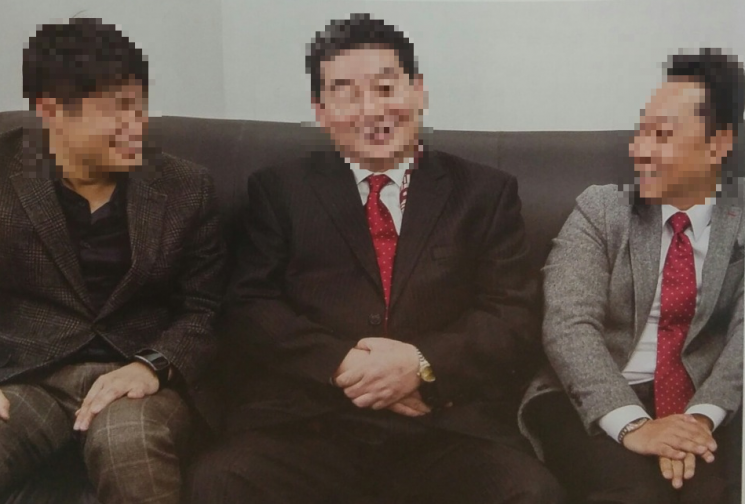 An introduction to Uri Auction featured in a media outlet. In the center is Professor Park, and on the right is former Uri Auction chairman Mr. Hwang. Mr. Hwang was sentenced to 2 years and 6 months in prison in August 2020 for fraud and violation of the Door-to-Door Sales Act.
There is evidence that professors were even mobilized to deceive employees. According to a tip, a nameplate of Professor Park Mo, who previously worked in the Department of Real Estate at a certain university, was hung in the office of Woori Auction Bupyeong branch. Informant A said, “Professor Park visited during Woori Auction’s New Year events and talked about his connection with former Woori Auction chairman Hwang Mo,” adding, “Woori Auction management gained favor by entering Professor Park’s research institute and office whenever important matters arose.”
It appears that even letters of intent to purchase were forged to deceive employees. The victims testified that defendant B, who is on trial at the Bucheon branch of the Incheon District Court, distributed a bankbook with 50 billion KRW deposited and a paper with the company name written on it to employees. B explained that this paper was a letter of intent to purchase land in Geumto-dong, Seongnam City, on behalf of the company. Subsequently, employees believed that a company with large capital would invest and either sold or directly purchased the land.
However, there is only one company with the same name in Seongnam City, and its capital is confirmed to be only 10 million KRW. The letter of intent is also crude and unconvincing. A legal expert said, “Although there is no clear format for letters of intent, expressing purchase intention by writing the company name on a bankbook is not standard,” adding, “If B gave this document to employees, it could be physical evidence proving guilt.”
Victim C lamented, “When the planned real estate fraud issue first became a topic, I thought the money taken would be recovered quickly,” and added, “Many victims still spend their days in tears, outraged that they were deceived.”
© The Asia Business Daily(www.asiae.co.kr). All rights reserved.


















