[Asia Economy Reporter Choi Seok-jin, Legal Affairs Specialist] A court ruling has stated that even if a childcare teacher accused of abusing children was acquitted in both the first and second criminal trials, it was justified to dismiss the teacher suspected of child abuse.
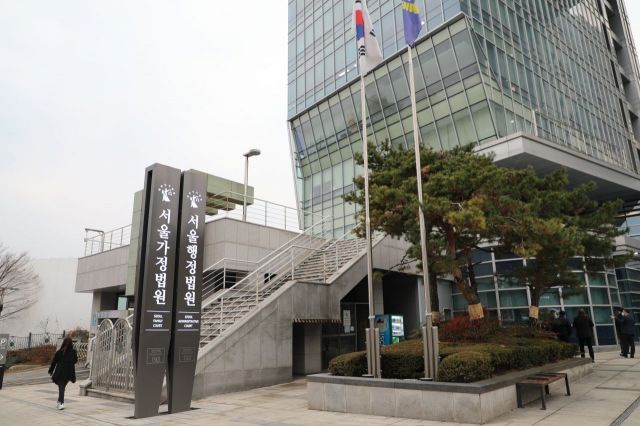
According to the legal community on the 27th, the Seoul Administrative Court, Administrative Division 14 (Chief Judge Lee Sang-hoon) ruled in favor of daycare center director A in a lawsuit seeking cancellation of the Central Labor Commission chairman’s decision on unfair dismissal relief reconsideration.
The court stated, "The reconsideration decision made by the Central Labor Commission on June 10, 2020, regarding the unfair dismissal relief reconsideration application case between plaintiff (A) and the assisted participant (childcare teacher) is hereby canceled."
A, who operates a daycare center in Gyeongju-si, Gyeongsangbuk-do, witnessed signs of child abuse by childcare teacher B, who was in charge of the 1-year-old class consisting of children aged 12 to 23 months, while reviewing CCTV footage of the daycare center on October 2, 2019.
On October 4 and 7 of the same month, A showed the footage to B and requested an explanation, then decided to hold a daycare operation committee meeting to determine disciplinary action against B.
B opposed, stating that it was not a matter for the operation committee and that if reported to investigative authorities, a thorough investigation would be conducted. Additionally, the Public Solidarity Labor Union, to which B belonged, sent an official letter to A demanding cessation of unfair labor practices.
Ultimately, on October 7, 2019, A reported B to the police on charges of violating the Child Welfare Act (child abuse) and held an operation committee meeting the next day.
The operation committee, consisting of seven members including director A, one teacher representative, four parent representatives, and one local community member, held a meeting attended by six members excluding one parent representative. The committee unanimously agreed that it was appropriate for B, suspected of child abuse, to resign.
Accordingly, on October 18, 2019, A dismissed B for reasons including ▲disobedience and threats against daycare work orders without just cause ▲causing or intending to cause significant damage to the daycare center ▲seriously damaging the daycare center’s reputation ▲emotional abuse of children, and notified B of the dismissal via certified mail.
Before B’s dismissal, some parents expressed unease about entrusting their children to the daycare where B worked, withdrawing their children from A’s daycare center and transferring them elsewhere, and some waiting applicants canceled their applications.
A survey conducted from October 10 to 11, 2019, among 32 daycare parents showed that 27 participants, accounting for 85%, responded that they would not entrust their children to B.
However, the situation at the daycare, the parents’ intentions, and the labor commission’s judgment differed.
On December 30, 2019, B filed an unfair dismissal relief application with the Gyeongbuk Regional Labor Commission. The commission acknowledged some disciplinary reasons but deemed the disciplinary measures excessive and accepted B’s application.
A appealed the Gyeongbuk commission’s decision and requested reconsideration from the Central Labor Commission, but on June 10, 2020, the Central Labor Commission also dismissed A’s reconsideration request, prompting A to file a lawsuit seeking cancellation of the reconsideration decision.
Meanwhile, the Gyeongju Police Station, which investigated B, closed the case on October 7, 2019, citing no charges regarding B’s alleged child abuse under the Child Welfare Act.
However, A and seven parents collected evidence of B’s abuse of eight children and filed a complaint with the prosecution on April 13, 2020. The charge was child abuse by a child welfare facility worker.
On May 19, 2020, the Gyeongbuk Southern Child Protection Agency sent a response titled "Child Abuse Case Information Sharing" to the Gyeongju Police Chief, stating that B was suspected of child abuse under the Child Welfare Act for actions such as picking up food presumed to have fallen on the floor and placing it back on a child’s tray, mixing soup, rice, and side dishes together and feeding it, which harmed the child’s health and welfare considering human rights and hygiene.
In another case, when a child did not eat lunch and wandered around, B grabbed the back of the child’s neck and force-fed a mixture of soup, rice, and leftovers with a spoon. This was seen as coercive behavior disregarding the child’s will and emotions, potentially causing fear and intimidation, thus suspected as child abuse.
Eventually, on December 23, 2020, the prosecution indicted B on charges of child abuse involving two children. However, the court acquitted B in both the first and second trials, citing inability to prove intent to abuse. The Supreme Court ruling has not yet been issued.
Although B was acquitted in the criminal trials, the Seoul Administrative Court, handling the unfair dismissal lawsuit, overturned the Central Labor Commission’s decision, ruling that the dismissal was not unfair.
The court first noted that the disciplinary reason of "abuse" against B is a normative concept requiring legal judgment and is not limited to physical or emotional abuse punishable under the Child Welfare Act.
The court pointed out, "According to the CCTV footage dated October 1, 2019, B’s care of the children lacked meticulousness and warmth, appearing merely to rush through tasks such as feeding and putting children to nap in a businesslike manner. Several instances showed B treating children roughly and coercively or acting negligently in childcare."
The court further stated, "When B’s suspected child abuse became known externally and investigations or prosecutions began, some children were withdrawn from the daycare due to parental concerns about entrusting their children to B, and some waiting applicants canceled their applications, causing actual damage to the plaintiff. Future difficulties in recruiting children and damage to the daycare center’s and operator A’s reputation are also foreseeable. Even B’s fellow teachers opposed B’s reinstatement, pointing out inappropriate misconduct."
The court added, "B insists on the righteousness of their actions and refuses to acknowledge wrongdoing. Under these circumstances, it is unreasonable to consider that a trust relationship sufficient to continue employment with B remains."
Concluding, the court said, "Considering the recognized facts, evidence, and overall arguments, the disciplinary reasons acknowledged here are sufficient to justify responsible grounds for terminating the employment relationship under social norms. Therefore, the dismissal cannot be seen as an abuse of discretion by the disciplinary authority."
© The Asia Business Daily(www.asiae.co.kr). All rights reserved.
![Clutching a Stolen Dior Bag, Saying "I Hate Being Poor but Real"... The Grotesque Con of a "Human Knockoff" [Slate]](https://cwcontent.asiae.co.kr/asiaresize/183/2026021902243444107_1771435474.jpg)
















